
PURE CYCLE CORPORATION: Asset Leverage, Project Momentum, and the Structural Stakes of Water Resource Development
PURE CYCLE CORPORATION's blend of water rights, infrastructure, and land development projects underpins recent profitability, but the company’s future will hinge on regulatory stability, execution at flagship developments like Sky Ranch, and its ability to convert asset depth into recurring cash flows.
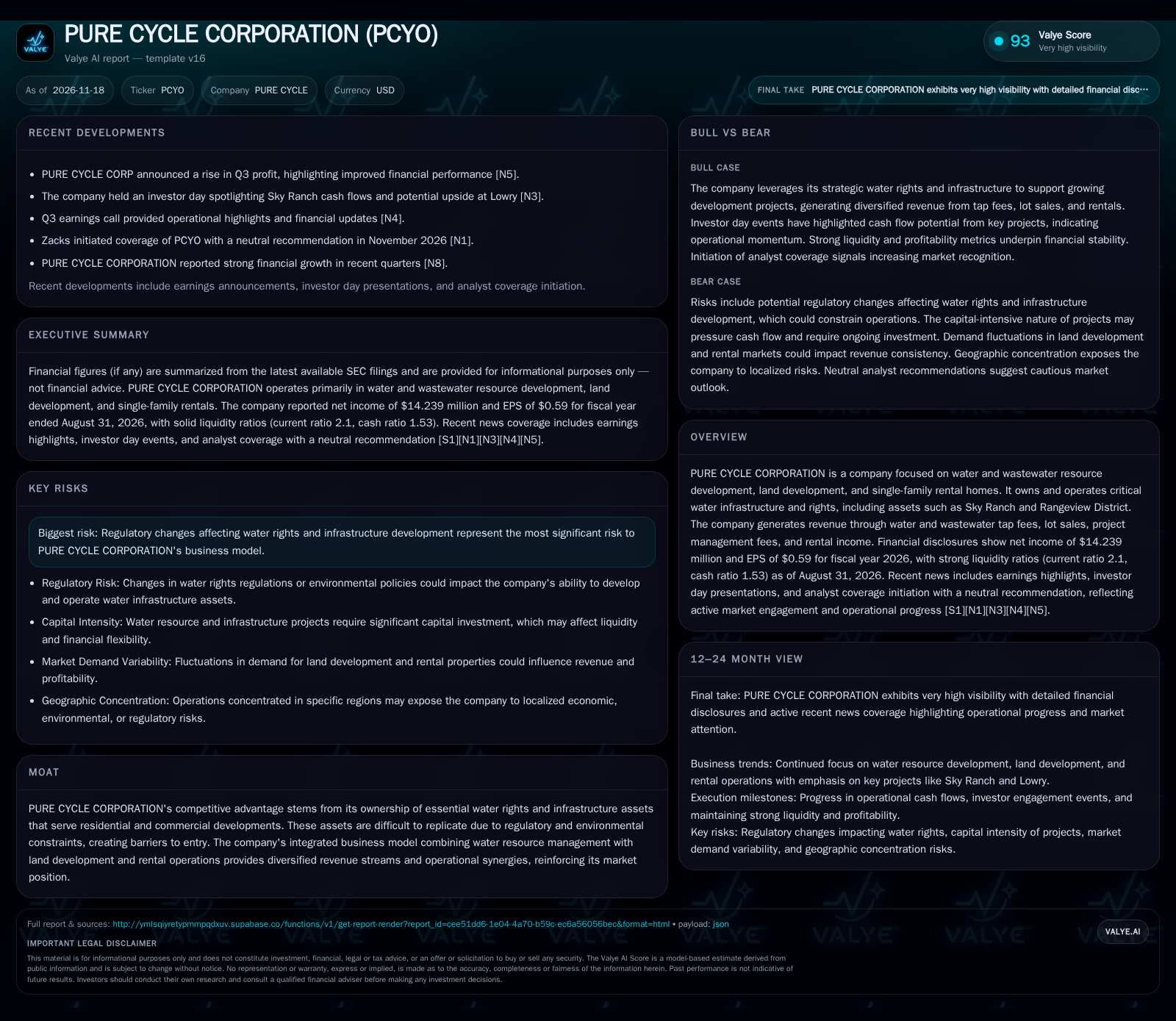
PURE CYCLE CORPORATION reported $14.2 million in net income for fiscal 2026, supported by reported liquidity position and diversified operations across water, land, and single-family rental segments. Ongoing projects such as Sky Ranch and Rangeview highlight the company’s asset leverage, but the path forward depends on regulatory conditions, capital deployment, and sustained demand in Colorado’s development corridor. Neutral analyst coverage and recent profit increases signal operational progress but also market caution regarding execution and risk.
PURE CYCLE CORPORATION is at a strategic crossroads: its control over scarce water rights and infrastructure in Colorado’s Front Range offers a defensible foundation, while ongoing projects like Sky Ranch and Rangeview District have begun translating asset depth into rising profits and investor attention. Fiscal 2026 results show clear financial progress and liquidity, but the business model’s long-term value realization will depend on regulatory continuity, the pace of land and rental absorption, and PURE CYCLE’s ability to create recurring cash flows from one-time development gains. As the company advances, the key questions are whether its integrated approach can withstand external shocks and if its asset-heavy model can achieve the scale and mix necessary for sustainable value creation.
Rising Profits, Liquidity, and Project Spotlight: The 2026 Operating Picture
PURE CYCLE CORPORATION posted net income of $14.239 million for the fiscal year ended August 31, 2026, with basic and diluted earnings per share of $0.59 [S1]. As of the same date, it reported cash and cash equivalents of $15.437 million, with current assets totaling $21.189 million against current liabilities of $10.113 million, yielding a current ratio of 2.1 and a cash ratio of 1.53 [S1]. The company’s operations span water and wastewater resource development, land development, and single-family rentals, with flagship projects including Sky Ranch and Rangeview District [S1]. Recent earnings calls and investor day events have highlighted improved profits and cash flow potential from these core assets [N3] [N4] [N5]. Zacks’ initiation of coverage with a neutral stance in November 2026 underscores both the company’s increased visibility and the market’s measured outlook [N1].
Asset-Driven Revenue Streams and the Challenge of Recurrence
PURE CYCLE’s economics are rooted in the monetization of water rights and infrastructure—a scarce and highly regulated resource in Colorado. The company generates revenue through multiple streams: water and wastewater tap fees, land and lot sales, project management fees, and rental income from single-family homes [S1]. Tap fees and lot sales typically provide large, one-time cash infusions tied to development milestones, while project management fees and rentals offer more predictable, recurring inflows if scaled. The capital intensity of water infrastructure and land development creates steep upfront costs and long payback periods, but also establishes high barriers to entry for would-be competitors.
Operating leverage can be significant: as fixed infrastructure and entitlement costs are covered, incremental lot sales or rental additions may carry high margins. However, the mix between one-time development gains and sustainable, recurring revenue is a structural question for PURE CYCLE. The company reported cash and liquidity metrics for the period; these figures do not by themselves establish operating runway, investment capacity, financial flexibility, or financing capacity. [S1] Ultimately, PURE CYCLE’s ability to achieve consistent cash flow will depend on balancing project pipeline velocity, rental portfolio scale, and regulatory permitting.
Water Rights as a Moat—and the Limits of Asset Advantage
PURE CYCLE’s ownership of water rights and infrastructure assets confers a substantial competitive advantage in the Colorado development corridor, where regulatory and environmental complexities make new water entitlements difficult to secure. This creates a natural moat: competitors must either acquire similar rights at high cost or partner with established holders, limiting direct rivalry in the company’s immediate service areas.
However, asset advantage is not absolute. Substitutes exist at the margin—municipal utilities, alternative water sources, and conservation-driven demand reduction can all affect the velocity of tap fee and lot absorption. The company also faces indirect competition from other land developers and single-family rental operators, particularly as housing cycles and regulatory priorities shift. If public policy changes the economics of new development or water allocation, PURE CYCLE’s moat could narrow. The key to maintaining its edge will be converting static asset value into dynamic, recurring cash flows and demonstrating that its integrated model can weather cyclical and regulatory volatility.
Unlocking Asset Value: When Development Momentum Converts to Recurring Returns
The most favorable scenario for PURE CYCLE is one in which regulatory stability enables rapid absorption of lots at Sky Ranch and Rangeview, driving both near-term tap fee and lot sale revenues and longer-term rental income. Continued population growth along Colorado’s Front Range could accelerate demand for both water services and housing, allowing the company to leverage its infrastructure and land bank efficiently. If project management fees and rentals scale as planned, PURE CYCLE could transition from episodic development gains to a more predictable, cash-generative model.
Evidence that would confirm this upside includes: sustained year-over-year growth in tap fee and lot sale revenue; rising occupancy and cash flow from the single-family rental portfolio; expanded entitlements or service rights; and minimal regulatory or permitting delays.
Steady Execution Amid Capital Demands and Regulatory Watchpoints
The most plausible trajectory for PURE CYCLE is continued incremental progress at core projects, with periodic bursts of revenue from lot sales and tap fees balanced by ongoing investment in infrastructure and land development. Rental income and project management fees may gradually rise as the portfolio matures, but the business will remain sensitive to permitting timelines, housing market cycles, and regulatory reviews.
This scenario would be confirmed by stable or moderately rising net income, consistent cash balances and liquidity ratios, and regular updates on project milestones without major regulatory setbacks. Conversely, a slowdown in lot absorption, unexpected permitting delays, or material increases in development costs would undermine this base case.
Regulatory Shocks and Demand Volatility: When Asset Depth Becomes Illiquidity Risk
The primary threat to PURE CYCLE’s model is adverse regulatory change—whether in water rights allocation, environmental permitting, or land use policy. If new restrictions delay or limit development at Sky Ranch, Rangeview, or other assets, the company could face cash flow gaps and be forced to slow or halt new projects. Similarly, a downturn in Colorado’s housing or rental markets would sap demand for both land and water services, stranding capital in underutilized infrastructure.
Confirmation of this scenario would include: regulatory or permitting denials; large, unexpected project cost overruns; declining cash balances without offsetting revenue; or a marked drop in lot and tap fee sales. Negative analyst revisions or the suspension of development activity would further validate downside risks.
Benchmarks for Testing PURE CYCLE’s Asset Monetization and Growth Thesis
Quarterly and annual tap fee and lot sale revenue—if disclosed—will indicate the pace of asset monetization and project absorption.
Trends in single-family rental occupancy and rental income growth would help gauge the success of PURE CYCLE’s push toward recurring revenue streams.
Updates on regulatory approvals, permit issuances, and entitlement expansions for Sky Ranch, Rangeview, and other core projects are crucial leading indicators.
Capital expenditure levels and project pipeline disclosures would clarify the company’s risk/reward balance and funding requirements.
Cash flow from operations, not just net income, should be tracked to assess the sustainability of reported profits and the conversion of development gains into actual liquidity.
Disclosure of any major regulatory or legal challenges would be an immediate red flag for the asset-heavy model.
A useful metric would be the average time from lot sale to occupancy/rental conversion, illustrating the velocity of asset cycling.
Disclaimer: This is research-only, informational analysis and not investment advice. It may include AI-generated interpretation and general industry context. Always verify important details using primary sources.

Comments