
Crown PropTech’s SPAC Extensions and Mkango Deal: Implications for Value Creation
With its IPO funds still in trust and a looming 2027 deadline to complete a merger, Crown PropTech Acquisitions’ future now hinges on the successful closure of its deal with Mkango Rare Earths Limited.
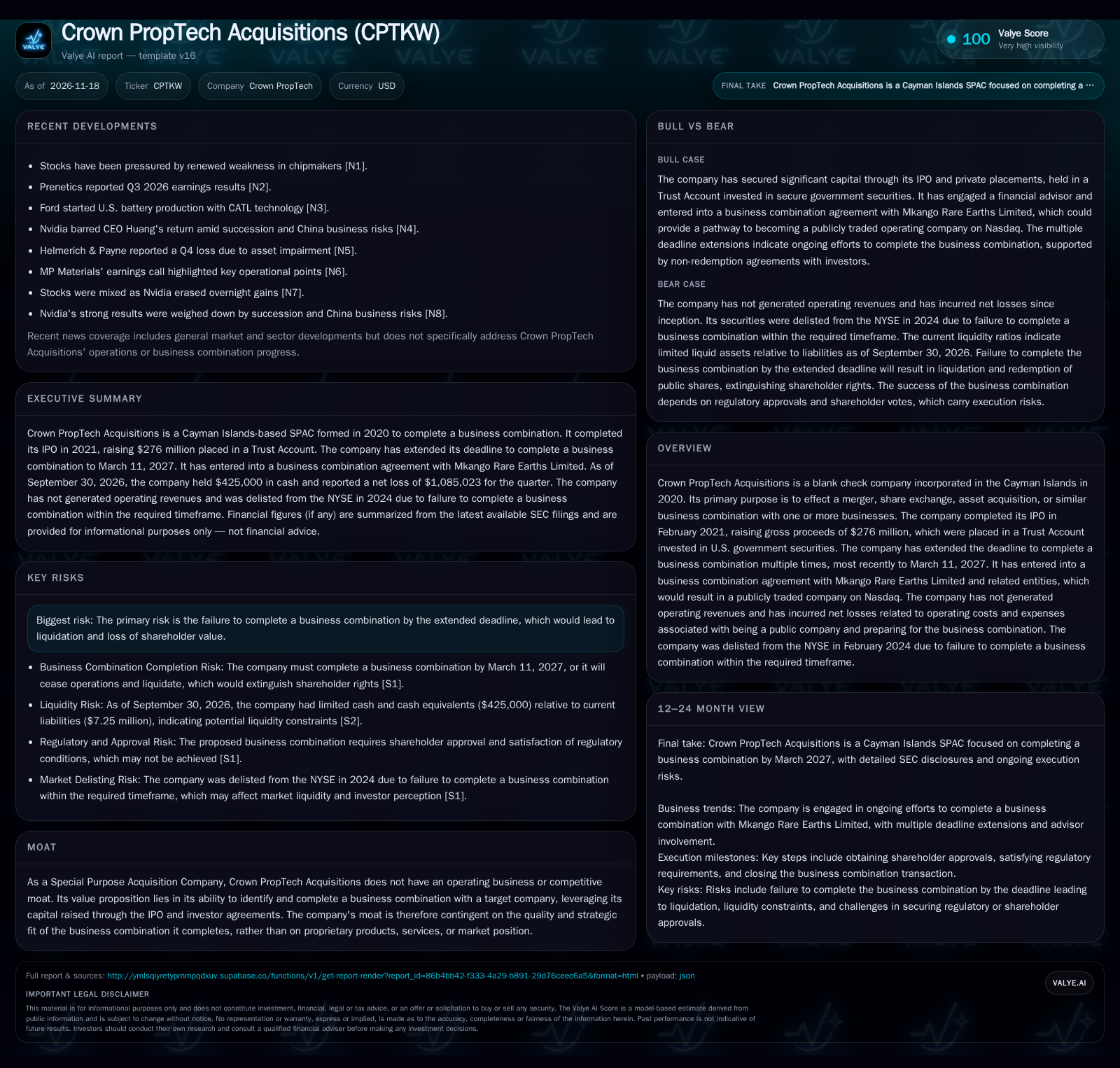
Crown PropTech Acquisitions, a Cayman Islands-based SPAC, has repeatedly extended its business combination deadline, now set for March 11, 2027. The company’s delisting from the NYSE and persistent net losses further underscore the binary nature of the SPAC’s remaining value proposition.
Crown PropTech Acquisitions exemplifies the high-stakes, all-or-nothing nature of late-stage SPACs. After raising $276 million in its 2021 IPO, the company has repeatedly extended its merger deadline and now faces a March 2027 cutoff. For investors, the outcome is binary: either a successful merger and new public entity, or forced liquidation and return of trust funds—with little room for error.
Implications of Recent SPAC Extensions and the Mkango Agreement for Crown PropTech
Crown PropTech Acquisitions is a Cayman Islands-incorporated SPAC that completed its $276 million IPO in February 2021, with proceeds placed in a trust account invested in U.S. government securities [S1]. The company has repeatedly extended its deadline to complete a business combination, most recently to March 11, 2027 [S1]. A business combination agreement with Mkango Rare Earths Limited has been announced, and if completed, the merged entity would list on Nasdaq [S1]. As of September 30, 2026, Crown PropTech reported cash and cash equivalents of $425,000 and current liabilities of $7.25 million, with a net loss of $1.09 million for the quarter [S2]. The company remains without operating revenues and was delisted from the NYSE in February 2024 after missing its original merger window [S1]. These facts underscore the urgency for deal closure and the limited flexibility remaining for management and shareholders.
Understanding SPAC Mechanics: Trust Accounts, Fee Impacts, and Valuation Factors
Crown PropTech’s economic structure is typical of SPACs: the majority of IPO proceeds are held in trust, invested in low-yield government securities, and cannot be accessed for general operations until a qualifying business combination is completed. The company has not generated operating revenues, instead incurring organizational and deal-related costs that have resulted in persistent net losses [S2].
The trust account is designed to protect public shareholders: if no merger is consummated by the deadline, the trust is liquidated and funds are returned (typically minus certain fees and expenses). Sponsor economics are highly levered—founders and early backers receive substantial equity (the “promote”) if a deal closes, but their risk is maximal if the SPAC liquidates. For public shareholders, upside exists only if the merger generates post-deal value above the pro-rata trust redemption value.
Operating leverage is limited prior to a merger, as ongoing expenses (legal, advisory, regulatory) are largely fixed and not offset by revenue. Once merged, the economics shift entirely to the target’s business model, making the quality and valuation of the target critical to final shareholder returns. Notably, as deadlines approach, the cost of extensions, non-redemption agreements, and potential bridging loans can erode residual value.
Evaluating Crown PropTech’s Position Amid SPAC Competition and Sponsor Influence
As a blank check company, Crown PropTech’s competitive position is not determined by operational differentiation but by its ability to secure and close an attractive merger. The SPAC market has become increasingly crowded, with many vehicles seeking targets amid tighter regulatory scrutiny and investor fatigue. The company’s delisting from the NYSE and multiple deadline extensions may weigh on its credibility with both targets and investors [S1].
The announced combination with Mkango Rare Earths Limited pits Crown PropTech against other SPACs and traditional IPOs as routes for companies seeking public listings. Sponsor reputation, deal terms, and the ability to deliver certainty of closure are key differentiators. However, execution risks—regulatory approvals, shareholder votes, and redemption rates—remain high across the sector. In this environment, SPACs with clear, actionable deals and strong advisory support (such as Jett Capital Advisors in this case) may have an edge, but only if the underlying target can generate sustainable post-merger value.
Potential Value Gains if the Mkango Merger Completes Successfully
The most favorable outcome for Crown PropTech shareholders is the successful completion of the Mkango Rare Earths Limited merger, followed by a Nasdaq listing. If the deal is approved by regulators and shareholders, and the combined entity demonstrates credible growth prospects, public shareholders could realize value above trust redemption levels—especially if the rare earths sector attracts strong market interest.
Upside could be amplified if the post-merger company achieves operational milestones, secures strategic offtake or supply agreements, or attracts institutional sponsorship. Confirmation evidence would include timely regulatory approvals, a low rate of redemptions at the merger vote, and robust trading volume and price support post-listing. Falsification would occur if the deal fails to close, redemptions are overwhelming, or the combined entity trades below trust value, eroding any potential premium.
Likely Outcomes: Extended Merger Process with High Redemption or Liquidation
Given the company’s delisting, repeated deadline extensions, and persistent net losses, the most plausible scenario is a drawn-out process leading to either a high-redemption merger or, if execution falters, liquidation. The SPAC sector has seen a trend toward high redemption rates, meaning that even if the Mkango deal closes, the public float may be limited and post-merger liquidity thin.
In this scenario, public shareholders are likely to redeem shares for their pro-rata trust value, with little upside beyond capital preservation. Confirmation would come from a merger closing with high redemptions and limited aftermarket activity. Falsification would require a reversal: a sudden surge in deal momentum, investor enthusiasm, or a notable strategic development that boosts confidence in the merger’s long-term value.
Consequences of Merger Failure or Regulatory Challenges on Sponsor Investment
The primary downside risk is failure to complete the merger by the March 2027 deadline, triggering mandatory liquidation of the trust and extinguishing all sponsor equity and warrants. Regulatory or shareholder approval failures, adverse due diligence findings, or a breakdown in negotiations with Mkango could all precipitate this outcome.
For public shareholders, liquidation typically returns trust funds (minus costs), but any capital invested outside the trust or in the sponsor’s promote would be lost. Sponsor and pre-merger investor interests are especially vulnerable, while public holders’ risk is mostly limited to opportunity cost. Downside confirmation would include regulatory delays, material adverse findings, or a formal announcement terminating the combination agreement.
Key Milestones Shaping Crown PropTech’s Value Outcome
Progress on regulatory and shareholder approvals for the Mkango Rare Earths Limited combination—any delays or adverse votes would be material.
Updates on the redemption rate at the merger vote: a high rate would signal limited investor confidence and challenge post-merger liquidity.
Evidence of additional financing, non-redemption agreements, or sponsor support to bridge ongoing operating costs until deal closure.
Material changes in trust account balance, including any withdrawals for permitted expenses or extensions—would help test the thesis.
Public disclosure of the combined entity’s post-merger business plan, financial projections, and key customer or offtake agreements, if available.
News on relisting or uplisting to a major exchange post-merger, which could impact trading liquidity and valuation.
If disclosed, any changes in the sponsor group’s commitment or willingness to backstop redemptions or provide additional capital.
Disclaimer: This is research-only, informational analysis and not investment advice. It may include AI-generated interpretation and general industry context. Always verify important details using primary sources.

Comments