
Envirotech Vehicles: Diversification Ambitions Collide with Policy Shifts and Liquidity Constraints
Envirotech Vehicles is refocusing from its commercial EV roots toward modular AI compute infrastructure and heavy-lift drones, while supporting cash flow with a U.S.-based medical supplies business.
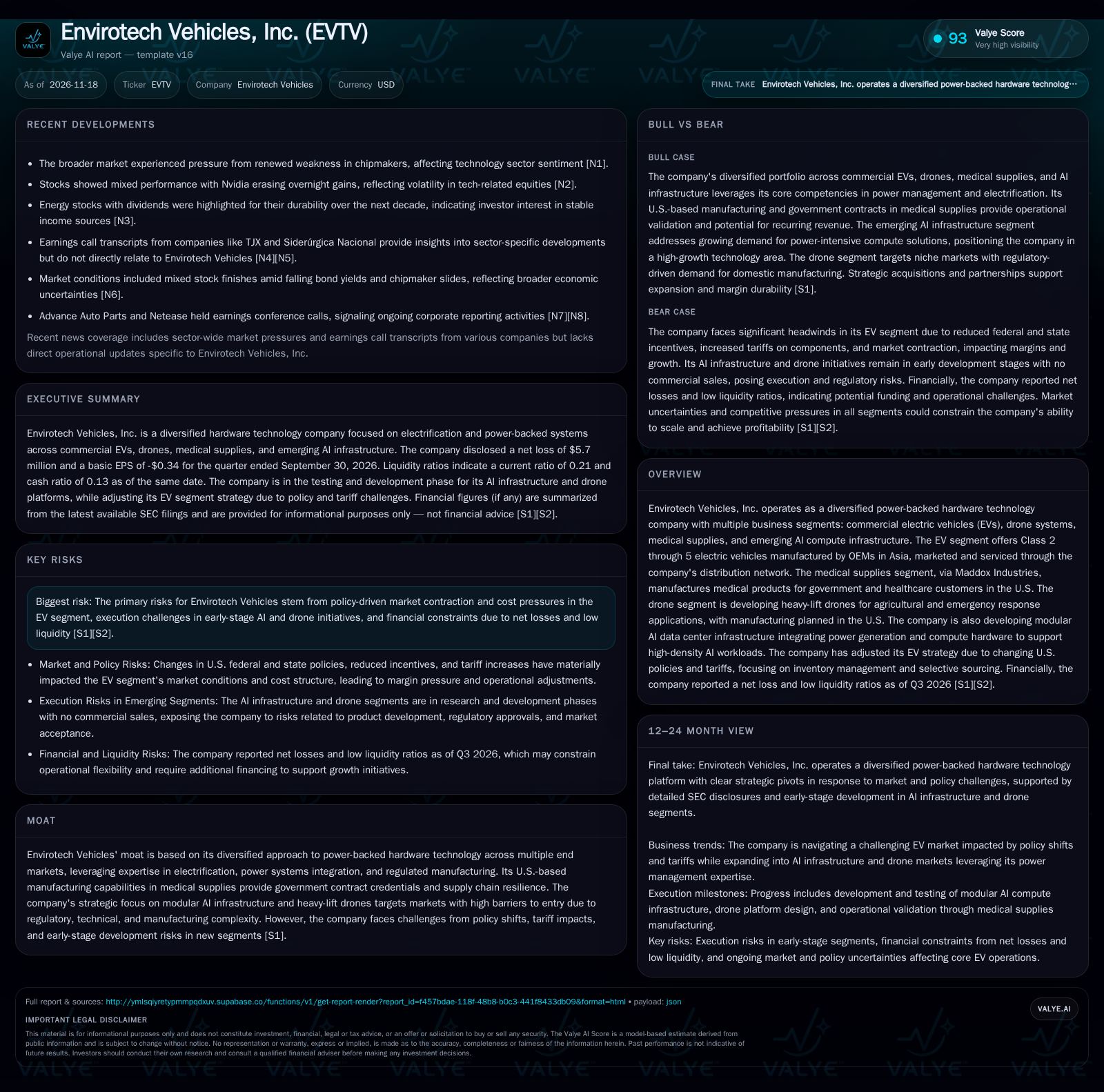
Envirotech Vehicles is refocusing from its commercial EV roots toward modular AI compute infrastructure and heavy-lift drones, while supporting cash flow with a U.S.-based medical supplies business. Near-term survival and longer-term upside both hinge on commercializing new platforms and securing external capital or strategic partners.[S1] [S2]
Envirotech Vehicles, Inc. is attempting a strategic pivot away from its embattled commercial EV roots toward higher-value, power-centric technology arenas—most notably, modular AI compute infrastructure and heavy-lift industrial drones. The company’s diversification is both a response to eroding EV market conditions (due to policy and tariff headwinds) and an attempt to capture upside in emerging, regulation-driven verticals. The company’s future now depends on its ability to quickly commercialize new platforms, secure fresh capital, and navigate complex regulatory and supply chain environments. [S1] [S2]
Liquidity Crisis and Segment Realignment Define the Present
As of September 30, 2026, Envirotech Vehicles reported cash and equivalents of $1.15 million, current assets of $5.27 million, and current liabilities of $24.67 million, resulting in a current ratio of 0.21 and a cash ratio of 0.13. This severe liquidity shortfall coincides with a reported quarterly net loss of $5.74 million and basic EPS of -$0.34. The company has exited a $10 million purchase order discounting facility, further tightening working capital options. Operationally, Envirotech has shifted its EV strategy in response to shrinking federal/state incentives and higher tariffs, while its AI infrastructure and drone segments remain in the R&D phase with no commercial sales. The medical supplies business, via Maddox Industries, continues to serve government and healthcare clients, providing some revenue continuity but likely with lower margin potential than the technology segments. [S1] [S2]
The company reported cash and liquidity metrics for the period; these figures do not by themselves establish operating runway, investment capacity, financial flexibility, or financing capacity. Moreover, the exit from the purchase order discounting facility removes a flexible financing tool that previously helped manage inventory and receivables, potentially leading to tighter supply chain management and slower order fulfillment. This dynamic underscores the importance of improving working capital efficiency and securing alternative financing to stabilize near-term operations while pursuing longer-term strategic pivots.
How Envirotech’s Multi-Segment Model Could Generate Profits—If Scale and Capital Arrive
Envirotech’s revenue mix spans four distinct categories: equipment sales (primarily EVs), system integration and infrastructure leasing (potentially for both EV charging and future AI compute modules), medical product manufacturing, and prospective joint ventures. The EV business is typically capital-intensive and sensitive to policy, with gross margins pressured by tariffs, incentives volatility, and international sourcing. The medical supplies segment may offer steadier, albeit thinner, margins due to government and healthcare contracts, but its scale and growth ceiling are unclear.
The most ambitious economic opportunity lies in the company’s AI infrastructure vision: modular, power-backed hardware for high-density AI workloads. If commercialized, this could enable a recurring-revenue model through leasing, managed services, or joint ventures, with higher margins tied to integration of power and compute hardware. However, the capital requirements for manufacturing, deploying, and operating such infrastructure are steep, and the company currently lacks the financial runway to self-fund these ambitions. The drone segment, still pre-revenue, could eventually participate in high-value, regulated industrial markets, but will require significant upfront investment and regulatory navigation before contributing meaningfully to profits.
The interplay between scale and capital availability is pivotal in determining the profitability trajectory across Envirotech’s segments. For the AI infrastructure business, economies of scale could significantly reduce per-unit costs of modular compute hardware, enhancing gross margins as deployment volumes grow. However, this scale is contingent on securing upfront capital to build manufacturing capacity and establish strategic partnerships for distribution and integration. Similarly, the drone segment’s path to profitability depends on reaching sufficient operational scale to amortize fixed R&D and certification costs, which are typically front-loaded. Without external capital or joint ventures to share these burdens, the company risks prolonged pre-revenue phases, increasing financial strain. Thus, the timing and size of capital infusions directly influence the feasibility of scaling these high-margin, technology-driven businesses.
Diversification as Defense: Strengths and Vulnerabilities in Each Market
Envirotech’s competitive advantage is its cross-segment expertise in electrification, power management, and regulated manufacturing. In medical supplies, domestic manufacturing and government contracts support supply chain credibility—a partial moat against offshore competitors. In EVs, the company’s reliance on Asian OEMs is now a weakness due to tariffs and policy shifts; established domestic and international EV makers, as well as new entrants, are aggressively competing on price, scale, and integration.
The AI infrastructure segment targets a nascent but rapidly growing market where barriers to entry include power density, modularity, and regulatory compliance. Here, Envirotech’s focus on physical infrastructure (rather than proprietary AI models) could make it a partner to other technology firms, but also exposes it to competition from data center incumbents, electrical integrators, and vertical-specific hardware startups. The drone business, if successfully launched, would face a mix of traditional aerospace firms and agile drone startups, with regulatory approval and reliability as key differentiators.
Envirotech’s diversification strategy can be viewed through the lens of risk mitigation and opportunity capture across distinct but interrelated markets. While the medical supplies segment offers a defensive revenue stream anchored by government contracts and domestic manufacturing, it may lack the growth potential and margin expansion that technology segments promise. Conversely, the AI infrastructure and drone markets are characterized by high entry barriers, including technological complexity, regulatory scrutiny, and capital intensity, which can both protect incumbents and slow market penetration. Success in these arenas will likely depend on Envirotech’s ability to leverage its electrification and power management expertise to differentiate its offerings, while carefully navigating regulatory landscapes and forging alliances to offset competitive pressures from established players and agile startups.
Plausible Upside: Commercialization of AI Infrastructure and Drone Platforms Accelerates Turnaround
The most compelling upside scenario is one in which Envirotech rapidly commercializes its modular AI compute infrastructure and heavy-lift drones, securing anchor customers—potentially in government, agriculture, or emergency response—and attracting strategic partners or investors. Successful pilot deployments of containerized, power-backed AI modules could establish recurring revenue streams via leasing or managed services, while demonstrating technical and operational differentiation.
Confirmation would come from signed customer contracts, joint ventures with major technology or energy players, and the first revenue from either AI infrastructure or drone sales. Additional signs would include external capital infusions, government grants, or expansion of the medical supplies book. Falsification would be continued R&D delays, lack of commercial traction, and ongoing cash burn without new funding.
Most Likely Outcome: Incremental Progress Amid Funding and Execution Hurdles
The most plausible near-term outcome is incremental progress on AI and drone development, with medical supplies providing some cash flow but not enough to offset losses or fund aggressive growth. The EV segment continues to struggle with contraction and margin pressure, and the company faces recurring capital needs to maintain operations. New segment launches may be slow, with revenue ramping only if external financing or major partnerships materialize.
Evidence confirming this base scenario would include small pilot projects, minor medical supply contract wins, and continued net losses with periodic capital raises or debt restructurings. Falsification would be either a sudden, material commercial breakthrough or an inability to secure new funding, forcing asset sales or restructuring.
Adverse Outcome: Liquidity Exhaustion Forces Restructuring or Asset Sales
In a downside scenario, Envirotech’s liquidity crisis deepens, with current assets insufficient to meet liabilities and no new capital forthcoming. Continued net losses, inability to monetize new platforms, and declining EV sales could push the company toward insolvency, forced restructuring, or asset liquidation. The termination of the purchase order facility and reliance on thin-margin medical supplies leave little buffer.
Confirmation of this scenario would be missed debt payments, working capital shortfalls, creditor actions, or fire-sale divestitures. Falsification would require a material new funding event or a rapid commercial breakthrough in a new segment.
What Will Determine If Envirotech’s Strategic Pivot Succeeds or Fails?
Material customer contracts or revenue from AI compute infrastructure or drone platforms—if disclosed—would signal commercial traction.
Any significant external capital raises, debt facilities, or strategic investments to address the current liquidity shortfall.
Updates on pilot deployments, regulatory approvals, or manufacturing readiness for AI infrastructure and drone products.
Changes in federal or state policy that could restore incentives or ease tariffs affecting the EV business.
Gross margin and segment-level profitability metrics for medical supplies and, if launched, for new technology segments.
Operating cash flow trends and working capital movements, particularly inventory and receivables management.
Announcements of new joint ventures, technology partnerships, or government grants related to power-backed infrastructure or industrial drones.
Disclaimer: This is research-only, informational analysis and not investment advice. It may include AI-generated interpretation and general industry context. Always verify important details using primary sources.

Comments