
VPR Brands: Patent Leverage, Regulatory Exposure, and the Economics of a Fragmented Vapor Market
VPR Brands, LP. has posted a rare quarter of net income and holds a sizable patent portfolio spanning vapor, lighter, and hemp-derived product categories. Yet, the company’s future hinges on its ability to monetize intellectual property, navigate regulatory shifts, and defend share against both Big Tobacco and nimble niche competitors.
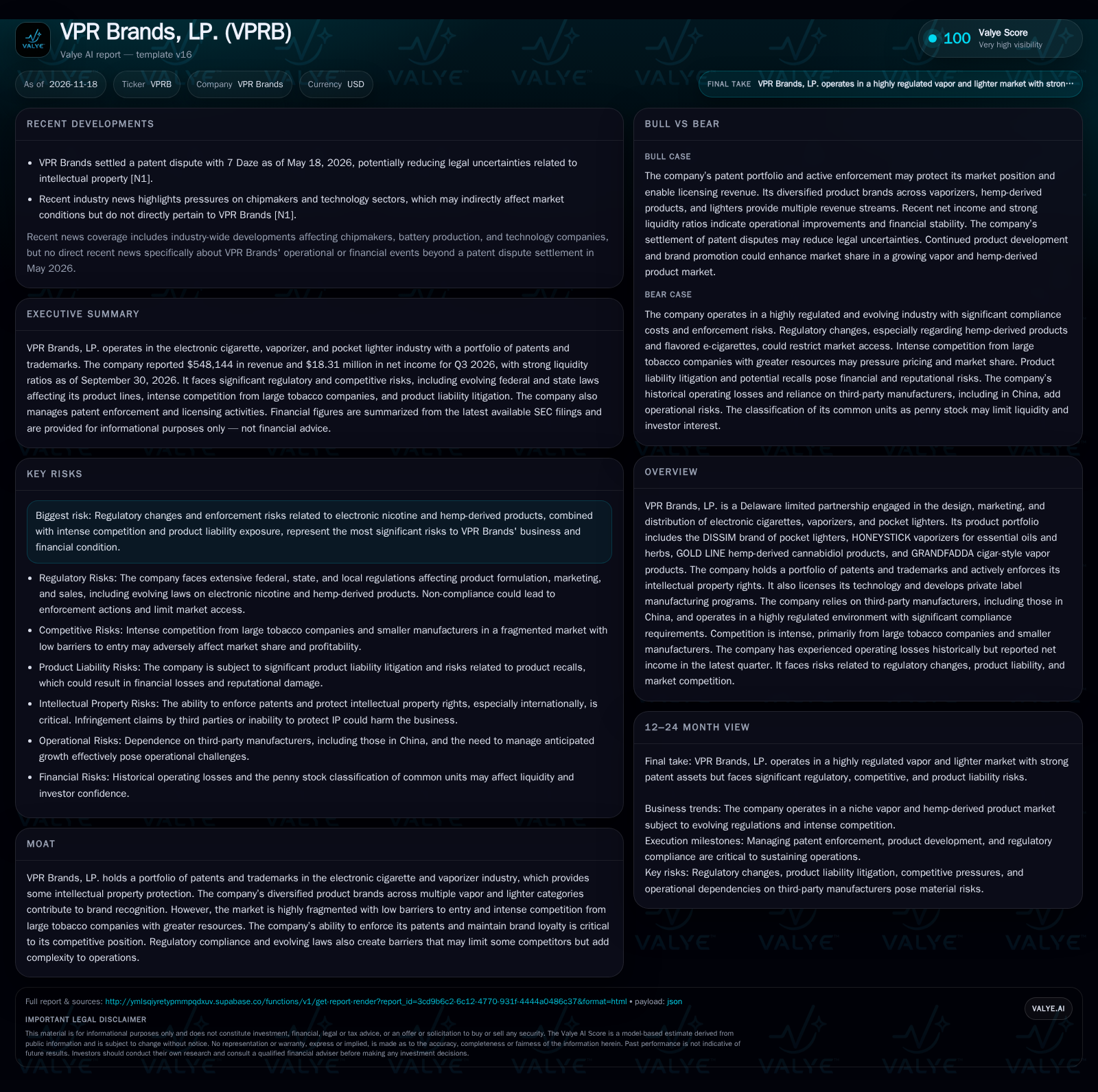
VPR Brands, LP. reported $548,144 in revenue and $18.31 million in net income for Q3 2026, underpinned by settlement income and a patent-centric business model. The company’s $20.13 million in liquid assets provides operational flexibility, but persistent regulatory risk, product liability exposure, and intense competition from larger and smaller industry players cloud the outlook. The company’s ability to enforce its IP and adapt to evolving federal and state laws will determine whether recent profitability is sustainable or fleeting. [S2]
VPR Brands, LP. stands at a crossroads: after years of operating losses, it has posted significant net income in the latest quarter, mainly due to settlement income rather than core operations. Whether VPR Brands can convert IP enforcement and diversified branding into durable profitability—or if recent results prove a one-off—will depend on its execution in a volatile and fragmented market. [S2]
Recent Profitability, Patent Resolution, and a reported cash balance: What’s Changed for VPR Brands?
For the quarter ended September 30, 2026, VPR Brands reported $548,144 in revenue and a net income of $18.31 million, translating to $0.20 in EPS per common unit. This result marks a sharp reversal from the company’s history of operating losses, although the underlying operating loss for the quarter was $607,116. The swing to net income was driven by other income, notably a settlement from a resolved patent dispute with 7 Daze as of May 18, 2026. [S2]
As of September 30, 2026, VPR Brands held $20.13 million in liquid assets (combining cash and short-term investments), with a current ratio of 2.92 and a cash ratio of 2.35. This provides operational flexibility and some protection against near-term shocks. [S2]
The company’s product lineup is anchored by the DISSIM lighter, HONEYSTICK vaporizers, GOLD LINE hemp-derived CBD products, and GRANDFADDA cigar-style vapor devices, supported by a portfolio of patents and trademarks. The strategic question is whether this IP and brand diversity can be converted into recurring, high-quality earnings, or whether recent profitability is non-repeatable.
Unit Economics and the Leverage of Intellectual Property in a Low-Barrier Market
VPR Brands’ revenue streams span physical product sales (lighters, vaporizers, hemp-derived goods), licensing of intellectual property, and potentially settlement income from patent enforcement. The business model is inherently high-mix and margin-volatile: physical goods face commoditization and pricing pressure, especially as manufacturing is outsourced to third parties (including China), which limits margin expansion and exposes the company to supply chain and quality risks.
Licensing and enforcement of patents offer a path to high-margin, low-capital income, but this is episodic rather than predictable unless the company can secure ongoing royalty streams or recurring licensing contracts. Patent settlements, as in the recent 7 Daze case, can deliver windfalls but are not a sustainable base. The cost structure includes moderate fixed costs (legal, regulatory, compliance) and variable costs tied to production and distribution.
Operating leverage is limited by the need to scale sales volume across multiple crowded categories to offset regulatory, legal, and compliance overheads. The company’s capital needs are modest for inventory and working capital, but unpredictable litigation and regulatory compliance costs can create sudden cash demands. Without recurring licensing or significant brand-driven pricing power, long-term margin expansion appears challenging absent a structural shift in the company’s revenue mix.
Patent Assets, Brand Breadth, and the Anatomy of Competitive Threats
VPR Brands theoretically benefits from a portfolio of patents and trademarks, which can act as both a defensive moat and a source of licensing revenue. However, the practical value of this moat is constrained by the fragmented nature of the vapor and lighter markets, where enforcement is costly and infringers are plentiful.
On the competitive front, the company faces bifurcated threats: large, well-capitalized tobacco companies with established distribution, regulatory muscle, and marketing budgets can outcompete on scale and compliance; meanwhile, small manufacturers can undercut on price and rapidly enter or exit the market due to low barriers. The result is persistent pricing pressure and limited ability to build durable customer switching costs.
Substitution risk is high, with consumers able to shift between brands and product formats—especially in the vapor and hemp-derived categories—while regulatory changes can quickly shift the competitive landscape by banning flavors, restricting formulations, or tightening distribution rules. The company’s reliance on third-party manufacturing, especially in China, further erodes control over product quality and cost.
Pathways to Durable Profitability: Licensing Momentum and Regulatory Resilience
A favorable scenario for VPR Brands would require several reinforcing developments. First, the company would need to translate its IP portfolio into recurring licensing or royalty streams—either from industry peers seeking to avoid litigation or from new entrants eager to leverage established technology. This could provide high-margin, capital-light revenue that is less vulnerable to the commoditization seen in physical product sales.
Second, regulatory changes could raise barriers to entry, favoring incumbents with compliance infrastructure and patent protection. If VPR Brands can demonstrate sustained revenue from licensing and clear evidence of successful enforcement against infringers—along with continued product innovation and stable or growing sales in its core brands—this would validate the upside thesis.
Confirmation of this scenario would come from disclosure of multi-year licensing deals, steady growth in royalty income, and improved gross margins. Falsification would include a return to operating losses, an absence of new licensing agreements, or regulatory changes that disproportionately harm the company’s product lines.
Sustaining Operations Amid Regulatory Flux and Episodic IP Settlements
The most plausible outlook is that VPR Brands continues to operate as a niche player, with periodic profitability driven by one-off settlement income and opportunistic licensing, while core product sales remain under pressure from competition and regulatory shifts. Physical product sales may provide baseline revenue but with thin margins and ongoing exposure to regulatory and supply chain risks.
In this scenario, the company’s liquidity buffer allows it to weather short-term disruptions, but without recurring, high-margin income from IP or a breakthrough in brand-driven market share, earnings remain volatile and unpredictable. Regulatory changes—such as the recent 'Total THC' standard—could periodically disrupt or reshape the company’s hemp-derived product lines, requiring rapid adaptation.
Evidence supporting this scenario would include lumpy earnings, continued reliance on settlement income, and modest product sales growth offset by compliance and legal costs. Sustained net income or a shift toward recurring licensing would falsify the base case, as would a major loss of market access from adverse regulatory action.
Regulatory Clampdown, Legal Exposure, and Margin Compression
A negative scenario unfolds if regulatory authorities tighten restrictions on vapor and hemp-derived products, restricting flavors, imposing new compliance costs, or banning certain formulations. This could lead to product withdrawals, inventory write-downs, and revenue contraction.
Simultaneously, if the company faces adverse judgments from product liability litigation or is unable to successfully enforce its patents (or defend against infringement claims), legal costs and potential damages could erode the liquidity buffer and threaten solvency. Intense pricing pressure from both large tobacco firms and smaller, price-aggressive entrants could further compress margins, leading to sustained operating losses.
Confirmation of this scenario would include regulatory bans or recalls, major legal settlements or judgments against the company, sharp revenue declines, and a rapid drawdown of cash reserves. Falsification would require evidence of regulatory stability, successful litigation outcomes, or a new, durable source of high-margin income.
Signals That Will Shape VPR Brands’ Trajectory in the Vapor and Hemp Sectors
Disclosures of new or expanded multi-year licensing or royalty agreements—especially those that recur or scale with industry adoption—would help test the sustainability of the company’s IP monetization strategy.
Breakdowns of revenue by segment (product sales, licensing, settlements, private label) if disclosed, to clarify the true drivers of profitability and margin resilience.
Gross margin trends, particularly whether licensing income leads to sustained margin expansion or if physical product sales remain margin-constrained.
Regulatory developments at the federal and state level, especially those affecting hemp-derived products and electronic nicotine delivery systems, as these could alter product viability and compliance costs.
Incidence and outcome of product liability claims or recalls, as material adverse judgments or frequent litigation could impair both brand equity and financial stability.
Changes in inventory levels or write-downs, which could signal regulatory disruption, demand shocks, or supply chain challenges.
Announcements regarding new private label partnerships or manufacturing arrangements, which could affect volume, cost structure, and brand exposure.
Evidence of customer concentration or diversification, as over-reliance on a small number of buyers could increase vulnerability to channel disruption.
Disclaimer: This is research-only, informational analysis and not investment advice. It may include AI-generated interpretation and general industry context. Always verify important details using primary sources.

Comments