
Medirom Healthcare Technologies: Digital Health Expansion Meets Acute Financial and Regulatory Pressures
Medirom is aggressively expanding its digital health and authentication footprint in Japan through high-profile partnerships and user growth, yet the company faces significant financial distress with a current ratio of 0.31 and is appealing Nasdaq delisting.
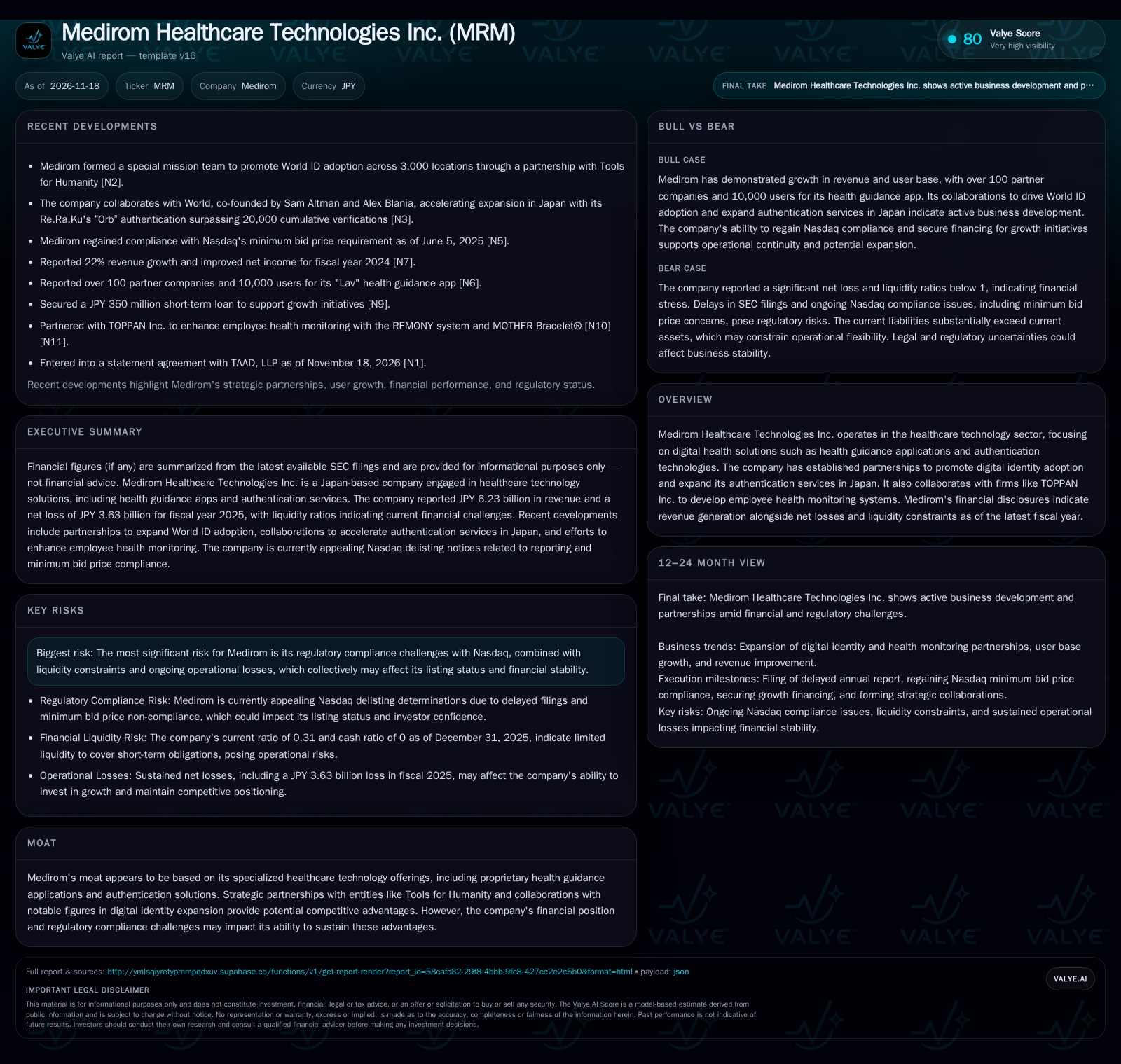
Medirom is aggressively expanding its digital health and authentication footprint in Japan through high-profile partnerships and user growth, yet the company faces significant financial distress with a current ratio of 0.31 and is appealing Nasdaq delisting. The business thesis hinges on converting partnership-driven scale into sustainable economics before liquidity or regulatory pressures force retrenchment or asset sales. [S1] [N2] [N3] [N5]
With revenue growth and user metrics trending positively, the core dilemma is whether these advances can be scaled into durable, cash-generating businesses before financial or regulatory realities force drastic restructuring. The coming quarters will test whether Medirom’s platform and authentication bets can outpace mounting obligations and regulatory scrutiny.
Liquidity Crisis and Regulatory Pressure Dominate the Current Landscape
The most material current facts are: (1) Medirom’s revenue for 2025 was approximately JPY 6.23 billion, but the company reported a net loss of JPY 3.63 billion, reflecting ongoing operating deficits; (2) liquidity is severely constrained, with current assets of JPY 1.49 billion against JPY 4.73 billion in current liabilities, and a cash ratio of 0 as of December 31, 2025; (3) Medirom is currently appealing Nasdaq delisting determinations, having previously regained minimum bid price compliance in June 2025; and (4) the company is leveraging partnerships—such as the World ID initiative and TOPPAN collaboration—to boost digital health adoption and authentication volume. [S1] [N2] [N3] [N5]
These facts are crucial because the company’s operational progress is being counterbalanced by acute financial distress and the threat of losing its public listing. The interplay between rapid user/partner growth and the need for immediate liquidity will dictate whether Medirom can remain a going concern or is forced into asset sales, restructuring, or delisting in the near term.
How Medirom’s Digital Health Model Could Convert Scale Into Profitability
Medirom’s business model is built on digital health solutions—such as the Lav health guidance app and authentication technologies like Orb—supported by partnerships and B2B deployments. Revenue is likely derived from a mix of software-as-a-service fees, per-user or per-authentication charges, and possibly device sales or integration fees, although commercial terms are not disclosed.
The economics of such a model can offer attractive operating leverage if user and partner growth translate into recurring, high-margin software revenue. However, the company’s persistent net losses suggest that current scale is insufficient to cover fixed costs, likely due to high ongoing investment in product development, sales, and technology integration. Variable costs may be manageable if user growth drives network effects or if authentication volumes rise rapidly, but the fixed cost base—especially in a heavily regulated and relationship-driven sector—remains a hurdle.
The company reported cash and liquidity metrics for the period; these figures do not by themselves establish operating runway, investment capacity, financial flexibility, or financing capacity. Without a step-change in gross margin or a dramatic reduction in operating expenses, the company will remain reliant on external capital or be forced to shrink operations. [S1]
Strategic Partnerships Versus Market Entrants in Japan’s Digital Health Arena
Medirom’s competitive position rests on early-mover advantage in digital identity and authentication, reinforced by partnerships with global players like Tools for Humanity and World (co-founded by Sam Altman and Alex Blania). Collaborations with TOPPAN for employee health monitoring broaden the company’s reach into enterprise health solutions. [N2] [N3]
However, the Japanese digital health market is attracting both domestic and international technology firms, many with deeper financial resources and established distribution. The risk is that broader platform providers or large healthcare IT incumbents could commoditize authentication and health guidance services, eroding pricing power and making partnerships less sticky. Medirom’s moat depends on the uniqueness of its technology, depth of its partner integrations, and ability to convert early user traction into high switching costs or regulatory barriers.
The competitive threat is amplified by Medirom’s financial distress, which could undermine customer and partner confidence, making it harder to win long-term contracts or renewals. Without demonstrable technology differentiation or regulatory capture, Medirom may struggle to defend share against better-capitalized entrants.
From Partnership Momentum to Sustainable Cash Flow: What Would Signal a Real Inflection
The upside scenario hinges on Medirom’s ability to convert its partnership-driven user and authentication growth into recurring, high-margin software revenue before liquidity constraints force retrenchment. If the World ID initiative expands rapidly—driving authentication volume across 3,000+ locations and leading to meaningful per-authentication or subscription fees—the company could achieve scale economies and improve gross margins. [N2] [N3]
A plausible positive chain: rapid adoption of authentication and health guidance tools triggers follow-on contracts with large enterprises or public sector clients, enabling Medirom to negotiate better commercial terms and reduce customer acquisition costs. Successful monetization of the Lav app’s user base or upselling device-integrated services could further boost revenue per user.
Evidence that would confirm this scenario includes: disclosure of multi-year, recurring contracts; a sharp reduction in operating losses; positive operating cash flow; and new capital raises on improved terms (or even a strategic investment by a larger technology or healthcare player). Conversely, if user growth stalls, margins remain compressed, or customer churn rises, the upside case would be undermined.
Operational Gains Offset by Balance Sheet Strain: A Stalemate for Now
The most plausible near-term outcome is that Medirom continues to grow its user base and partnership count but remains structurally unprofitable due to high fixed costs and low gross margins. The company may secure additional short-term financing or asset sales to buy time, but is unlikely to generate sufficient cash internally to resolve its liquidity crisis in the next 12–18 months.
Base case confirmation would include: continued announcements of partnership expansions and moderate user growth (e.g., incremental gains in authentication volume or Lav app adoption), but with no material improvement in net losses or liquidity ratios. Regulatory compliance remains an overhang, with the Nasdaq appeal unresolved and ongoing risk of delisting. [S1] [N5]
Falsification of this scenario would require either a sudden improvement in operating margins (suggesting cost discipline or pricing power) or a rapid deterioration in partner/customer relationships (leading to revenue contraction).
Liquidity Exhaustion and Regulatory Action Could Force Restructuring
With a current ratio of 0.31 and a cash ratio of 0, even minor revenue shortfalls or payment delays could trigger a cash crisis. [S1]
If the Nasdaq appeal fails and the company is delisted, access to capital markets would likely tighten, accelerating distress and potentially forcing asset sales, workforce reductions, or a search for a white knight acquirer. Rapid partner or customer attrition could follow if counterparties lose confidence in Medirom’s viability.
Evidence for this scenario would be: missed debt payments, layoffs, divestitures of core assets, abrupt declines in authentication or user metrics, or public statements about going-concern risk. Any announcement of bankruptcy proceedings or a distressed sale would confirm the downside thesis.
Milestones That Will Determine Whether Medirom Can Convert Growth Into Endurance
Progress toward resolving the Nasdaq delisting appeal, including any updates on reporting compliance or minimum bid price status.
Disclosure of new or expanded multi-year, recurring revenue contracts—especially with large enterprises or government entities—that would indicate durable monetization.
Updates on operating cash flow and any narrowing of net losses, suggesting successful cost control or improved gross margins.
Material expansion in authentication volume (e.g., World ID or Orb verifications) and user growth for the Lav app, if disclosed.
Announcements of new technology integrations or major product launches that could differentiate Medirom’s offerings or create higher switching costs.
Evidence of customer or partner churn, such as contract non-renewals or publicized terminations, which would signal weakening commercial momentum.
Regulatory, legal, or compliance developments that might impact the company’s ability to operate, raise capital, or maintain partnerships.
Disclaimer: This is research-only, informational analysis and not investment advice. It may include AI-generated interpretation and general industry context. Always verify important details using primary sources.

Comments