
Hyperscale Data’s AI Transition: Multi-Segment Ambitions, Capital Strain, and the Stakes of Diversification
A $1.2 billion AI data center deal and major debt reduction headline Hyperscale Data’s pivot from Bitcoin mining to high-performance computing. Yet, liquidity pressures and sprawling operations raise questions about execution, capital needs, and the company’s ability to unlock durable value across its disparate businesses.
The company’s multi-industry structure offers optionality but complicates execution and magnifies the risk of capital shortfalls.
Hyperscale Data, Inc. is attempting a high-stakes transformation—shedding its legacy as a crypto miner to become a major player in AI-driven data center hosting and high-performance computing. Its sprawling portfolio—from defense to fintech to real estate—offers multiple shots at value creation, but also amplifies execution and capital allocation risks. The next phase will test whether vision, deal flow, and capital discipline can translate into sustainable returns.
Recent Milestones: Revenue Growth, AI Pivot, and Financial Strain
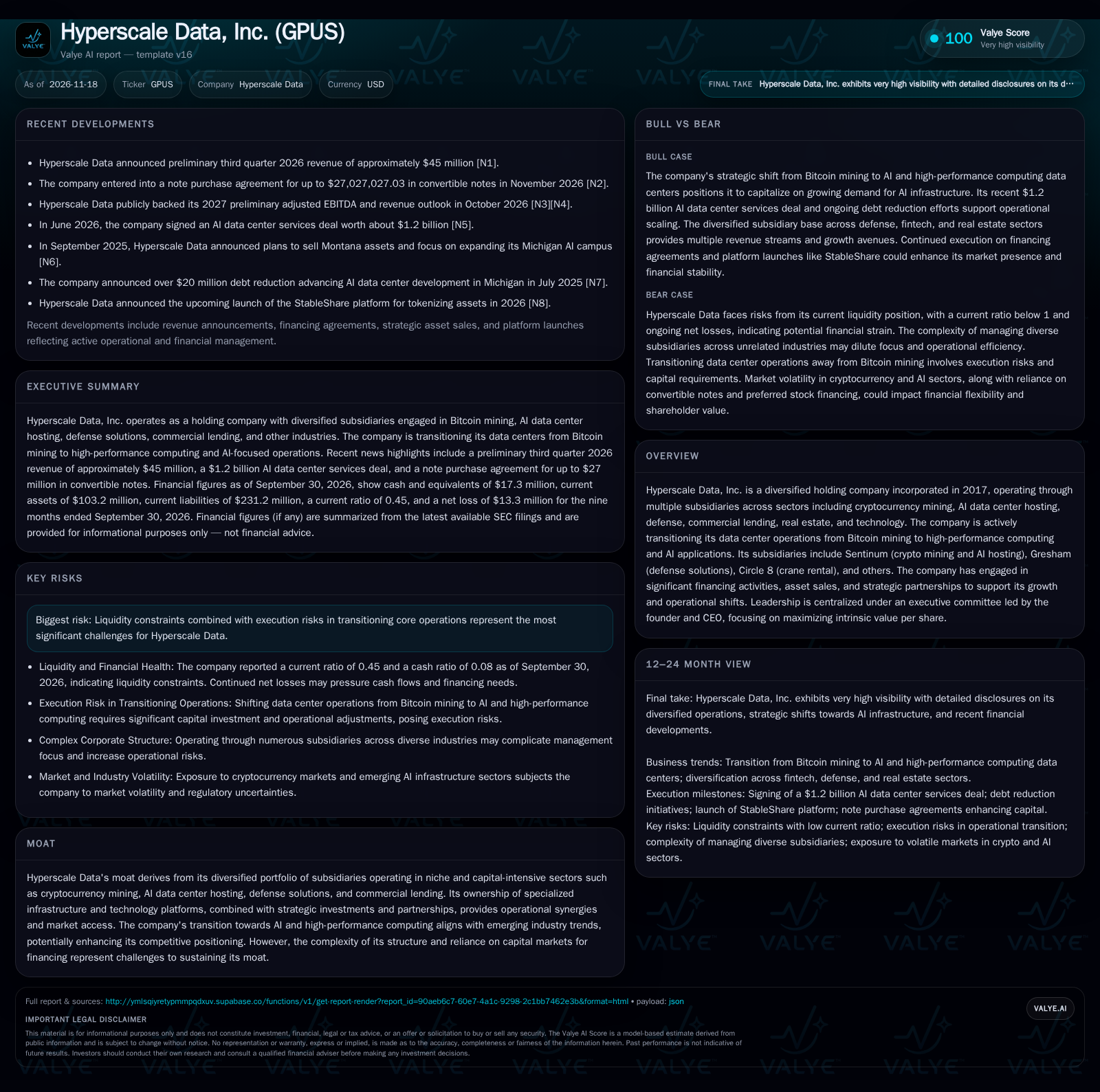
Hyperscale Data reported preliminary third quarter 2026 revenue of approximately $45 million, marking visible top-line momentum even as the company remains unprofitable [N1] [S2]. The most significant strategic development is a $1.2 billion AI data center services agreement signed in June 2026, underscoring the transition from Bitcoin mining to high-performance computing and AI hosting [N5]. The company has also executed a $20 million debt reduction and is reallocating assets by selling Montana properties to expand its Michigan AI campus [N6] [N7]. Despite these moves, Hyperscale Data ended September 2026 with $17.3 million in cash, a current ratio of just 0.45, and a net loss of $13.3 million for the first nine months of the year [S2]. These facts highlight a tension between growth ambitions and near-term liquidity constraints.
How the Model Shifts: From Mining Volatility to AI Infrastructure Economics
Hyperscale Data’s historical revenue model was anchored in cryptocurrency mining, a sector defined by volatile pricing, high energy costs, and limited operating leverage. The company’s pivot to AI data center hosting and high-performance computing could theoretically deliver more stable, contract-based revenue streams if customer demand for AI compute remains robust. The $1.2 billion AI data center services deal suggests potential for multi-year, high-value contracts, but without explicit disclosure of contract structure or margin terms, the predictability and profitability of these revenues remain unproven [N5].
The economics of data center hosting for AI workloads differ meaningfully from crypto mining: AI customers may value uptime, security, and scalability, supporting premium pricing and potentially higher gross margins. However, the capital intensity of building and upgrading data centers for AI applications is substantial, often requiring significant up-front investment in power, cooling, and networking. This dynamic raises the stakes for execution: operating leverage may be favorable if fixed costs are leveraged over large, long-term contracts, but capital missteps or underutilization could amplify losses.
Beyond the data center segment, Hyperscale Data’s diversified subsidiaries—spanning defense, equipment rental, fintech, and real estate—offer both offsetting cash flow opportunities and managerial distraction. Each segment brings its own capital and operating requirements, complicating consolidated cash flow management and increasing the risk of value dilution if capital is not allocated to the highest-return opportunities.
Competitive Stakes: Infrastructure, Customer Stickiness, and Structural Headwinds
In the AI data center space, Hyperscale Data competes against hyperscalers, colocation specialists, and infrastructure funds—all with deep capital bases, established customer relationships, and, in some cases, proprietary technology stacks. Potential differentiators for Hyperscale Data include ownership of specialized infrastructure, a willingness to serve emerging AI workloads, and the flexibility to structure bespoke deals. The company reported cash and liquidity metrics for the period; these figures do not by themselves establish operating runway, investment capacity, financial flexibility, or financing capacity.
Switching costs for AI and high-performance computing customers can be significant if workloads are mission-critical and require custom infrastructure or integration. If Hyperscale Data can demonstrate high reliability and performance, it could develop customer stickiness and renewal opportunities. Conversely, the company’s complex structure could dilute focus, making it harder to develop deep operational expertise or to cross-sell effectively among subsidiaries.
Substitute offerings—such as public cloud AI services or larger colocation providers—could exert downward pressure on pricing or attract incremental demand, depending on market dynamics. The company’s success may hinge on its ability to carve out niches where its infrastructure or service model offers a clear advantage over more commoditized providers.
Unlocking Value: What Would a Successful AI Transition Look Like?
A favorable trajectory for Hyperscale Data would see the $1.2 billion AI data center deal catalyzing a wave of similar contracts, enabling the company to achieve high utilization rates and recurring revenue streams from blue-chip AI or enterprise customers [N5]. If the company succeeds in selling non-core assets and reallocating capital to its Michigan AI campus, it may accelerate the shift to higher-margin, more predictable business lines [N6].
Execution on platform launches, such as StableShare for asset tokenization, could add incremental revenue streams and enhance the company’s ecosystem, attracting new customer segments [N8]. Debt reduction and new convertible note financing would provide breathing room for further investment and operational ramp-up [N2] [N7].
Confirmation of this scenario would come from multi-year contract disclosures, rising contracted backlog, margin expansion in the data center segment, and evidence of customer retention. Sustained revenue growth, narrowing losses, and improved liquidity ratios would further validate the company’s strategic pivot.
Managing Complexity: The Most Likely Outcome Absent Breakthroughs
The most plausible outcome is a gradual rebalancing: Hyperscale Data continues to wind down legacy crypto mining, ramps up AI data center operations, and manages a portfolio of diversified, but unevenly performing, subsidiaries. Revenue growth from AI hosting partially offsets losses from sunset operations, but capital expenditures and restructuring costs keep free cash flow negative in the near term.
The company’s asset sales and cost-cutting efforts may provide short-term liquidity, but unless new contracts or platform launches scale rapidly, operational leverage remains limited. The diversified structure may buffer volatility but also risks managerial distraction and suboptimal capital allocation.
Evidence supporting this scenario would include steady, but not dramatic, revenue growth; persistent but narrowing losses; and ongoing asset reallocation. Absence of clear margin expansion or backlog growth in AI services would indicate a more incremental trajectory.
If Liquidity Tightens: Risks of Capital Shortfall and Strategic Drift
Should AI data center contracts fail to materialize as expected, or if capital expenditures outpace new inflows, Hyperscale Data could face a worsening liquidity crisis. With a current ratio of 0.45 and a cash ratio of 0.08, the company has little margin for operational missteps or delays in asset sales [S2].
Continued net losses—especially if compounded by underutilized infrastructure or cost overruns—could force the company to seek dilutive equity or expensive debt financing. The complexity of the holding company structure may slow decision-making, hampering the ability to respond quickly to market shifts or competitive threats.
Confirmation of this scenario would come from deteriorating cash balances, rising short-term debt, missed operational milestones (such as delayed AI campus expansions), or unsuccessful asset sales. Strategic drift—manifested in stalled platform launches or loss of focus—would reinforce downside risk.
Testing the Hyperscale Data Thesis: Concrete Developments That Would Move the Needle
Sustained growth in contracted AI data center backlog or multi-year service agreements, if disclosed, would indicate demand durability and revenue visibility.
Trends in segment gross margins—especially in the AI hosting and high-performance computing businesses—would clarify whether the transition is driving operating leverage.
Quarterly cash flow from operations, rather than only cash balances, would highlight whether the company is approaching self-sufficiency or remains reliant on external financing.
Execution milestones on the Michigan AI campus expansion—including utilization rates and capital spending—would help assess the pace and efficiency of the strategic pivot.
Progress on asset sales and redeployment of proceeds toward high-return areas would demonstrate capital discipline.
Updates on the StableShare platform launch, initial customer traction, and revenue contribution would help validate the company’s fintech expansion.
Disclosure of customer concentration, retention rates, or renewal terms in the AI and hosting segments would help test the stickiness and quality of revenue.
Disclaimer: This is research-only, informational analysis and not investment advice. It may include AI-generated interpretation and general industry context. Always verify important details using primary sources.

Comments