
PHAOS Technology: Navigating Concentration Risk and Capital Constraints in a Niche Microscopy Market
PHAOS Technology Holdings faces acute financial pressure and heavy dependence on a handful of customers in Singapore. With a recent equity facility and cost cuts, the company’s future hinges on diversifying revenue streams and restoring operational momentum in a specialized but unforgiving market.
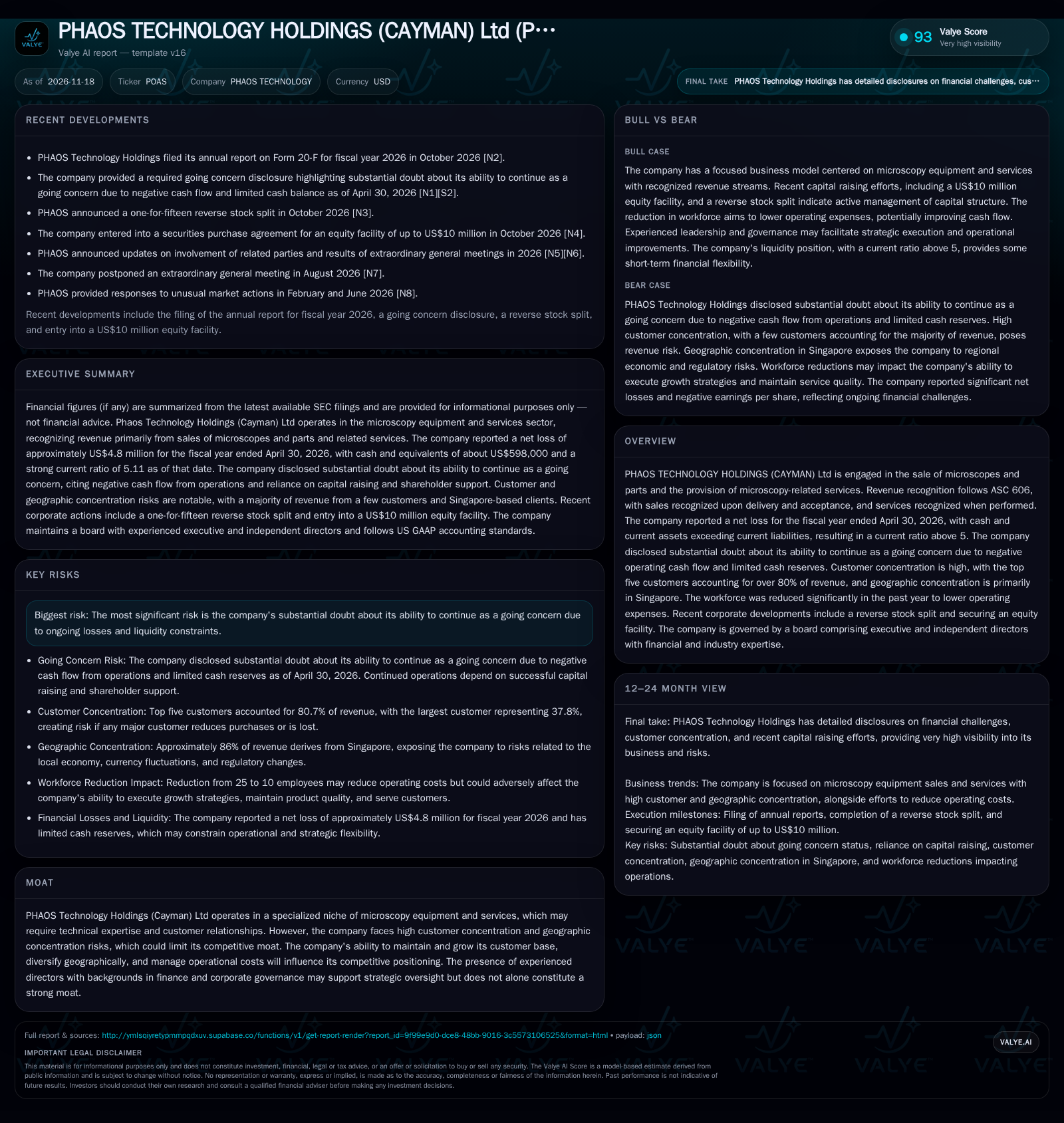
Customer concentration is extremely high, with the top five customers representing over 80% of revenue, and most sales are generated in Singapore. The company has responded with workforce reductions, a reverse split, and a $10 million equity facility, but ongoing viability depends on revenue growth, cost containment, and capital access. [S1] [S2] [N1] [N2] [N3] [N4]
PHAOS Technology Holdings (Cayman) Ltd operates in the specialized field of microscopy equipment and services, but its 2026 disclosures highlight a company at a crossroads. Facing a steep net loss, severe customer and geographic concentration, and substantial doubt about its ability to continue as a going concern, PHAOS is taking urgent steps to shore up its financial footing. Recent moves—including a major workforce reduction, a reverse stock split, and the establishment of a $10 million equity facility—reflect both the gravity of its challenges and the urgency of its response. The next chapter for PHAOS will be defined by its ability to diversify its revenue base, regain operational momentum, and secure the funding required to weather a highly competitive and capital-intensive market. [S1] [N1] [N3] [N4]
Acute Liquidity Strain and Concentration Risks Define the 2026 Backdrop
PHAOS Technology Holdings ended fiscal 2026 with a net loss of approximately US$4.8 million and cash and cash equivalents of just under US$600,000. The company reported cash and liquidity metrics for the period; these figures do not by themselves establish operating runway, investment capacity, financial flexibility, or financing capacity. However, the company explicitly disclosed substantial doubt about its ability to continue as a going concern due to negative operating cash flow and reported cash balance. [S1] [N1]
Customer risk is acute: the top five customers contributed over 80% of revenue, with the largest single customer representing nearly 38%. Geographically, 86% of revenue was generated in Singapore, compounding the company’s exposure to regional economic or regulatory shocks. [S1]
To address mounting losses and cash burn, PHAOS reduced its workforce from 25 to 10 employees over the past year and executed a one-for-fifteen reverse stock split. The company also entered into a securities purchase agreement for an equity facility of up to US$10 million in October 2026, aiming to stabilize its capital structure and provide much-needed liquidity. [N3] [N4]
Microscopy Economics: High Fixed Costs, Lumpy Demand, and Capital Intensity
PHAOS’s core business—selling microscopes, parts, and related services—typically features a blend of high up-front R&D and manufacturing costs, episodic sales cycles, and limited recurring revenue unless service contracts can be expanded. Margins in microscopy can be attractive for differentiated systems, but commoditization and price competition from global peers often compress gross margins for standard equipment.
Revenue is recognized upon delivery and acceptance, while services are recognized when performed. The presence of a right of return introduces potential volatility in recognized sales, and high customer concentration likely increases quarter-to-quarter variability. [S1]
Negative operating cash flow and persistent net losses suggest that current sales volumes and average selling prices (ASP) are insufficient to cover fixed costs. The company’s drastic headcount reduction is an attempt to scale back fixed overhead, but such cuts can also erode capacity for product development, customer support, and sales expansion.
Capital intensity remains a challenge: microscopy companies often require ongoing investment in inventory, demo units, and technical support. PHAOS’s ability to access the recently announced $10 million equity facility will determine whether it can invest for growth or merely fund ongoing losses. [N4]
Specialization Versus Scale: PHAOS in a Crowded Global Landscape
Microscopy is a mature global market with entrenched multinational competitors, including both premium brands and lower-cost regional manufacturers. Technical expertise, product reliability, and after-sales service are critical differentiators, but scale advantages in procurement, R&D, and channel coverage often accrue to larger players.
PHAOS’s heavy reliance on a small number of Singapore-based customers suggests a business model built on deep relationships or niche customization, but such concentration also limits bargaining power and heightens vulnerability to customer churn. If these customers are research institutions or government labs, contract cycles may be long but renewal risk is high if funding or procurement priorities shift.
Without geographic or customer diversification, PHAOS remains exposed to competitive displacement by larger, better-capitalized rivals or by emerging substitutes (such as digital imaging or lower-cost imported systems). The company’s ability to sustain technical differentiation or move into higher-value-add services will be critical to long-term positioning.
The board’s mix of financial and industry expertise provides governance depth but cannot, by itself, offset the lack of structural moat without further commercial progress.
Unlocking the Equity Facility and Expanding Beyond the Singapore Core
The most constructive scenario for PHAOS is predicated on two breakthroughs: successful drawdown and deployment of the $10 million equity facility, and tangible progress in customer and geographic diversification. If management can leverage new funding to invest in sales and technical support, the company could target new institutional or industrial customers outside Singapore, reducing its exposure to any single client or region.
A credible upside would be confirmed by evidence of new contract wins in additional APAC or international markets, a rising proportion of service revenue (potentially via maintenance or training contracts), and stabilization or growth in headcount to support expanded operations. Improved gross margins and a declining operating loss would also signal that cost containment is not coming at the expense of future growth. [N4]
This scenario would be falsified if new funding is either unattainable or consumed by ongoing losses without corresponding revenue expansion, or if customer and geographic concentration remains unchanged.
Operating in Survival Mode: Narrow Focus, Reduced Overhead, and Status Quo Risks
The most probable near-term path is that PHAOS continues to operate in a highly constrained mode, serving its core Singapore customer base with a minimized workforce. Revenue remains lumpy and highly concentrated, with operating losses persisting but potentially reduced due to lower fixed costs.
Confirmation of this scenario would be continued dependence on a handful of customers, flat or modestly declining revenues, and ongoing going concern disclosures. Incremental capital from the equity facility may help bridge short-term liquidity gaps but is not transformative unless paired with new business development.
The base case is challenged if customer attrition accelerates, or if cost reductions undermine service quality or product delivery, leading to further revenue erosion.
Liquidity Exhaustion and Customer Loss Trigger Structural Decline
The adverse scenario is defined by an inability to raise further capital and/or the loss of one or more major customers. Given the high fixed-cost nature of the business and the already lean workforce, a significant revenue drop would likely trigger a cash crisis, forcing asset sales, business wind-down, or insolvency proceedings.
Early warning signs would include a rapid drawdown of remaining cash, missed or delayed deliveries, further staff cuts, or disclosures of unsuccessful capital raising attempts. If Singapore’s macro environment deteriorates or procurement cycles slow, the geographic concentration risk would compound these vulnerabilities.
This scenario would be partially falsified if the company demonstrates new customer wins, successful cost management without further erosion in service capability, or secures alternative sources of liquidity.
Milestones and Metrics That Will Define PHAOS’s Trajectory in the Next Year
Actual drawdown and terms of the $10 million equity facility, including dilution impact and whether proceeds are used for growth or merely to cover ongoing losses. [N4]
Quarterly updates on customer concentration—specifically, whether the proportion of revenue from the top five customers and the Singapore market declines. A useful metric would be the number of new customers or markets entered, if disclosed.
Sustained gross margin trends, as a signal of pricing power or cost discipline amid workforce reductions. If disclosed, tracking ASPs and service revenue mix would provide further insight.
Changes in employee headcount and functional breakdown (e.g., sales, R&D, service), which would indicate whether cost cuts are undermining operational capacity.
Cash balance and operating cash flow trends on a quarterly basis, to assess runway and dependence on external capital.
Any disclosures of lost or non-renewed major customer contracts, which would materially alter the revenue outlook.
Board or management changes, especially those involving directors with turnaround or international business development expertise.
Evidence of new product launches, expanded service offerings, or technical partnerships that could signal a shift toward higher-margin or recurring revenue streams.
Disclaimer: This is research-only, informational analysis and not investment advice. It may include AI-generated interpretation and general industry context. Always verify important details using primary sources.

Comments