
Aeon Acquisition I Corp.: Strategic Stakes and Contingent Liabilities in the SPAC Lifecycle
Aeon Acquisition I Corp.
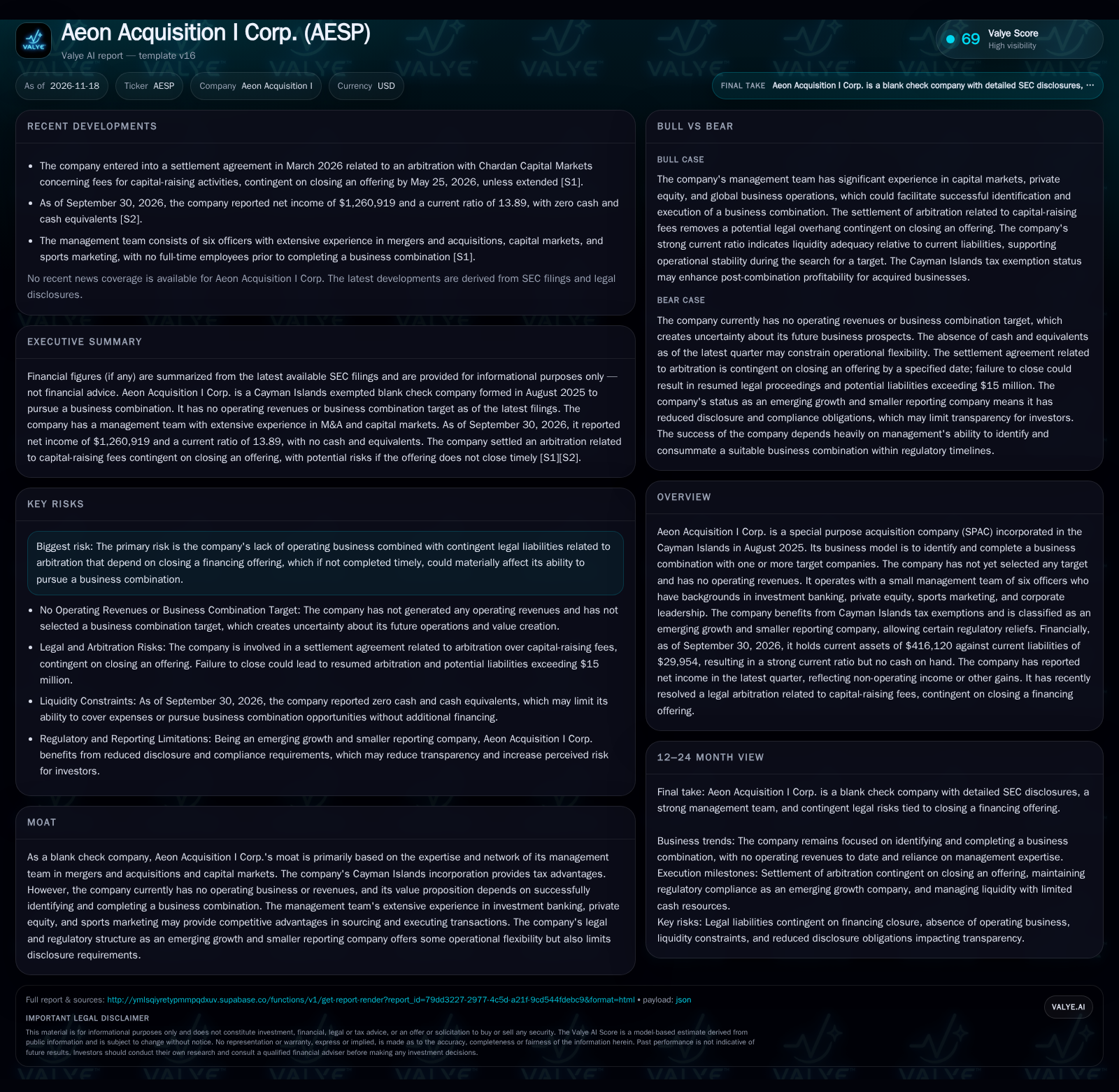
Aeon Acquisition I Corp. is a newly formed blank check company that recently completed its IPO but has not yet identified a target or generated operating revenue. The company’s ability to secure a suitable target and resolve its contingent liabilities will determine its long-term viability and investor returns. [S1] [S2]
Aeon Acquisition I Corp. sits at a classic SPAC crossroads: flush with IPO proceeds and led by a seasoned management team, but with no target in hand, zero cash on the balance sheet, and a material legal settlement hanging in the balance. Its near-term value is defined not by operations but by its ability to execute a successful business combination and resolve contingent liabilities tied to capital-raising activities. This analysis dissects Aeon’s structural economics, legal overhang, and the scenario dynamics that will determine whether the SPAC delivers value or stalls amid execution risk.
Legal Contingencies and Cash Position Frame the Near-Term Outlook
Aeon Acquisition I Corp. completed its initial public offering in June 2026, raising $143.75 million in gross proceeds through the sale of public and private placement units. As of September 30, 2026, the company reported zero cash and cash equivalents, with current assets of $416,120 and current liabilities of $29,954, resulting in a current ratio of 13.89. [S2]
A significant legal overhang persists: Aeon entered into a settlement agreement in March 2026 with Chardan Capital Markets regarding capital-raising fees, contingent on closing a financing offering by May 25, 2026. If the offering fails to close, the company faces the risk of renewed arbitration and potential liabilities exceeding $15 million. This creates a hard deadline for resolving both capital access and legal exposure. [S1]
No operating revenues have been generated, and no acquisition target has been announced. The company’s management team, composed of six senior officers with backgrounds in M&A, private equity, and capital markets, is tasked with identifying and executing a business combination under these constraints. [S2]
SPAC Mechanics: Trust Structure, Incentives, and Cost Pressures
Aeon’s business model is typical of blank check companies: it raises capital in an IPO, places the proceeds in a trust, and seeks to acquire a private operating business. The trust structure means most capital cannot be used for general operations and must be preserved for the eventual business combination or returned to shareholders if no deal is consummated. This explains the reported zero cash on hand despite a reported current ratio. [S2]
Revenue generation and value creation for Aeon depend entirely on successfully closing a business combination. Until then, its only income is non-operating, such as interest earned on trust assets—insufficient to cover all legal, compliance, and due diligence costs if a deal is protracted. The economics of a successful SPAC are heavily back-loaded: sponsors and management typically receive a 'promote' (equity stake) only upon successful merger, while public shareholders may redeem shares if dissatisfied with the target or deal terms.
Fixed costs for legal, regulatory, and due diligence functions can be significant, especially if the target is not compliant with U.S. reporting or SOX requirements. Additional capital may be needed to fund operations through the deal process, particularly if unforeseen legal or transaction costs arise. The settlement agreement with Chardan Capital Markets further complicates the economics, as a failure to close the offering could result in substantial legal liabilities, reducing any potential upside from an eventual deal.
Management Networks Shape SPAC Sourcing and Differentiation Challenges
Aeon’s competitive edge is primarily grounded in the track records and networks of its executive team, who bring backgrounds in M&A, investment banking, and global operations. In a crowded SPAC market, this can be decisive in sourcing proprietary deals or negotiating favorable terms with potential targets.
However, the SPAC sector in late 2026 is characterized by intense competition for attractive acquisition candidates, with many blank check companies chasing a finite pool of suitable targets. Target companies have become increasingly selective, often demanding higher valuations or more favorable deal structures. Larger or more established SPAC sponsors may crowd out newer entrants unless they offer unique value-add or sector expertise.
SPACs also compete not only with each other, but with private equity and strategic acquirers. The ability to offer a faster public listing, access to capital, and management support is offset by the dilution from sponsor promotes and the risk of redemption waves by shareholders. Aeon’s lack of a stated industry focus could be a double-edged sword: it maximizes optionality but reduces signaling value to potential targets and investors.
Unlocking Value Through Successful Deal Execution and Legal Resolution
A favorable outcome for Aeon hinges on the management team leveraging its M&A expertise and networks to identify a high-quality, scalable, and compliant target in a sector with public market appetite. If the company can close a business combination before the deadline, and the settlement with Chardan Capital Markets is finalized without triggering further arbitration or liabilities, the SPAC can unlock the trust capital and deliver value to shareholders and sponsors.
Confirmation of this scenario would require formal announcement of a definitive agreement with a target that is well-received by the market, clear resolution of the contingent legal settlement, and evidence that the merged entity is positioned for public company compliance and growth. Additional positive signals would include low redemption rates, strong PIPE (private investment in public equity) participation, and post-merger trading above the redemption value.
Falsification would occur if the company fails to announce a credible target in time, faces renewed arbitration or legal claims, or is forced to liquidate and return funds to shareholders, destroying sponsor economics and limiting investor upside.
Execution Window Reflects the Typical SPAC Timetable and Associated Risks
The most plausible outcome is that Aeon continues its search for a business combination, incurring operational and legal costs while engaging with multiple potential targets. The management team’s experience and networks may yield a deal, but there is a material risk that the process will be protracted or that the target will be suboptimal due to competitive pressures or time constraints.
In this scenario, the legal settlement with Chardan Capital Markets remains an overhang until the offering is closed. If the deadline for closing is extended or met, the risk of renewed arbitration is reduced, but operational risks persist. Market conditions for SPAC deals remain challenging, with elevated redemption rates and greater investor scrutiny of target quality and deal structure.
If Aeon announces a deal, confirmation would come from timely SEC filings, definitive agreement terms, and market reaction. Falsification would be signaled by a lack of progress toward a deal, missed deadlines on the legal settlement, or evidence of cash shortfalls to cover ongoing costs.
Risks of Deal Failure, Legal Escalation, and Forced Liquidation
The adverse scenario involves Aeon failing to close the contingent financing offering, triggering renewed arbitration with Chardan Capital Markets and exposing the company to potential liabilities exceeding $15 million. This could deplete available resources and materially impair the company’s ability to pursue a business combination.
If the company is unable to identify and close a suitable acquisition within the regulatory timeframe, it would be required to liquidate and return trust proceeds to shareholders. In such a scenario, sponsor economics are wiped out, and public shareholders receive only their pro-rata share of the trust, with no upside.
Confirmation of the downside would come from public disclosures of failed settlement negotiations, legal filings indicating renewed arbitration, missed offering deadlines, or liquidation announcements. Falsification would require clear evidence of settlement resolution and credible progress toward a business combination.
Factors Influencing Aeon’s SPAC Trajectory and Investor Outcomes
Announcement of a definitive business combination agreement, including details on target industry, valuation, and deal structure.
Formal confirmation or extension of the settlement agreement with Chardan Capital Markets, including whether the financing offering closes by the stated deadline.
Disclosure of cash and trust account balances, and any additional financing or PIPE commitments secured to support the business combination.
Redemption rates at the time of shareholder vote on the business combination—high redemptions may signal weak investor confidence and limit post-merger capital.
Legal filings or public statements regarding the status of arbitration or potential liabilities related to the Chardan settlement.
Evidence of compliance readiness and SOX/internal control status for any announced acquisition target, as regulatory missteps could delay or derail a deal.
Updates on management’s search process, sector focus, or engagement with potential targets, if disclosed.
Any changes in regulatory or SPAC market conditions affecting deal execution, extension votes, or shareholder support.
Disclaimer: This is research-only, informational analysis and not investment advice. It may include AI-generated interpretation and general industry context. Always verify important details using primary sources.

Comments