
Greif, Inc.: Margin Management, Structural Shifts, and the Packaging Economics Crossroads
Facing persistent input cost inflation and operational restructuring, Greif, Inc. leans on pricing power and cost optimization to defend profitability. The closure of the Sweetwater Mill marks a strategic pivot, but the company’s ability to maintain earnings and liquidity amid evolving industrial packaging demand will be tested as supply chain and market dynamics shift.
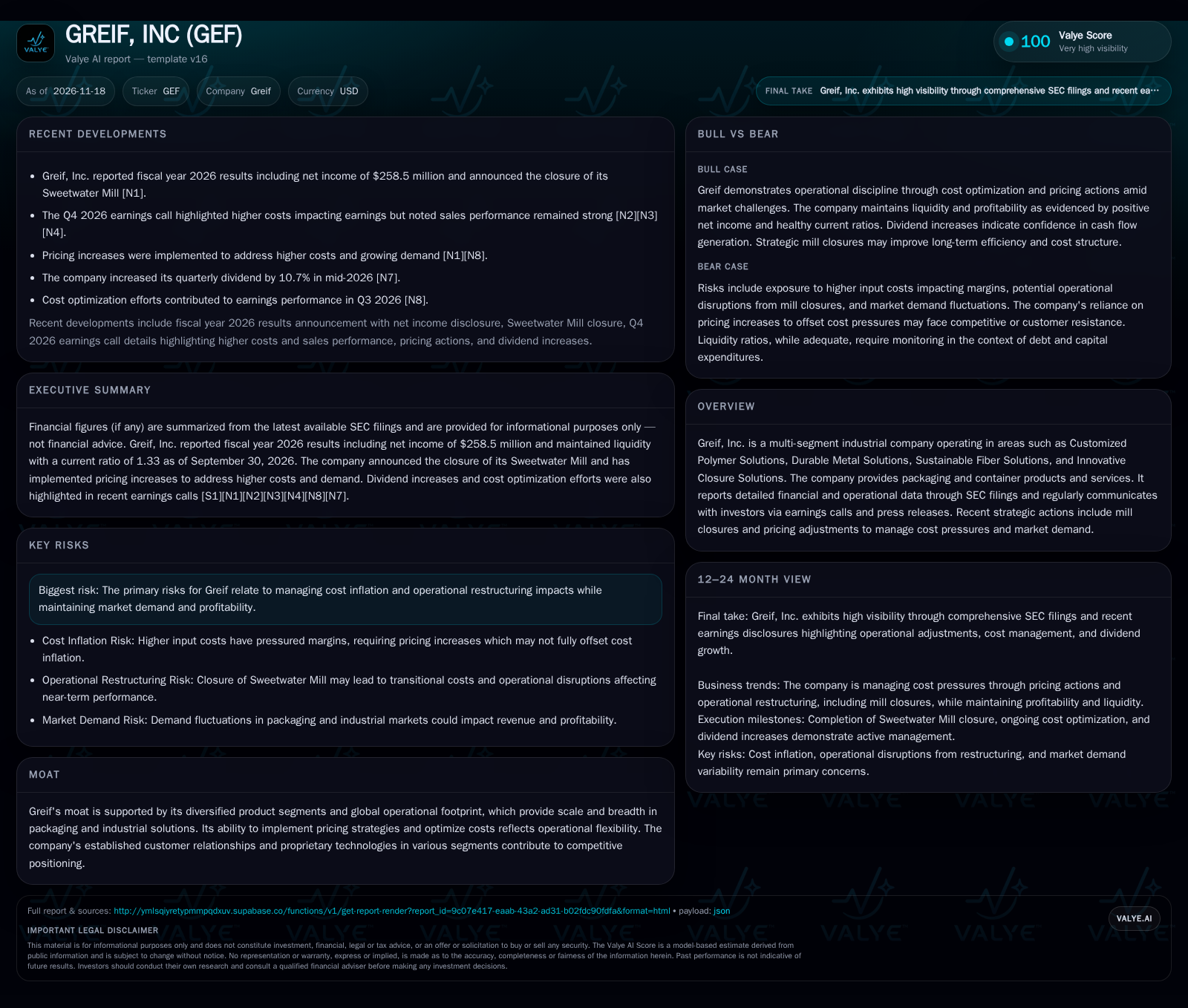
Greif, Inc.’s 2026 results highlight net income resilience and active cost controls despite higher input costs and the closure of the Sweetwater Mill. Management’s reliance on pricing actions and operational discipline underpins current profitability, but long-term value creation will depend on balancing structural efficiency with market demand and competitive pressure. Watch for the impact of restructuring, further cost inflation, and customer response to ongoing price adjustments. [S1] [N1] [N2] [N3] [N4] [N8]
Greif, Inc., a diversified industrial packaging supplier, delivered $258.5 million in net income for fiscal 2026 despite navigating elevated input costs and market uncertainty. The company’s recent closure of its Sweetwater Mill signals a willingness to restructure for long-term efficiency, while management continues to lean on pricing actions and cost controls to defend margins. As Greif’s segments span polymers, metals, fibers, and closures, its ability to sustain profitability will hinge on absorbing cost shocks, maintaining customer relationships amid price hikes, and executing operational realignment in a competitive, cyclical market. [S1] [N1] [N2] [N3] [N4] [N8]
Operational Realignment and Margin Defense Shape 2026 Results
Greif reported net income of $258.5 million for fiscal year 2026, demonstrating continued profitability despite persistent cost inflation. The closure of the Sweetwater Mill, announced alongside results, marks a significant structural adjustment aimed at improving long-term efficiency, though it introduces near-term disruption risk. Management’s decision to implement pricing increases in response to higher costs and demand further underscores the company’s reliance on commercial levers to defend margins. Liquidity, as measured by a current ratio of 1.33 and cash of $295.4 million, appears adequate for ongoing operations and restructuring, though future capital allocation will be critical as the company manages inflation and potential demand variability. [S1] [N1] [N8]
How Greif’s Multi-Segment Model Translates Inputs into Profits
Greif generates revenue across several segments—Customized Polymer Solutions, Durable Metal Solutions, Sustainable Fiber Solutions, and Innovative Closure Solutions—each tied to industrial packaging and container products. In these markets, profitability is shaped by the interplay of input costs (resins, metals, fibers, energy), manufacturing scale, and pricing power. Fixed costs are significant in legacy mill and plant infrastructure, making utilization rates and asset efficiency key to margins. Variable costs, particularly raw materials, are volatile and often require timely pricing adjustments to protect earnings.
The closure of the Sweetwater Mill likely reduces fixed-cost drag and may improve segment margins if volume is consolidated or shifted to more efficient facilities. However, such restructuring can entail upfront costs and temporary underutilization elsewhere. Greif’s ability to pass on input-cost increases through pricing is central to short-term earnings resilience, but this lever can encounter customer resistance, especially in commoditized or price-sensitive end-markets. Capital intensity remains moderate to high due to ongoing maintenance, compliance, and modernization needs, while operating leverage is most pronounced when demand is stable or growing, allowing for incremental volume to flow through a largely fixed cost base.
The multi-segment model also introduces complexity in managing cross-segment synergies and cost allocations, which can affect overall profitability. For instance, shared services such as procurement, logistics, and R&D must be optimized to prevent duplication and leverage scale economies. If Greif can enhance integration across its polymer, metal, fiber, and closure businesses, it may unlock incremental margin improvements beyond pure cost-cutting. However, this requires sophisticated operational coordination and data analytics capabilities to identify and execute efficiency opportunities without disrupting customer service or innovation pipelines.
Defending Share in a Fragmented, Inflation-Prone Packaging Landscape
Greif competes in a global industrial packaging sector characterized by fragmented supply, cyclical demand, and a mix of commodity and value-added products. Its diversified segment structure offers some resilience, but also exposes the company to a wide array of input cost drivers and end-market cycles. Competitors range from large multinational packaging conglomerates to regional or specialized suppliers, with varying degrees of vertical integration and geographic reach.
The company’s scale, breadth of product offerings, and established customer relationships support a degree of pricing power—particularly in custom or specialty solutions. However, in more commoditized segments, price-based competition can erode margins, especially if input-cost inflation outpaces the industry’s ability to reprice. Substitution risk is moderate, as customers may switch suppliers or materials if pricing diverges significantly. The current environment’s elevated cost pressures test the durability of Greif’s competitive advantages: operational flexibility, product breadth, and the ability to execute on cost optimization.
In addition to price competition, product differentiation and innovation increasingly shape competitive positioning in industrial packaging. Greif’s ability to develop sustainable and customized packaging solutions can create value that justifies premium pricing and fosters customer loyalty. However, such differentiation demands ongoing investment in R&D and market intelligence to anticipate evolving customer needs and regulatory trends. Failure to innovate or adapt to sustainability requirements could erode Greif’s competitive moat, especially as end-users and regulators emphasize environmental impact and circular economy principles.
Efficiency Gains and Pricing Discipline Drive Margin Expansion
In a favorable scenario, Greif’s operational restructuring—anchored by the Sweetwater Mill closure—yields sustained cost savings and asset utilization improvements across its network. Pricing actions, carefully calibrated to reflect both input inflation and value-added service, are successfully absorbed by customers with minimal volume attrition. Demand for industrial packaging remains robust, supported by secular growth in e-commerce, logistics, and sustainable packaging trends, enabling Greif to leverage its diversified portfolio.
Confirmation of this scenario would come from expanding segment margins, continued net income growth, and disclosure of cost savings realized from restructuring. Additional evidence would include stable or rising volumes despite higher pricing, as well as customer retention metrics or new contract wins in higher-value segments. If Greif can reinvest savings into innovation or further operational upgrades, its competitive position could strengthen, supporting upward revisions to earnings power.
Margin Stability Amid Cost Volatility and Moderate Demand
The most likely outcome is that Greif maintains profitability through disciplined cost management and selective pricing increases, but faces ongoing headwinds from input cost volatility and mixed demand signals. Operational restructuring delivers some efficiency gains, but near-term friction from mill closures and associated transition costs partially offsets benefits. Pricing power remains intact in specialty and custom segments, while more commoditized areas endure margin pressure or occasional volume loss as customers shop for alternatives.
Evidence supporting this scenario would include steady net income, a current ratio that remains above 1.2, and management commentary affirming continued cost optimization. Margins may fluctuate quarter-to-quarter depending on input prices and customer response to price adjustments, but structural profitability is preserved. If disclosed, stable customer retention and modest volume growth in core segments would reinforce the base case.
Input Cost Surges and Demand Erosion Undermine Margin Defenses
An adverse scenario would see input cost inflation accelerate further, outpacing Greif’s ability to raise prices or shift costs. This could coincide with a downturn in industrial packaging demand, driven by macroeconomic weakness or customer destocking. In this context, the Sweetwater Mill closure and other restructuring moves might introduce operational disruptions or fail to deliver planned savings, compounding pressure on margins and cash flow.
Additional warning signs include volume declines, customer loss to competitors, or failure to realize expected restructuring benefits. If capital expenditures rise unexpectedly to support restructuring or compliance, liquidity could become a concern, especially if credit markets tighten.
Milestones That Will Shape Greif’s Structural and Margin Trajectory
Progress on cost savings and operational improvements linked to the Sweetwater Mill closure—management updates and quantification would help test efficiency assumptions.
Quarterly segment margins and their sensitivity to raw material and energy input cost fluctuations—if disclosed, this would clarify pricing power and cost pass-through effectiveness.
Volume trends in core product lines, particularly after pricing actions—sustained or growing volumes would signal customer acceptance; declines would indicate pushback.
Customer retention rates or new business wins in higher-value or custom solution segments—would confirm commercial resilience.
Capital expenditure levels and timing, especially as they relate to facility closures, upgrades, or compliance—unexpected increases could signal execution or regulatory challenges.
Management commentary on market demand conditions in primary end-markets—would help distinguish between cyclical softness and structural share shifts.
Disclaimer: This is research-only, informational analysis and not investment advice. It may include AI-generated interpretation and general industry context. Always verify important details using primary sources.

Comments