
Texas Ventures Acquisition III Corp: Merger Execution, Capital Dynamics, and the Stakes of SPAC Competition
The economics of deal execution, potential dilution from additional financing, and the risk of liquidation if a transaction is not completed on time all shape TVA’s outlook.
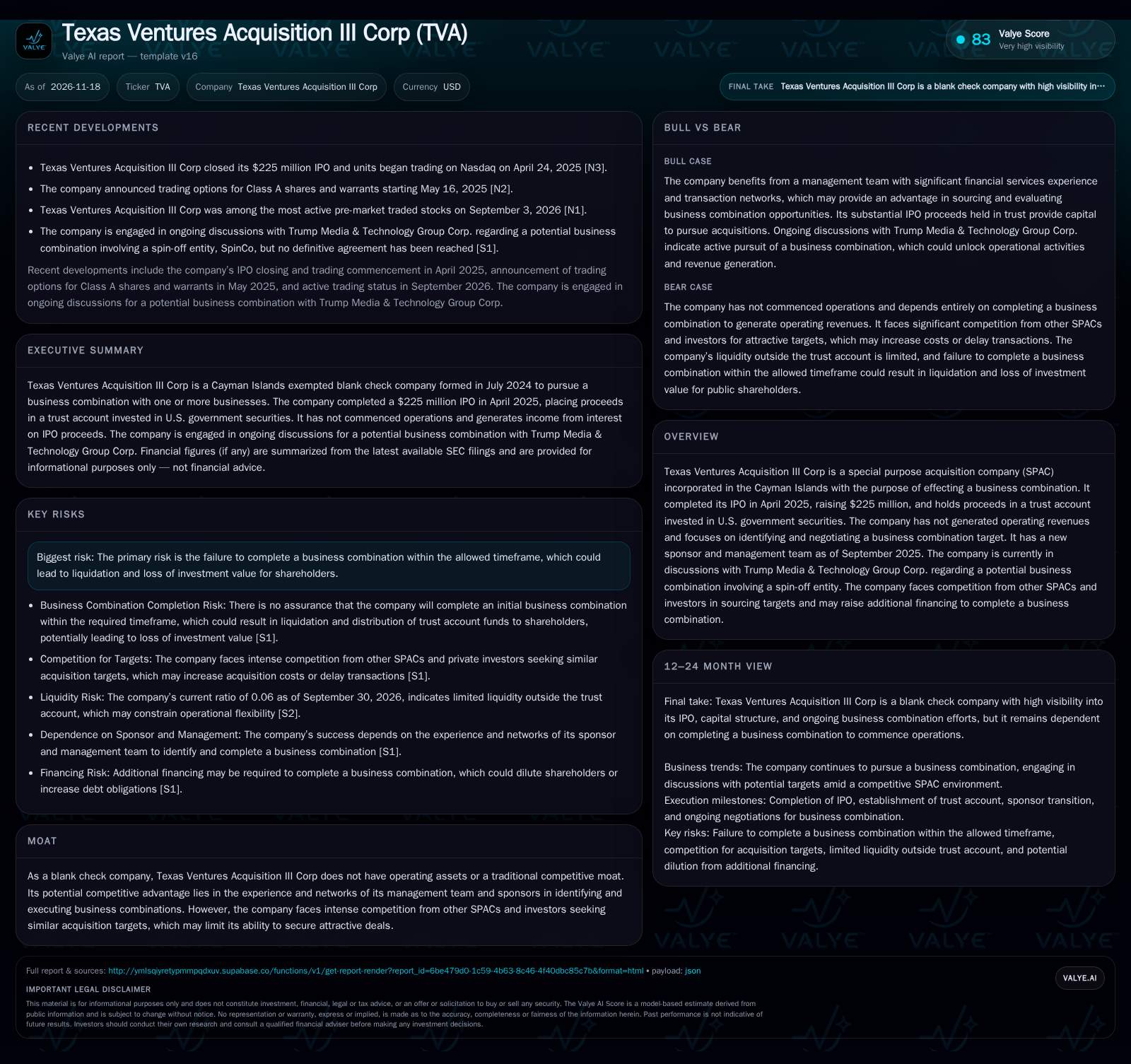
TVA, a SPAC with $225 million in trust from its 2025 IPO, is pursuing a merger with PlusAI. Despite no operating revenues, a sponsor transition, and minimal liquidity outside its trust, TVA has secured PIPE and convertible note commitments for the proposed deal. The next phase hinges on executing the merger before regulatory deadlines amid fierce competition and potential shareholder redemptions. Failure to close a deal in time could trigger liquidation and loss of shareholder value. [S1] [S2]
Texas Ventures Acquisition III Corp (TVA), a blank check company formed in 2024, has reached an inflection point. Having raised $225 million in its 2025 IPO and recently transitioning to a new sponsor, TVA is now focused on closing a business combination with PlusAI. The interplay between deal financing, shareholder redemptions, and the risk of liquidation will determine TVA’s trajectory in the coming quarters.
Merger Agreement and Liquidity: TVA’s Defining Moment
The most material development for Texas Ventures Acquisition III Corp is the execution of a definitive merger agreement with PlusAI on September 2, 2026. This agreement includes concurrent PIPE investment commitments of approximately $4 million and convertible note commitments of $57.5 million, designed to supplement the $225 million held in trust from the IPO. Despite these potential capital infusions, TVA’s operational liquidity remains extremely tight, with just $256,761 in current assets against $4.35 million in current liabilities as of September 30, 2026, resulting in a current ratio of 0.06 and a cash ratio of zero. These figures highlight TVA’s acute dependence on trust assets and successful deal closure to avoid default or forced liquidation. The sponsor and management transition in September 2025 further underscores the company’s evolving strategy and urgency. [S1] [S2]
SPAC Economics: Capital Flows, Dilution, and Deal Execution
Texas Ventures Acquisition III Corp’s business model is typical of special purpose acquisition companies (SPACs): raise capital via IPO, invest proceeds in a trust account, and use those funds to acquire an operating business. Until a merger is executed, TVA generates nominal income from interest on trust assets. The underlying economics hinge on successful completion of a business combination. If the deal with PlusAI closes, TVA’s trust funds, combined with the PIPE and convertible note proceeds, would be deployed to fund PlusAI’s growth or balance sheet, with the merged entity inheriting any associated liabilities and dilution. The economics for public shareholders depend heavily on redemption rates and the relative value of the acquired business.
The structure creates several critical economic levers. First, substantial redemptions by public shareholders at the time of the merger can drain the trust, reducing available capital for the target and potentially triggering minimum-cash conditions. Second, additional financing from PIPEs or convertible notes can bridge funding gaps but may also result in material dilution or introduce new debt-service burdens. Finally, operational leverage is latent until a business is acquired; until then, fixed costs (legal, advisory, listing fees) erode the sponsor’s capital and, indirectly, the SPAC’s ability to negotiate favorable terms.
SPAC Market Pressures and TVA’s Strategic Position
TVA operates in a crowded SPAC landscape, where hundreds of blank check companies compete for a limited pool of attractive targets. The company’s potential advantage lies in its refreshed sponsor team, which may bring differentiated networks or sector expertise. However, it faces direct competition not only from other SPACs but also from private equity and strategic acquirers targeting similar high-growth businesses. In this environment, deal terms have become more challenging, with targets often extracting higher valuations, more favorable earnouts, or PIPE funding as a precondition for closing.
The competitive dynamic is further complicated by regulatory deadlines (the '36-month rule'), which force SPACs to complete a deal or face delisting and liquidation. This time pressure can erode negotiating leverage, especially as the deadline approaches. TVA’s ability to consummate a deal with PlusAI before these deadlines—and to do so on terms that preserve value for public shareholders—will determine whether it can differentiate itself in a saturated market.
If the PlusAI Merger Closes Smoothly: Value Creation Pathways
The bull case for TVA hinges on a successful and timely closing of the PlusAI merger, minimal shareholder redemptions, and effective deployment of both trust and PIPE/convertible note capital into a business with compelling growth prospects. If PlusAI can demonstrate strong financials, scalable technology, or a credible path to profitability, the merged entity could command a higher market valuation, benefiting both legacy TVA shareholders and new investors.
Confirmation of this scenario would be evidenced by: (1) high PIPE/convertible note participation at closing, (2) low public shareholder redemptions, (3) robust post-merger guidance from PlusAI management, and (4) positive market reaction to the combined entity’s strategy and disclosures. Falsification would occur if the merger fails to close, if redemptions drain the trust, or if post-merger business fundamentals disappoint.
A Typical SPAC Outcome: Dilution, Redemptions, and Execution Risk
The most plausible path is that TVA completes the PlusAI merger, but with substantial public shareholder redemptions that reduce the trust proceeds available at closing. The company relies on PIPE and convertible note funding to meet minimum-cash thresholds, but these instruments introduce dilution and potentially a more leveraged capital structure for the merged entity. The post-merger business may face integration, reporting, and market-acceptance challenges typical for de-SPAC transactions.
This scenario would be confirmed by: (1) the merger closing with a smaller-than-anticipated trust balance, (2) significant dilution to legacy TVA shareholders from additional financing, and (3) a period of heightened volatility and scrutiny as the combined entity establishes its footing in public markets. Evidence against this scenario would include either a failed merger or an unexpectedly smooth closing with minimal redemptions and strong aftermarket performance.
Deal Failure or Liquidation: Consequences of Missed Execution
The bear case is that TVA is unable to consummate the PlusAI merger due to regulatory hurdles, insufficient financing, or excessive redemptions, leading to a failure to meet Nasdaq’s business combination deadline. In this case, TVA would be forced to liquidate, returning trust proceeds to public shareholders, who could receive less than their initial investment after accounting for costs and redemptions. The sponsors and management would lose their investment in founder shares and private warrants.
This outcome would be confirmed by: (1) regulatory or shareholder rejection of the merger, (2) a failed PIPE/convertible note raise, (3) delisting or liquidation notices, or (4) a public statement from TVA acknowledging the inability to complete a business combination in time.
Milestones and Conditions That Will Shape TVA’s Post-SPAC Trajectory
Progress and finalization of the PlusAI merger agreement, including regulatory approvals and satisfaction of closing conditions.
Actual redemption rate of public shares at the time of the merger, as high redemptions can deplete trust assets and jeopardize deal viability.
PIPE and convertible note funding participation rates, as strong take-up is necessary to supplement any shortfall in trust proceeds.
Post-merger financial guidance and business strategy disclosures from PlusAI, which will shape market perception and valuation.
Timeliness in meeting Nasdaq’s 36-month business combination requirement; any extension votes or regulatory updates would help test the thesis.
Changes in sponsor or management team composition, as further turnover could impact execution continuity or market confidence.
If disclosed, the combined entity’s pro forma capital structure and projected cash runway post-merger would clarify dilution and leverage implications.
Market reaction and trading volumes in TVA’s Class A shares and warrants following merger-related announcements or closing.
Disclaimer: This is research-only, informational analysis and not investment advice. It may include AI-generated interpretation and general industry context. Always verify important details using primary sources.

Comments