
Beam Global’s Next Act: Diversification Beyond Federal Contracts and the Stakes of Capital Access
The company’s future hinges on its ability to convert a broadening pipeline into stable revenue, execute on product innovation, and navigate intensifying competition in EV charging and energy storage.
The company’s long-term viability will depend on successfully scaling new products, integrating European operations, and maintaining capital market access amid Nasdaq listing pressure. Execution on these fronts could determine whether Beam Global can transition from a niche player to a sustainable force in the EV charging infrastructure sector. [S1] [S2] [N1] [N2] [N3]
Beam Global is at a strategic crossroads, navigating away from its historical dependence on U.S. federal government contracts toward a more diversified customer base spanning commercial, municipal, and European markets. The next phase for Beam Global will hinge on its ability to realize revenue from a broader sales pipeline, achieve operational scale, and secure ongoing access to capital markets amid intensifying competition in the EV charging and energy storage sector.
Strategic Realignment and Financial Strains Define Beam Global’s Present
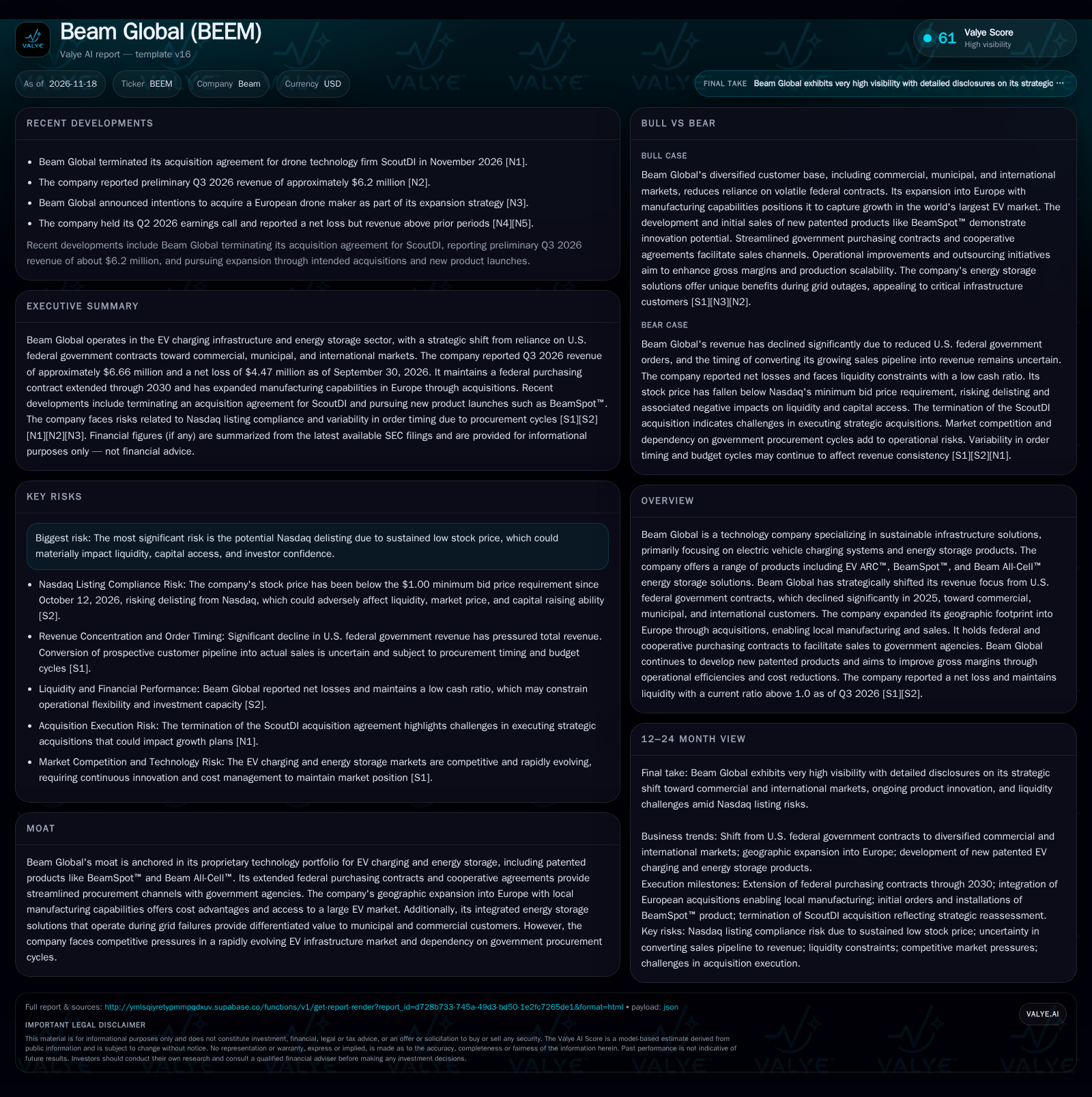
Beam Global reported preliminary Q3 2026 revenue of approximately $6.2–6.66 million and a net loss of $4.47 million, underscoring ongoing financial pressure as the company pivots away from U.S. federal government contracts. This revenue contraction follows a significant decline in federal orders, which previously represented a major share of Beam’s business. In response, Beam Global has accelerated efforts to capture commercial, municipal, and international customers, particularly in Europe, where it has expanded manufacturing capacity through acquisitions [S1] [S2] [N2] [N3].
The company reported cash and liquidity metrics for the period; these figures do not by themselves establish operating runway, investment capacity, financial flexibility, or financing capacity. Compounding these challenges, Beam faces the risk of Nasdaq delisting after its stock price fell below the $1.00 minimum bid price in October 2026—a development that could restrict access to capital and impair investor confidence [S2].
Recent events highlight execution risk: Beam terminated its planned acquisition of ScoutDI, a drone technology company, signaling potential hurdles in executing inorganic growth strategies [N1]. Meanwhile, product innovation continues with new offerings like BeamSpot™, but the ability to scale these innovations into meaningful revenue remains unproven.
Revenue Mix, Margin Levers, and Funding Needs in the EV Charging Landscape
Beam Global’s core business economics are shaped by the interplay of hardware sales (EV ARC™ charging stations, BeamSpot™, energy storage solutions) and integrated services, with an ambition to transition from lumpy project-based government orders to a more predictable commercial and international revenue stream. Historically, U.S. federal contracts provided high-value, often sporadic revenue, but with the decline of these contracts, Beam must contend with the slower ramp and greater volatility of commercial and municipal procurement cycles.
The company’s ability to generate sustainable gross margins is central to its economic model. Beam cites operational efficiencies, cost reductions, and outsourcing as levers to improve margins, but fixed costs associated with manufacturing, R&D, and geographic expansion (notably in Europe) may weigh on profitability in the near term [S1] [S2]. Without explicit disclosure of recurring revenue mechanics, it is plausible that the business remains primarily transactional, with only limited recurring elements tied to maintenance, support, or energy storage monitoring.
Capital needs are heightened by ongoing net losses and expansion initiatives. Access to external capital—either through equity or credit—will be critical, but the looming Nasdaq delisting risk may impair these avenues, raising the stakes of operational execution and cash management.
Defining Differentiation: Proprietary Technology Amid Intensifying Competition
Beam Global’s competitive proposition rests on its portfolio of patented EV charging and energy storage solutions, such as BeamSpot™ and Beam All-Cell™, which offer value in scenarios like grid outages—a feature that may appeal to municipalities and critical infrastructure operators [S1]. The company’s federal and cooperative purchasing contracts provide streamlined sales channels to government entities, though the efficacy of these channels is diminished as federal demand wanes.
European expansion offers access to the world’s largest EV market and potential cost advantages via local manufacturing. However, Beam faces formidable competition from established EV charging infrastructure providers, energy storage firms, and vertically integrated energy companies—many of which benefit from greater scale, broader product ecosystems, and deeper capital reserves.
Switching costs for customers may be modest unless Beam can establish meaningful integration, proprietary software ecosystems, or service-based contracts that lock in recurring revenue. The company’s differentiation will be tested by the pace of technology innovation, regulatory shifts, and the ability of larger competitors to undercut on price or outspend on R&D.
How Successful Pipeline Conversion and Margin Expansion Could Unlock Sustainable Growth
A favorable scenario for Beam Global envisions the company effectively converting its expanded pipeline of commercial, municipal, and international prospects into stable, recurring revenue. The integration of European acquisitions could yield local manufacturing efficiencies and accelerate market penetration in regions with robust EV adoption incentives. Should new products like BeamSpot™ gain traction, they could command premium pricing and reinforce Beam’s technology leadership.
Operational improvements and outsourcing initiatives could drive gross margin expansion, potentially enabling positive operating leverage as revenues scale. If Beam manages to sustain Nasdaq compliance, it would preserve access to public capital markets—critical for funding growth and weathering short-term losses.
Evidence supporting this scenario would include a demonstrable increase in order volume from non-federal customers, improving gross and operating margins, successful initial installations of new products, and public disclosures of recurring revenue contracts. Confirmation would also come from restored compliance with Nasdaq listing requirements and a stabilized or rising cash balance.
Navigating Volatility as Beam Global Rebuilds Its Commercial Engine
The most likely trajectory sees Beam Global operating in a transitional state: gradually shifting its revenue mix toward commercial, municipal, and international clients while continuing to experience periodic revenue volatility due to procurement cycles and project-based sales. Ongoing net losses may persist until operational scale is achieved or until the company secures higher-margin, repeat business.
Gross margin improvement may be incremental, reflecting a mix of cost containment and selective outsourcing, but offset by fixed costs from European expansion and continued R&D investment. Liquidity will remain tight, requiring careful working capital management and, potentially, opportunistic capital raises if market conditions allow.
Beam’s Nasdaq listing status will remain a watchpoint—if the company regains compliance, it may support improved market sentiment and capital access. However, continued uncertainty around order timing, acquisition execution, and customer adoption of new products may limit near-term upside. Evidence confirming this scenario would include steady but unspectacular revenue growth, static or modestly improving margins, and periodic updates on pipeline conversion without clear inflection points.
Liquidity Squeeze and Competitive Pressures Could Force Strategic Retrenchment
An adverse scenario unfolds if Beam Global fails to convert its broadened pipeline into sustained revenue, resulting in persistent net losses and further erosion of its cash position. In this environment, the company could face delisting from Nasdaq, materially impairing its ability to raise capital or attract institutional investors [S2].
Competitive pressures from larger, better-capitalized EV charging and energy storage companies could drive price compression and customer attrition, especially if Beam cannot keep pace with technology innovation or if its products are perceived as niche or non-essential.
The inability to execute on planned acquisitions (as signaled by the terminated ScoutDI deal [N1]) or to deliver on new product launches could further undermine confidence. Evidence of this downside would include shrinking cash balances, missed revenue targets, a formal Nasdaq delisting notice, or discontinued expansion efforts. In extreme cases, Beam may be forced to pursue strategic alternatives, such as asset sales or restructuring, to preserve value for stakeholders.
Milestones That Will Clarify Beam Global’s Transition and Long-Term Viability
Order volume and revenue mix from commercial, municipal, and international customers—if disclosed, a rising proportion would indicate successful diversification.
Gross and operating margin trends in subsequent quarters, revealing whether operational improvements and outsourcing are translating into profitability gains.
Nasdaq listing compliance updates and any actions taken to remedy bid price deficiencies, as these will impact capital access and market perception.
Initial sales and installations data for new products like BeamSpot™, as adoption will validate or challenge the company’s innovation thesis.
Progress on European manufacturing integration and the realization of local cost or sales advantages.
Formal announcements of recurring revenue contracts or service agreements, which would support higher revenue visibility and potential switching costs.
Updates on M&A activity and acquisition execution, particularly any renewed efforts to expand through inorganic means or lessons learned from the ScoutDI termination.
Disclaimer: This is research-only, informational analysis and not investment advice. It may include AI-generated interpretation and general industry context. Always verify important details using primary sources.

Comments