
Mueller Water Products: Tariff Pressures, Geopolitical Risk, and the Economics of Water Infrastructure Supply
Mueller Water Products delivered solid FY2026 revenue and profitability, but faces intensifying headwinds from higher raw material costs and operational uncertainty in Israel. The company’s ability to manage margin pressure, supply chain disruptions, and capital allocation will determine whether it can sustain its competitive position in a changing water infrastructure market.
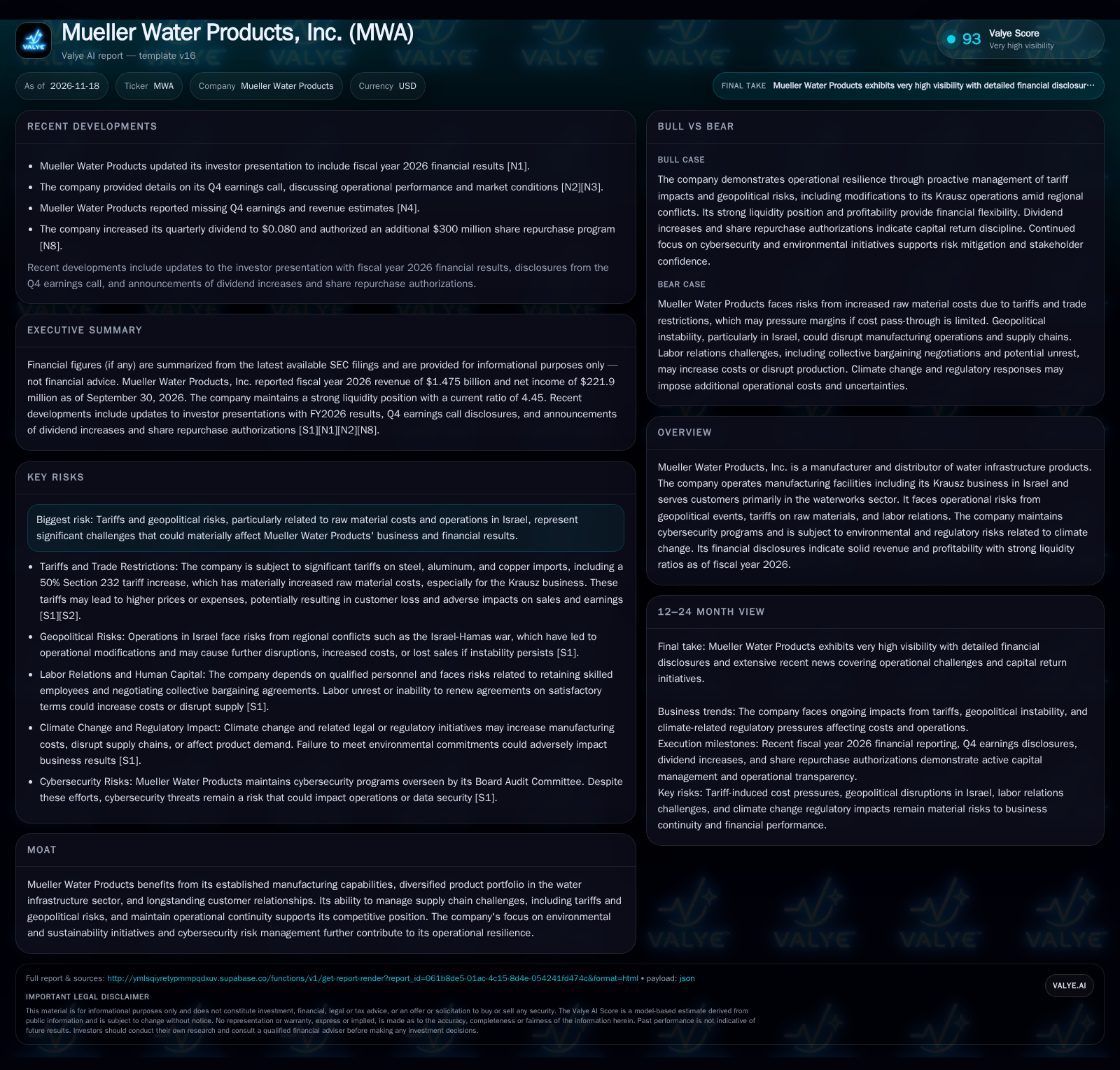
Mueller Water Products reported $1.475 billion in FY2026 revenue and $221.9 million in net income, maintaining a robust current ratio of 4.45. However, higher Section 232 tariffs on steel and aluminum, as well as instability in its Israeli manufacturing operations, are raising input costs and operational risks. A recently increased dividend and a new $300 million share repurchase authorization reflect active capital management, but future performance will hinge on the company’s ability to offset cost pressures and navigate external shocks. [S1] [N1] [N8]
Mueller Water Products, a major supplier of water infrastructure components, has delivered consistent financial performance in fiscal 2026, highlighted by strong reported revenue and net income. Yet the company now finds itself at the nexus of several converging risks: escalating tariffs on key raw materials, operational exposure to Middle Eastern conflict, and a broader regulatory environment shaped by climate change. The sustainability of Mueller’s profitability and capital returns will depend on its ability to adapt its supply chain, manage labor and geopolitical disruptions, and defend margins in an inflationary, volatile environment.
How Tariffs and Geopolitics Are Shaping Mueller Water Products’ Present
Mueller Water Products closed fiscal 2026 with $1.475 billion in revenue and $221.9 million in net income, translating to a diluted EPS of $1.41 [S1]. While these headline figures reflect continued demand for water infrastructure products, they mask intensifying cost pressures. The company’s Krausz business, which operates manufacturing in Israel, has faced higher input costs due to a 50% increase in Section 232 tariffs on steel and aluminum imports [S1] [S2]. Compounding these pressures, the Israel-Hamas conflict has forced operational adjustments, increasing uncertainty around supply continuity and cost structure [S1]. In response, the company has signaled capital discipline via a dividend increase and a new $300 million share repurchase program [N8]. However, missing Q4 earnings and revenue estimates signals that underlying volatility is already impacting results [N4].
Margin Dynamics in a Capital-Intensive, Tariff-Exposed Water Supply Chain
Mueller’s business model is built around manufacturing and distributing essential water infrastructure—valves, hydrants, fittings, and related components. Revenue is driven primarily by municipal and utility customers with long project cycles, which can provide stable baseline demand but limit rapid pricing adjustments. The company’s cost structure is heavily influenced by commodity prices, especially steel and aluminum, making gross margins vulnerable to swings in input costs if these cannot be fully passed through to customers. The recent surge in Section 232 tariffs directly raises raw material costs for core product lines, particularly in the Krausz segment.
While Mueller benefits from some economies of scale and manufacturing integration, fixed costs remain substantial due to plant operations, specialized labor, and regulatory compliance. This creates both operating leverage in times of demand growth and margin compression risk when costs rise or volumes fall. The cited source reports dividend-related activity; that disclosure alone does not establish dividend-policy continuity, management confidence, or a material constraint on capital flexibility. [S1]
The capital-intensive nature of Mueller’s operations also implies a significant sensitivity to interest rate fluctuations and credit market conditions. Should borrowing costs rise, the company’s ability to finance capital expenditures or refinance existing debt could be constrained, potentially delaying modernization efforts or expansions necessary to maintain competitive advantage. Additionally, the long project cycles characteristic of municipal infrastructure contracts mean that revenue recognition and cash flow timing can be uneven, requiring prudent working capital management to avoid liquidity stress under cost inflation scenarios. A useful metric to monitor would be the company’s free cash flow conversion rate, as it would help assess whether operational cash generation keeps pace with capital deployment and dividend commitments.
Defending Market Share Amid Supply Chain Shocks and Regulatory Uncertainty
Mueller Water Products operates in a market dominated by a handful of large manufacturers and numerous regional players supplying municipal water utilities and contractors. Its competitive advantages have traditionally stemmed from scale, manufacturing expertise, product breadth, and entrenched customer relationships. However, the current environment is testing the durability of these advantages.
Tariff-driven cost inflation is not unique to Mueller, but the company’s exposure is amplified by its reliance on imported steel and aluminum, and by its Krausz operations in Israel. If competitors have more diversified supply chains or local sourcing, Mueller could face relative margin erosion. Geopolitical instability introduces further risk, as prolonged disruptions in Israel could cede share to rivals with more resilient operations. Meanwhile, regulatory trends around climate change may require accelerated investment in product innovation or compliance, raising costs and potentially eroding profitability if not matched by market pricing.
Switching costs for municipal customers are moderate, as qualification and installation standards can create some stickiness, but not enough to guarantee retention if pricing or supply reliability falters. In this context, customer loyalty and reputation for reliability are critical, but vulnerable to supply chain shocks and cost-driven price increases.
From a competitive standpoint, Mueller’s reliance on a concentrated supplier base for raw materials could exacerbate vulnerability to tariff shocks and supply disruptions. If the company can diversify sourcing geographically or develop alternative materials that reduce dependence on tariff-impacted inputs, it would enhance resilience and potentially create differentiation. Conversely, competitors with vertically integrated supply chains or localized production might achieve cost advantages that pressure Mueller’s pricing power. Furthermore, the regulatory environment’s increasing emphasis on sustainability and water conservation technologies may shift customer preferences toward suppliers offering innovative, compliant products. Mueller’s ability to invest in R&D and rapidly bring such solutions to market will be critical in maintaining market share amid evolving utility procurement standards.
If Mueller Can Pass Through Costs and Stabilize Supply, Margin Expansion Is Possible
A favorable outcome for Mueller would require successful pass-through of higher raw material costs to customers, either via contractual escalators or effective negotiation, preserving or even expanding gross margins. If supply chain adaptations—such as alternative sourcing or operational adjustments—can mitigate the impact of Israeli instability, the company could maintain production continuity and customer reliability. Continued capital returns (via dividends and buybacks) would reinforce investor confidence.
Evidence confirming this scenario would include sequential improvement in gross margin, explicit disclosure of successful price increases or contract renegotiations, and stable or growing market share despite external shocks. A return to meeting or exceeding earnings expectations in subsequent quarters would further validate the company’s ability to manage through volatility. Conversely, if margin recovery is delayed or cost pass-through proves limited, the upside scenario would be weakened.
Stability Through Incremental Adjustments, but Margin Pressure Persists
The most plausible trajectory is that Mueller absorbs some cost increases while passing through a portion to customers, resulting in moderate margin compression but continued profitability. Operational disruptions in Israel may persist, but not escalate to the point of sustained supply outages.
Any extended period of earnings misses, market share loss, or negative cash flow from operations would challenge this middle-path outlook.
Prolonged Tariff and Geopolitical Shocks Drive Margin Erosion and Capital Constraints
The most adverse scenario for Mueller involves a sustained combination of tariff-driven cost inflation and prolonged disruption to its Israeli manufacturing base. If the company is unable to pass through higher costs or secure alternative supply, gross margins could contract sharply. Extended operational instability could lead to missed deliveries, customer defections, or lost contracts, particularly if competitors are less exposed to the same risks.
In this environment, cash flow could deteriorate, forcing the company to curtail buybacks or dividend growth and potentially to tap external financing. Evidence of this downside would include persistent earnings shortfalls, rising inventory or receivables (signaling distribution or demand issues), and any public guidance reductions or negative revisions.
Where the Thesis Could Break: Margin, Supply, and Customer Dynamics to Track
Gross margin trends: Quarterly disclosure of gross margin, especially commentary on cost pass-through success or failure, would help test the ability to defend profitability.
Operational status of Israeli manufacturing: Updates on the Krausz facility’s output, supply disruptions, or contingency plans would clarify the impact of regional instability.
Pricing actions and customer response: Evidence of successful price increases, contract renegotiations, or customer retention in the face of higher costs would be critical.
Working capital movements: Trends in inventory, receivables, and payables could flag emerging supply chain or demand issues.
Competitive responses: If disclosed, market share shifts or customer wins/losses relative to tariff/geopolitical exposure would help assess competitive resilience.
Labor relations developments: Updates on negotiations, strikes, or workforce disruptions would indicate execution risk.
Climate and regulatory developments: New regulations or compliance costs impacting manufacturing or product standards would be material to monitor.
Disclaimer: This is research-only, informational analysis and not investment advice. It may include AI-generated interpretation and general industry context. Always verify important details using primary sources.

Comments