
Dynamic Aerospace Systems: Navigating Innovation Ambitions Amid Severe Liquidity Constraints
Dynamic Aerospace Systems has built a robust portfolio of next-generation UAV and logistics technologies, but its zero-revenue status and acute liquidity shortfall raise existential questions about its ability to commercialize its vision before competitive and financial pressures intervene.
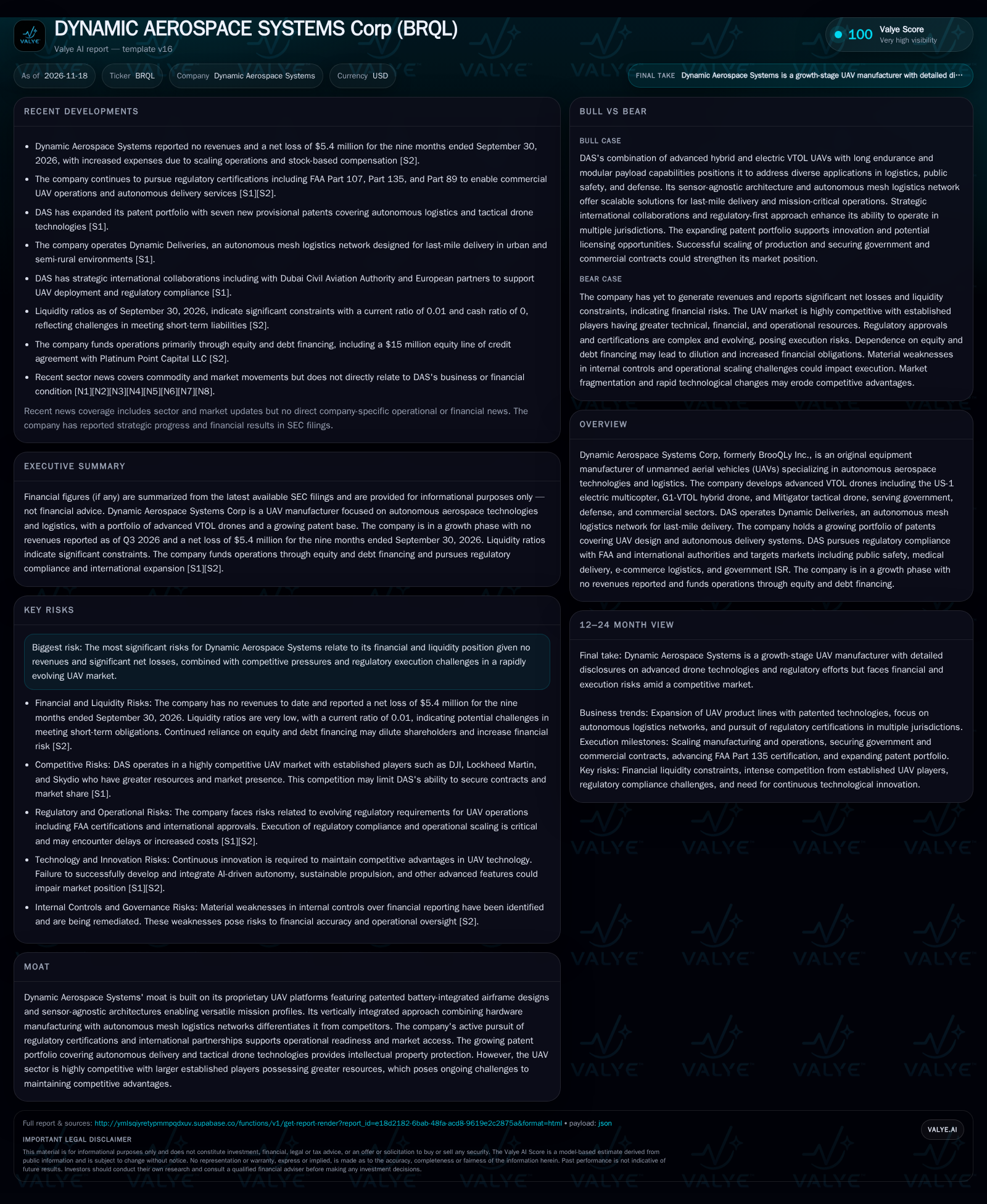
Dynamic Aerospace Systems (DAS) is a rebranded UAV OEM focused on advanced, endurance-driven drones and autonomous delivery networks, underpinned by a growing patent portfolio and global regulatory engagement. Near-term viability hinges on securing funding and demonstrating commercial traction before competitive and financial headwinds outpace operational progress. [S1] [S2]
Dynamic Aerospace Systems has positioned itself at the frontier of UAV innovation, blending patented VTOL drone platforms with ambitions for autonomous mesh logistics networks and international regulatory integration. As the company pursues contracts in public safety, logistics, and government sectors, its near-term survival and long-term differentiation will depend on bridging the gap between technical promise and commercial reality—before capital constraints or competitive advances close the window of opportunity.
Liquidity Crunch and Zero Revenue: The Immediate Stakes for Dynamic Aerospace Systems
Dynamic Aerospace Systems (DAS) stands at a critical juncture, reporting no revenues for the nine months ended September 30, 2026, and a net loss of $5.4 million over that period. Expenses have risen as the company scales R&D and operations, including stock-based compensation. The company reported cash and liquidity metrics for the period; these figures do not by themselves establish operating runway, investment capacity, financial flexibility, or financing capacity. The company’s operational funding is now largely dependent on external capital, including a recently secured $15 million equity line of credit. [S2]
From Prototypes to Platforms: Unpacking the Commercial Model and Economic Levers
DAS’s business model aspires to blend high-value UAV hardware sales, recurring Drone-as-a-Service (DaaS) contracts, and logistics network monetization. The company’s advanced products—such as the US-1 multicopter (long endurance, battery-integrated airframe), G1-VTOL hybrid (multi-hour range), and Mitigator tactical drone—target segments with both hardware and service components. If realized, DaaS and logistics-network models could deliver recurring, higher-margin revenue streams compared to one-off hardware sales, leveraging fixed-cost infrastructure and software for operating leverage. However, in the current pre-revenue phase, all costs are effectively fixed, with R&D and operational scaling outpacing any incoming cash. Capital needs are structurally high, covering certification, manufacturing ramp-up, and network buildout. Without evidence of contract wins or customer prepayments, DAS’s path to positive unit economics remains unproven and highly sensitive to volume ramp and pricing power—both of which are at risk if the company cannot quickly establish commercial traction.
The scalability of DAS’s business model fundamentally depends on its ability to transition from capital-intensive prototype development to volume production and service delivery. This transition is often marked by a shift in cost structure, where fixed costs incurred during R&D and certification phases can be amortized over a growing installed base and recurring service contracts. However, this scale-up requires not only securing sufficient upfront capital but also demonstrating operational reliability and regulatory compliance to attract early adopters. The timing of this inflection point is critical; delays in certification or technical setbacks can exacerbate liquidity pressures and increase the risk of value-destroying dilution. Moreover, the company’s pricing strategy must balance competitive positioning with margin preservation, especially as established players may leverage economies of scale to undercut nascent entrants.
Differentiation at Risk: Competitive Dynamics in a Crowded UAV Landscape
DAS claims differentiation through its patented battery-integrated airframes, long-endurance hybrid VTOLs, and sensor-agnostic platforms. Its vertically integrated approach, particularly the Dynamic Deliveries autonomous logistics network, is designed to move the company beyond hardware into recurring service revenues. However, the UAV sector is defined by rapid innovation and aggressive competition from both commercial (e.g., DJI, Zipline) and defense-oriented (e.g., Lockheed Martin, Skydio) incumbents with far larger R&D budgets, established customer channels, and proven manufacturing scale. DAS’s regulatory-first strategy and international MOUs may provide early-mover advantages in certain jurisdictions, but these are not yet translated into defensible contracts or recurring revenue. The critical question is whether DAS’s technical and regulatory head start can persist long enough to achieve commercial scale before competitors replicate or outpace its offerings.
The competitive landscape also imposes strategic constraints on DAS’s market entry and expansion. Established UAV manufacturers benefit from entrenched customer relationships, extensive distribution networks, and brand recognition, which can create high switching costs for potential clients. DAS’s patented technologies offer differentiation, but intellectual property alone may not suffice to deter competitors who can rapidly innovate or bundle UAV solutions with broader defense or logistics offerings. Furthermore, regulatory engagement, while a potential moat, is subject to evolving standards and geopolitical considerations that can either accelerate or hinder market access. The company’s success will depend on its agility to adapt product features, certification strategies, and partnership models in response to competitor moves and regulatory shifts.
Pathway to Commercial Breakthrough: What Would Signal a Viable Growth Trajectory?
A favorable scenario for DAS would begin with successful completion of key regulatory certifications (FAA Part 135 for BVLOS operations, Part 107 for pilot compliance, and Part 89 for Remote ID), unlocking the ability to operate commercial logistics and ISR missions in the U.S. and select international markets. Early contract wins—particularly in public safety, medical delivery, or government ISR—would provide critical validation and cash flow, reducing dependence on external funding. If the company secures anchor customers and demonstrates reliable UAV performance (e.g., consistent flight endurance, payload flexibility), it could leverage its sensor-agnostic and modular architecture to serve a broad range of use cases and drive incremental DaaS subscriptions. Confirmation of this scenario would include disclosed multi-year contracts, recurring service revenue, and evidence of pilot logistics network deployments with positive customer feedback. Falsification would include further quarters of zero revenue, regulatory delays, or loss of first-mover advantage to better-capitalized rivals.
A viable growth trajectory would also require DAS to establish a robust ecosystem around its UAV platforms, including third-party payload developers, software integrators, and service partners. This ecosystem approach can enhance platform stickiness, reduce customer acquisition costs, and foster innovation through complementary capabilities. Additionally, leveraging data generated by UAV operations—such as flight analytics, maintenance diagnostics, and mission outcomes—could open ancillary revenue streams via analytics services or predictive maintenance contracts. Achieving this level of ecosystem integration is contingent on open architecture design, developer engagement, and scalable cloud infrastructure, all of which demand upfront investment and strategic foresight. Success in this domain could materially improve margins and competitive resilience.
Survival Mode: Navigating Capital Scarcity and Proving Commercial Demand
The most plausible near-term outcome is a period of capital-constrained operations, with DAS drawing on its equity line to shore up liquidity while prioritizing regulatory milestones and pilot deployments. The company may achieve limited demonstration projects or pilot contracts, but meaningful recurring revenue is likely to lag until it can prove reliability and regulatory compliance at scale. External fundraising—via equity or strategic partnerships—remains essential, and the company may need to accept dilution or less favorable terms to sustain development. Evidence supporting this scenario would include incremental progress on certifications, small-scale deployments, or new financing rounds. Falsification would be signaled by inability to access further capital, layoffs, or a rapid deterioration in operational capability.
Under capital scarcity, DAS may need to prioritize modular product development and phased network rollouts to conserve resources while demonstrating incremental value to stakeholders. This approach involves focusing on core UAV capabilities and select high-impact use cases that can generate early revenue or strategic partnerships, rather than pursuing broad market coverage prematurely. Additionally, the company might explore alternative financing mechanisms such as milestone-based funding, joint ventures, or government grants targeting innovation in autonomous systems. These avenues can provide non-dilutive capital or risk-sharing structures but often require rigorous performance milestones and transparent progress reporting. Failure to secure such funding or to meet milestones could accelerate liquidity depletion and constrain operational flexibility.
Running Out of Runway: How Financial and Execution Risks Could Force a Reset
The adverse case is defined by a failure to secure either commercial contracts or sufficient new capital before liquidity is exhausted. In this scenario, ongoing net losses, regulatory delays, or operational setbacks (such as failed test flights or customer pilots) erode confidence and preclude further investment. The company could face forced asset sales, a distressed capital raise, or even insolvency proceedings. Competitive risks intensify as rivals capture contracts or regulatory approvals first, nullifying DAS’s early technical differentiation. Confirmation signals would be missed payroll, vendor disputes, or public disclosures of going-concern risks; conversely, even modest contract wins or bridge financings would help falsify this outcome.
Milestones to Test the Commercialization and Survival Thesis for DAS
Disclosure of any signed commercial contracts or government awards for UAV platform sales, DaaS subscriptions, or logistics network services.
Progress updates on FAA Part 135, Part 107, and Part 89 certifications—publicly announced milestones or regulatory filings would help validate operational readiness.
Evidence of successful pilot deployments or paid demonstration projects, especially with public safety or medical delivery partners.
Updates on patent approvals beyond provisional filings, particularly if tied to commercial licensing or technology transfer agreements.
Regular reporting of actual cash inflows, burn rate, and available draw from the $15 million equity line—quarterly liquidity disclosures are critical.
Announcements of new equity, debt, or strategic funding rounds, including terms and dilution impact.
Disclosures (if any) on customer retention, DaaS renewal rates, or logistics network utilization—would help assess stickiness and recurring revenue potential.
Public acknowledgment or remediation updates regarding material weaknesses in internal controls, as these affect both risk oversight and investor confidence.
Disclaimer: This is research-only, informational analysis and not investment advice. It may include AI-generated interpretation and general industry context. Always verify important details using primary sources.

Comments