
Viewbix Inc.: Customer Concentration, Liquidity Strain, and the Precarious Economics of a Digital Ad Platform
With industry giants dominating the digital advertising landscape and regulatory uncertainties looming, Viewbix’s future hinges on contract retention, platform adaptability, and its ability to stabilize its financial footing.
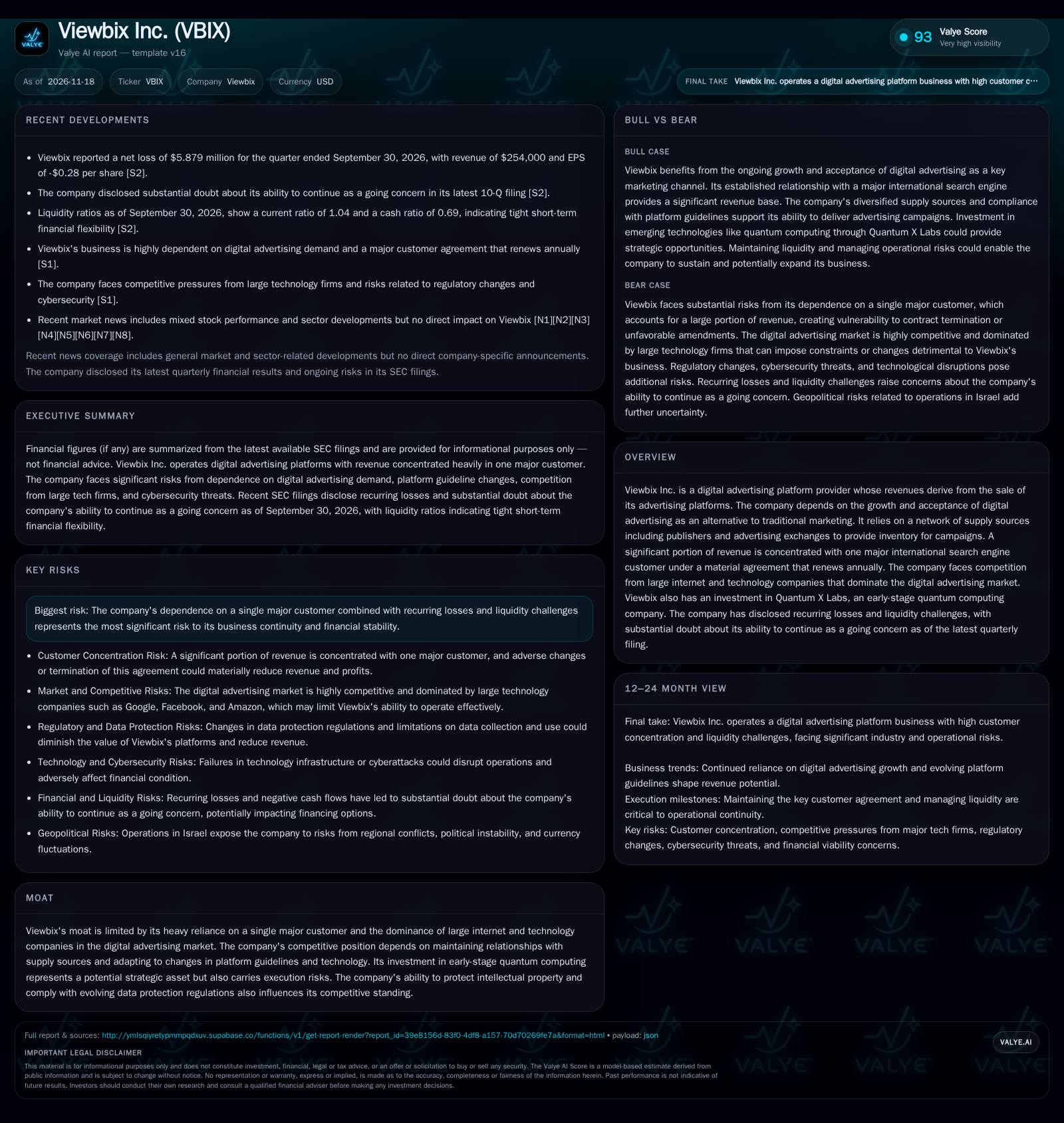
Viewbix Inc.'s business model is under significant strain from its reliance on one customer for the vast majority of revenue, ongoing net losses, and limited cash resources. The company’s annual contract renewal cycle with its largest customer, intense competition from digital advertising leaders, and mounting regulatory and technology risks create a narrow margin for error. Strategic decisions around diversification, cost structure, and capital access will determine whether Viewbix can survive and adapt in a rapidly evolving market landscape. [S2]
Viewbix Inc. stands at a crossroads where its economic survival is threatened by two interlocking pressures: overwhelming revenue dependence on a single major customer and persistent, deep operating losses. The company’s digital advertising platform operates in a fiercely competitive market dominated by large technology firms, while regulatory and technical risks further erode visibility. With cash and equivalents barely exceeding current liabilities and a going-concern warning flagged, the next 12 months will test whether Viewbix can retain its crucial customer, adapt its platform, and secure new capital—or whether the business model will succumb to structural fragility. [S2]
Liquidity Squeeze and Revenue Concentration Define Immediate Risk
Viewbix Inc.’s Q3 2026 financials reveal a company in acute distress, reporting just $254,000 in revenue against a net loss of $5.879 million. The company’s cash and equivalents stood at $2.373 million, with a current ratio of 1.04 and a cash ratio of 0.69 as of September 30, 2026. These metrics prompted management to disclose substantial doubt about the company’s ability to continue as a going concern. [S2]
The existential risk is compounded by extreme customer concentration: approximately 81% of 2025 revenues came from a single major international search engine customer, under an agreement that renews annually. Any disruption, renegotiation, or non-renewal of this contract could immediately jeopardize operational viability. [S1]
Platform Revenue Model Under Pressure: High Fixed Costs, Low Bargaining Power
Viewbix generates revenue from the sale of its digital advertising platforms, sourcing ad inventory from publishers, exchanges, and social networks. The platform’s economics are shaped by the spread between what advertisers pay and what is remitted to inventory suppliers, with margins highly sensitive to volume and mix.
In theory, digital ad platforms can achieve attractive operating leverage if they scale, as technology infrastructure and compliance costs are largely fixed. However, Viewbix’s ongoing losses suggest that either gross margins are thin, scale is insufficient, or customer acquisition costs are high relative to revenue. The company’s dependence on a single customer diminishes its pricing power and negotiating leverage, likely forcing it to accept terms that favor the customer rather than the platform provider.
The company reported cash and liquidity metrics for the period; these figures do not by themselves establish operating runway, investment capacity, financial flexibility, or financing capacity. Without a diversified customer base or self-sustaining unit economics, the company’s business model remains highly vulnerable to shocks.
Dominance of Digital Giants and Platform Dependency Erode Strategic Flexibility
Viewbix operates in a digital advertising ecosystem dominated by global technology platforms such as Google, Facebook, and Amazon. These incumbents control not only the largest pools of ad inventory but also the underlying data, targeting technologies, and regulatory relationships.
Viewbix’s ability to access supply sources—publishers, exchanges, and social networks—is ultimately subject to the policies, fee structures, and technical integrations dictated by these larger players. Frequent updates to operating systems, browsers, and platform guidelines can disrupt Viewbix’s service delivery or require costly compliance work, eroding any cost or feature advantage.
Barriers to switching for advertisers are typically low in digital advertising, making differentiation difficult unless tied to proprietary inventory, unique data sets, or exclusive customer relationships. Viewbix’s single-customer concentration highlights a lack of defensible moat, while its small scale limits its ability to absorb regulatory or technical shocks compared to its much larger competitors.
Diversification and Platform Innovation Could Unlock Stability—If Executed Swiftly
A favorable outcome for Viewbix would require a multi-pronged turnaround: the company retains and potentially expands its contract with the major customer, while successfully acquiring new clients to reduce revenue concentration. This could be driven by enhancements to the core platform—such as improved targeting, analytics, or integration with emerging ad formats—that deliver measurable ROI to advertisers.
If Viewbix can demonstrate a shift toward positive unit economics (e.g., gross margin expansion, reduced customer acquisition cost, or higher advertiser retention), investors might regain confidence, enabling the company to raise capital on less dilutive terms. Progress in leveraging its Quantum X Labs investment—such as quantum-powered ad optimization or unique analytics—could provide a long-term differentiator, though this remains speculative.
Concrete evidence of new customer wins, margin improvement, or renewal of the major contract on favorable terms would support this scenario.
Tenuous Continuity Hinges on Contract Renewal and Cost Discipline
The most plausible near-term scenario is one of fragile stability: Viewbix manages to renew its critical customer contract for another cycle, but revenue remains heavily concentrated and insufficient to offset ongoing losses. Cost-cutting and working capital discipline become paramount to extend the operating runway, with limited resources available for growth investment.
In this scenario, the company’s ability to secure incremental capital—through equity or convertible debt—becomes a recurring necessity, likely at increasingly dilutive terms. The absence of meaningful customer diversification or a step-change in platform differentiation keeps the business highly exposed to customer renegotiation, regulatory shifts, or platform policy updates.
Evidence confirming this trajectory would include another annual renewal of the major contract, continued net losses, and small-scale capital raises accompanied by minimal revenue diversification.
Contract Loss or Platform Disruption Could Trigger Rapid Business Unraveling
The adverse scenario is triggered by the non-renewal of the major customer agreement or a sharp reduction in spending due to external shocks (platform policy changes, regulatory restrictions, or geopolitical events). Given that over 80% of revenue is at stake, such an event would likely force immediate restructuring, staff reductions, or even insolvency if new capital cannot be raised quickly.
Other plausible triggers include a cyberattack or major technology failure that disrupts platform operations, or a regulatory change (such as new privacy mandates) that reduces the effectiveness of data-driven advertising and erodes the value proposition for advertisers.
Confirmation of this scenario would come from public disclosure of contract non-renewal, a sudden collapse in quarterly revenue, or emergency measures such as bankruptcy protection filings or going-concern updates indicating imminent liquidity exhaustion.
Milestones and Metrics That Will Determine Viewbix’s Next Chapter
Annual renewal status and disclosed terms of the material agreement with the major international search engine customer—any deviation in timing or language would be a leading indicator of risk or stability.
Quarterly customer concentration: A shift in the percentage of revenue from the major customer versus new customer additions would help test the company’s diversification efforts.
Gross margin trends—if disclosed—would indicate whether platform economics are improving or eroding.
Quarterly net cash flow and cash balance: Persistent negative cash flow or rapid cash burn will foreshadow capital needs.
Capital-raising events: Frequency, size, and terms of new financings will show if dilution risk is escalating.
Product/technology updates: Evidence of new platform features, integrations, or adoption of advanced analytics would suggest strategic progress.
Regulatory and platform policy developments: Any public changes to data privacy, ad targeting, or supply access that directly affect Viewbix’s operating model.
Any material developments or monetization from the Quantum X Labs investment, which could provide non-core upside but is not currently a revenue driver.
Disclaimer: This is research-only, informational analysis and not investment advice. It may include AI-generated interpretation and general industry context. Always verify important details using primary sources.

Comments