
D.R. Horton’s 2026 Results: Housing Cycles, Mortgage Dependence, and Capital Strategy
D.R. Horton reported $33.04 billion in 2026 revenue and a 19% cancellation rate for home sales contracts, underscoring the sensitivity of its homebuilding and mortgage operations to macroeconomic shifts.
D.R. Horton’s 2026 earnings show both scale-driven resilience and exposure to cyclical housing volatility. The company’s performance remains tightly linked to mortgage availability, buyer sentiment, and capital market conditions. Recent moves to increase dividends and repurchase shares highlight capital strength, but softening demand and elevated contract cancellations warrant close attention to the sustainability of margins and closings as market conditions evolve. [S1] [N6] [N8]
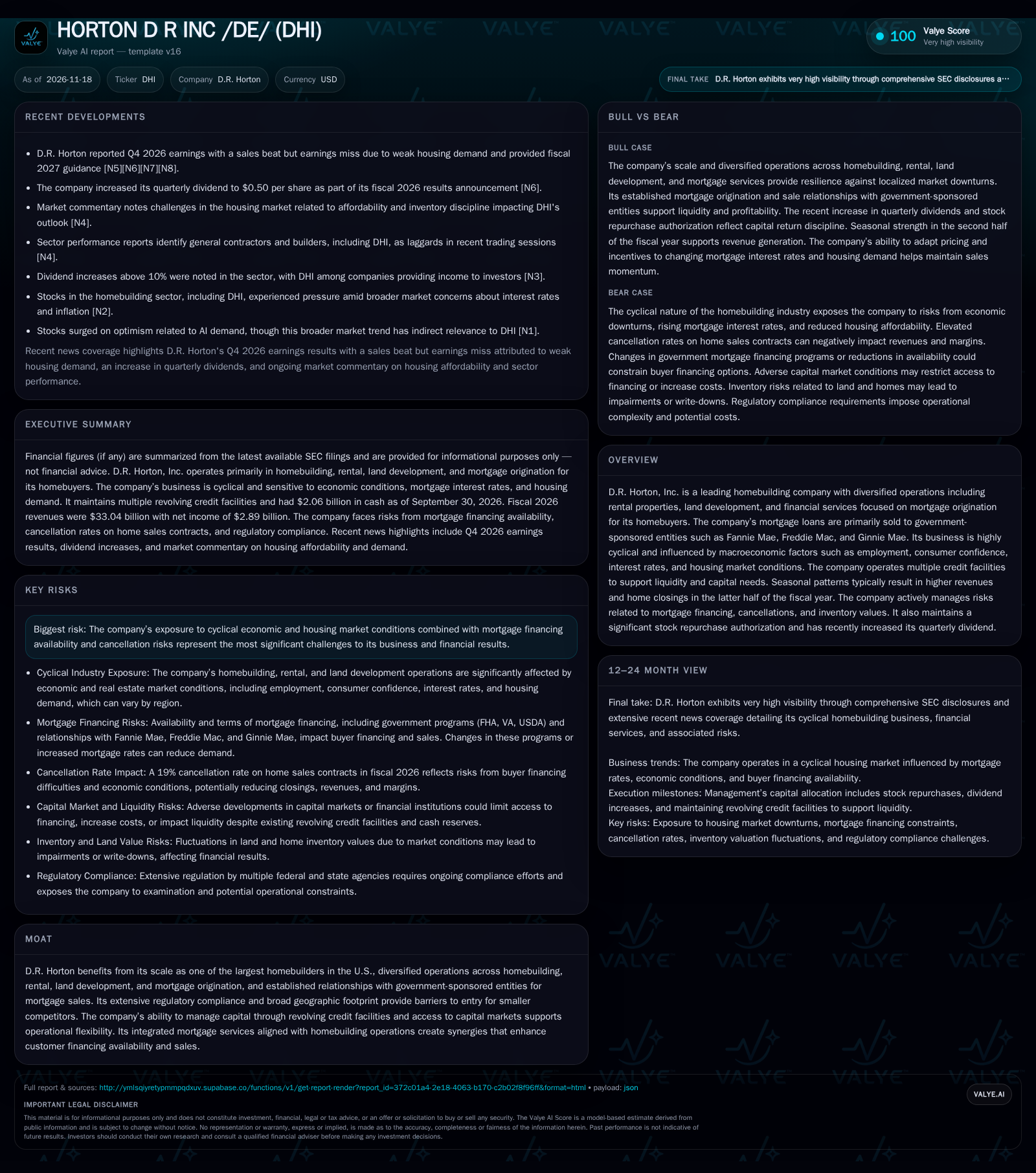
D.R. Horton, America’s largest homebuilder, closed fiscal 2026 with $33.04 billion in revenue and $2.89 billion in net income, reinforcing its leadership in a sector buffeted by economic cycles. The company’s results highlight both the resilience provided by scale and diversification—spanning homebuilding, rentals, land development, and mortgage origination—and the persistent vulnerability to shifts in mortgage rates, buyer confidence, and housing affordability. Recent increases in dividends and buyback capacity suggest management’s confidence in capital strength, but a 19% contract cancellation rate and a softening demand backdrop point to the ongoing risks facing the business as macroeconomic uncertainty lingers. [S1] [N6] [N8]
2026 Performance Snapshot: Revenue Growth Confronts Demand Challenges
D.R. Horton reported $33.04 billion in revenue and $2.89 billion in net income for fiscal 2026, translating to diluted EPS of $10.11. The company ended the period with $2.06 billion in cash and cash equivalents, and maintained access to multiple revolving credit facilities. While sales volumes beat expectations in Q4 2026, earnings came in below consensus due to weaker housing demand and affordability pressures, as evidenced by a 19% cancellation rate on home sales contracts. The cited source reports dividend-related activity; that disclosure alone does not establish dividend-policy continuity, management confidence, or a material constraint on capital flexibility. [S1] [N6] [N8]
D.R. Horton’s Integrated Model: Profit Drivers and Vulnerabilities
D.R. Horton’s economics are built on high-volume, diversified homebuilding supplemented by land development, rental operations, and a tightly integrated mortgage origination business. Revenue is primarily driven by home sales, with the company leveraging its scale to manage costs, negotiate with suppliers, and spread fixed overhead. The mortgage subsidiary originates loans for most homebuyers and sells approximately 78% of these to government-sponsored entities (GSEs) such as Fannie Mae and Freddie Mac, providing liquidity and reducing balance-sheet risk. This model supports operating leverage in strong demand environments, but exposes margins to swings in housing affordability, interest rates, and GSE policy changes.
The company’s ability to adjust pricing and incentives in response to market shifts helps sustain volume, but at the risk of compressing gross margins. Rental and land development segments diversify income streams and may cushion downturns, yet are ultimately tied to underlying real estate values and demand cycles. D.R. Horton’s capital needs are significant, given land acquisition, development, and inventory build, but are partly offset by access to sizable revolving credit facilities and capital markets. The combination of dividend increases and buybacks suggests management believes current cash flows are robust, but persistent high cancellation rates and softening demand could strain economics if conditions worsen.
The interplay between D.R. Horton’s mortgage origination and homebuilding segments creates a feedback loop that can amplify both growth and risk. When mortgage rates are favorable and GSE policies supportive, the origination unit not only facilitates buyer financing but also generates fee income and liquidity through loan sales. However, this integration means that shifts in credit availability or investor appetite for mortgage-backed securities can directly affect the volume and profitability of both segments. For example, a contraction in secondary market demand for mortgage loans could force the company to hold more loans on its balance sheet, increasing capital requirements and interest expense, thereby compressing margins across the enterprise.
Additionally, D.R. Horton’s land acquisition strategy is inherently cyclical and capital intensive, requiring careful timing and forecasting. The company must balance the risk of overpaying or accumulating excess inventory against the benefits of securing prime development sites ahead of competitors. This dynamic is particularly sensitive to regional economic conditions and regulatory environments, which can vary widely across markets. Consequently, the company’s ability to dynamically allocate capital and adjust land inventories in response to shifting demand patterns is a critical determinant of its medium-term profitability and resilience to downturns.
Competitive Strengths Rooted in Scale, Integration, and GSE Relationships
D.R. Horton’s advantages stem from its national scale, geographic diversification, and vertically integrated model—including direct mortgage origination and land development. These attributes provide bargaining power with suppliers, better absorption of fixed costs, and a broader platform to deploy capital and adapt to regional market changes. Its established relationships with GSEs facilitate efficient mortgage sales, supporting buyer financing and home closings.
However, these strengths do not eliminate risk. Large public homebuilders face competition from other national firms, regional builders, and, in some markets, institutional investors in single-family rentals. Substitution risk arises from multifamily rentals and, if affordability deteriorates, from alternative housing options. Regulatory burdens and compliance costs are higher for large operators. While D.R. Horton’s size and credit access provide resilience, the industry’s cyclicality and reliance on government mortgage programs remain shared vulnerabilities among major peers.
Recovery Scenario: Affordability Improves, Demand Strengthens, and Capital Returns Rise
In a favorable scenario, mortgage rates stabilize or decline, improving affordability and reigniting buyer demand—especially among entry-level and move-up segments. D.R. Horton leverages its scale to capture outsized share as competitors with weaker balance sheets pull back. The company’s integrated mortgage platform expedites closings and maintains high loan sale volumes to GSEs, further supporting liquidity and inventory turns.
Improved demand reduces cancellation rates below the current 19%, while pricing power and operating leverage drive margin recovery. Capital returns accelerate, with increased buybacks and potential further dividend hikes. Confirmation would come from sequential reductions in contract cancellations, rising backlog, higher average selling prices, and sustained or growing home closing volumes, even as industry data show rebounding affordability and consumer confidence.
Base Scenario: Navigating Macro Volatility with Consistent Closings and Margin Headwinds
The most plausible path is one of continued macroeconomic volatility. Mortgage rates remain elevated but not worsening, and D.R. Horton maintains sales volumes via aggressive incentives and localized pricing adjustments. Cancellation rates hover near current levels, and the company’s diversified operations offset regional softness. Margins remain under pressure from affordability constraints, but cost discipline and supply chain management prevent severe deterioration.
Evidence for this scenario would be stable (but not growing) home closing volumes, persistently high but not escalating cancellation rates, and moderate dividend or buyback activity. Industry data would show flat or only modestly improving affordability, with no major policy shocks to GSE programs.
Downside Scenario: Extended Affordability Issues and Mortgage Constraints Deepen Slowdown
If mortgage rates rise further or government mortgage program support is curtailed, affordability could deteriorate to levels that materially depress demand. Cancellation rates increase beyond the current 19%, backlog erodes, and inventory build-up leads to price cuts or write-downs. D.R. Horton’s home closings decline across key regions, straining operating leverage and compressing margins.
The company’s mortgage origination business faces higher default rates and reduced loan sale profitability. Confirmation would be found in consecutive quarters of declining sales and earnings, rising inventory days, upward-trending cancellation rates, and negative commentary on access to mortgage financing in industry and company disclosures.
Key Developments Shaping D.R. Horton’s Financial and Operational Stability
Quarterly home sales contract cancellation rate: persistent elevation or improvement would be a leading indicator of demand health and execution risk.
Sequential trends in home closing volumes and backlog: rising volumes or backlog would suggest demand stabilization or recovery; declines would signal further pressure.
Average selling price (ASP) movement and gross margin trends: stable or rising ASP and margins would confirm pricing power; declines could indicate discounting or overhang.
Credit facility utilization and liquidity disclosures: monitoring drawdowns or changes in revolver terms would help assess potential financial flexibility under stress.
Changes in mortgage origination mix and loan sale profitability: shifts away from GSE-eligible loans or reduced gain-on-sale margins would highlight emerging financial services risk.
Inventory and land impairment charges: new or increasing impairments would suggest deteriorating real estate market conditions.
Regulatory or policy changes affecting FHA, VA, USDA, or GSE programs: any announced or enacted changes could quickly alter the operating environment and buyer financing landscape.
Disclaimer: This is research-only, informational analysis and not investment advice. It may include AI-generated interpretation and general industry context. Always verify important details using primary sources.

Comments