
China Pharma Holdings: Strategic Shifts and Market Pressures in Branded Generics
China Pharma Holdings faces acute liquidity pressure and ongoing net losses, even as it seeks to expand its product base with a new dry eye device. The company’s dependence on a small distributor network and exposure to government price controls highlight both the potential and the severe limitations of its branded generics strategy in China.
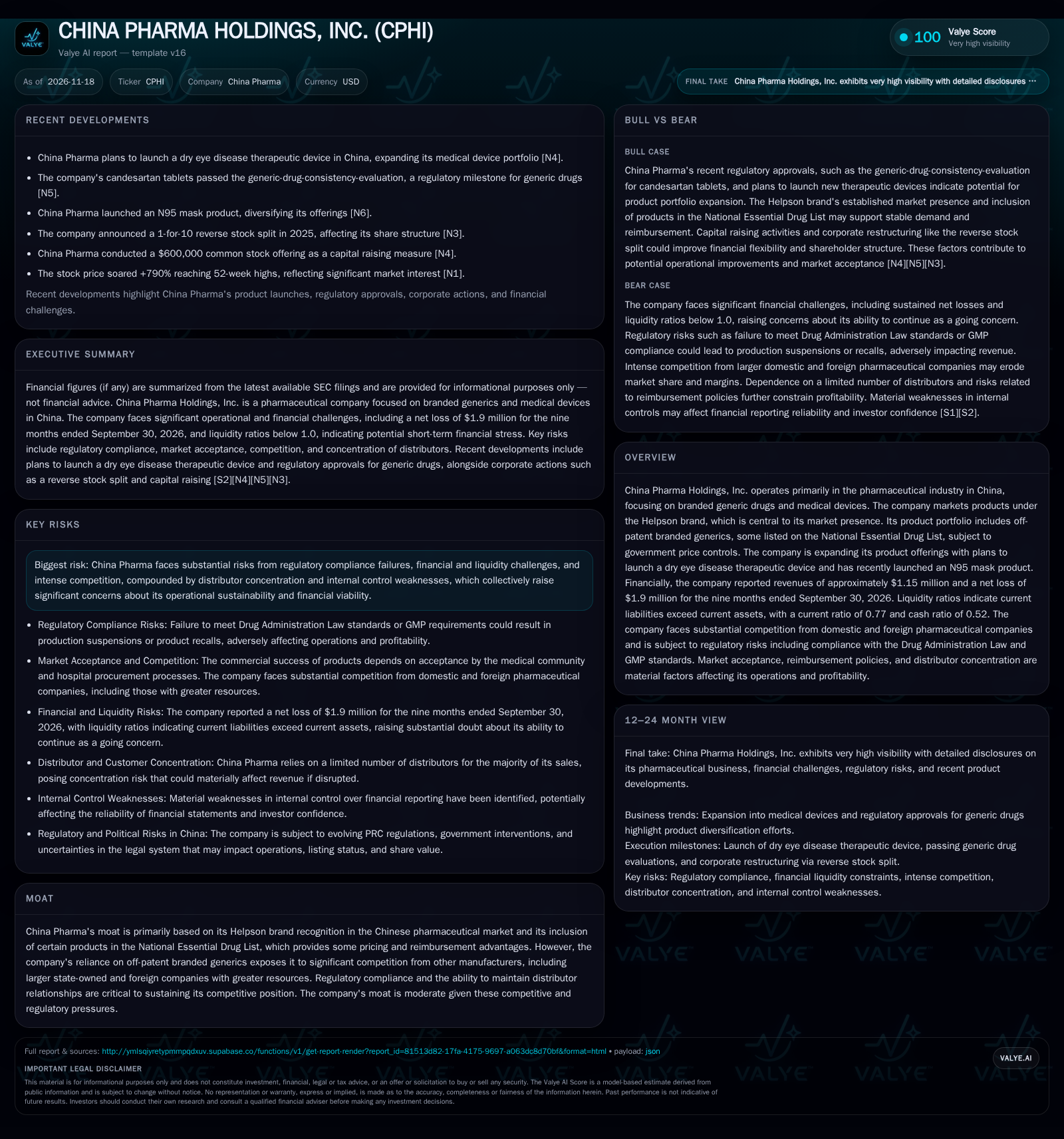
China Pharma Holdings is battling substantial financial distress, with current liabilities outstripping assets and a net loss for the year. While the company is attempting to diversify into medical devices and has leveraged its Helpson brand, competitive and regulatory headwinds—compounded by distributor concentration and internal control weaknesses—cast doubt on operational sustainability. The success of a new dry eye device launch and any improvement in working capital will be critical to reshaping the outlook.
China Pharma Holdings stands at a precarious inflection point. The company’s latest filings reveal a combination of shrinking liquidity, persistent losses, and an urgent need for strategic adaptation. While management has taken visible steps to address these challenges—including a reverse split, capital raise, and an announced entry into the therapeutic device market—core risks around distributor dependence, regulatory compliance, and the economics of branded generics remain unresolved. The coming quarters will test whether China Pharma can stabilize its financial base and prove the commercial value of its new initiatives, or whether structural headwinds will prove insurmountable.
Current Environment Marked by Liquidity Pressures and Strategic Adjustments
China Pharma Holdings is confronting acute liquidity constraints: as of September 30, 2026, the company reported $3.68 million in cash and equivalents, current assets of $5.39 million, and current liabilities of $7.03 million, yielding a current ratio of 0.77 and a cash ratio of 0.52—both well below what is generally considered safe for ongoing operations. The company posted $1.15 million in revenue and a net loss of $1.9 million for the first nine months of 2026, underscoring persistent operating losses [S2].
Recent actions—such as a $600,000 capital raise and a 1-for-10 reverse stock split—signal management's recognition of urgent financial stress and a need to comply with listing requirements [N3] [N4]. Meanwhile, the planned launch of a dry eye disease therapeutic device marks a notable attempt to diversify the company's product mix and potentially tap new revenue streams [N4]. These developments matter because they are both a reaction to existential financial pressure and an attempt to reposition the business amid persistent headwinds.
Branded Generics Pose Challenges to Unit Profitability
China Pharma’s core business revolves around branded generics and select medical devices, with the Helpson brand providing some degree of market recognition. Off-patent generics, especially those on the National Essential Drug List (EDL), are subject to government price controls, which compress margins and limit pricing power. The company’s cost structure is likely characterized by high fixed costs (manufacturing, compliance, R&D for new device initiatives) and variable costs tied to distribution and raw materials. Because of EDL price caps, volume is the primary lever for revenue growth, but any scale benefits are blunted by intense competition and procurement processes that favor the lowest cost.
The planned dry eye disease therapeutic device could offer a differentiated, potentially higher-margin revenue stream—assuming successful market entry and reimbursement. However, device commercialization in China entails regulatory hurdles and significant upfront investment, with uncertain adoption rates. Persistent net losses and the recent capital raise suggest that China Pharma’s operating leverage is currently negative: incremental revenues are not sufficient to cover fixed costs, and the company has little flexibility to absorb further shocks without additional funding [S2] [N4].
Market Leadership Concentrated Among Large-Scale Competitors Amid Policy Changes
China Pharma competes in a landscape crowded with domestic state-owned enterprises and foreign multinationals—many of which have far greater resources, broader product portfolios, and established relationships with hospital procurement systems. The company’s moat is modest and rooted mainly in brand recognition via Helpson and the inclusion of select products on the EDL, which can support volume but not necessarily profitability.
A critical vulnerability is China Pharma’s reliance on a limited number of distributors for the bulk of its revenue, raising concentration risk. Should a major distributor defect or lose access to hospital tenders, revenue could decline sharply [S1]. Additionally, government procurement policies and the hospital bidding process often prioritize price over brand, eroding any premium the company might command. New device launches offer a possible route to differentiation, but larger players are better equipped to navigate regulatory, reimbursement, and marketing hurdles.
Growth Opportunities in Devices and Distribution May Alter Outlook
A favorable scenario would see China Pharma successfully launching and scaling its dry eye disease therapeutic device, achieving rapid adoption among ophthalmologists and inclusion in hospital procurement lists. If the device can command premium pricing or secure reimbursement outside the EDL framework, it could materially improve gross margins and diversify revenue beyond the structurally challenged generics business.
Further upside would come if the company reduces distributor concentration—either by expanding its network or by building direct sales channels—thereby mitigating key revenue risks. Evidence confirming this scenario would include: regulatory approval and strong early uptake of the device (as indicated by sales growth in device segments, if disclosed); a shift in revenue mix toward higher-margin products; and visible expansion or diversification of distribution relationships.
Outlook Depends on Moderate Device Adoption and Enhanced Cost Efficiency
The most plausible near-term outcome is one of ongoing operational fragility. The company may succeed in launching the dry eye device, but adoption could be slow, limited by regulatory bottlenecks, reimbursement delays, or entrenched competition. Branded generics will likely continue to generate the bulk of revenue, constrained by price controls and competitive bidding.
Cost containment and incremental improvement in working capital management could help China Pharma avoid acute insolvency, but the company will remain dependent on periodic capital raises to fund operations. Confirmation would come from stable or slightly growing quarterly sales, marginally improved net loss figures, and the absence of further material distributor losses. Falsification would be evident in continued cash burn, further declines in revenue, or erosion of distributor relationships.
Risks Increase with Possible Distributor Losses and Regulatory Hurdles
A negative turn could result from the defection of a major distributor, a failed device launch, or regulatory non-compliance leading to production suspensions. Any of these events would likely precipitate a sharp drop in revenue, exacerbating liquidity problems and potentially forcing asset sales, deeper restructuring, or even delisting.
Additional stress could arise from further tightening of government price controls or reimbursement restrictions, which would compress margins to unsustainable levels. Evidence supporting this scenario would include a sudden drop in reported sales, loss of distribution partners, increased regulatory warnings or fines, and disclosure of further going-concern risks.
Key Developments Will Determine China Pharma’s Capacity for Adaptation
Progress toward regulatory approval and commercial launch of the dry eye disease therapeutic device, including any disclosed early sales figures or hospital procurement wins.
Changes in distributor concentration—specifically, whether the company can diversify its channel mix or secure new distribution agreements.
Quarterly revenue growth or contraction, particularly shifts in product mix between generics and new device offerings.
Gross margin trends, especially if the device segment is rolled out and reported separately, which would indicate pricing power and cost discipline.
Updates on internal control remediation efforts, as improvements here could restore some investor confidence and reduce operational risk.
Any additional capital raising or restructuring activities, which would signal ongoing liquidity pressure or, conversely, improved access to funding.
Disclosure of regulatory warnings, production suspensions, or product recalls, which could immediately impact operational continuity.
Disclaimer: This is research-only, informational analysis and not investment advice. It may include AI-generated interpretation and general industry context. Always verify important details using primary sources.

Comments