
EACO CORP: Strong Earnings and Asset Base, but Cash Constraints Raise Strategic Questions
The company's lack of disclosed business segmentation or explicit industry focus leaves the durability and drivers of its profitability open to interpretation, especially against a backdrop of macroeconomic volatility.
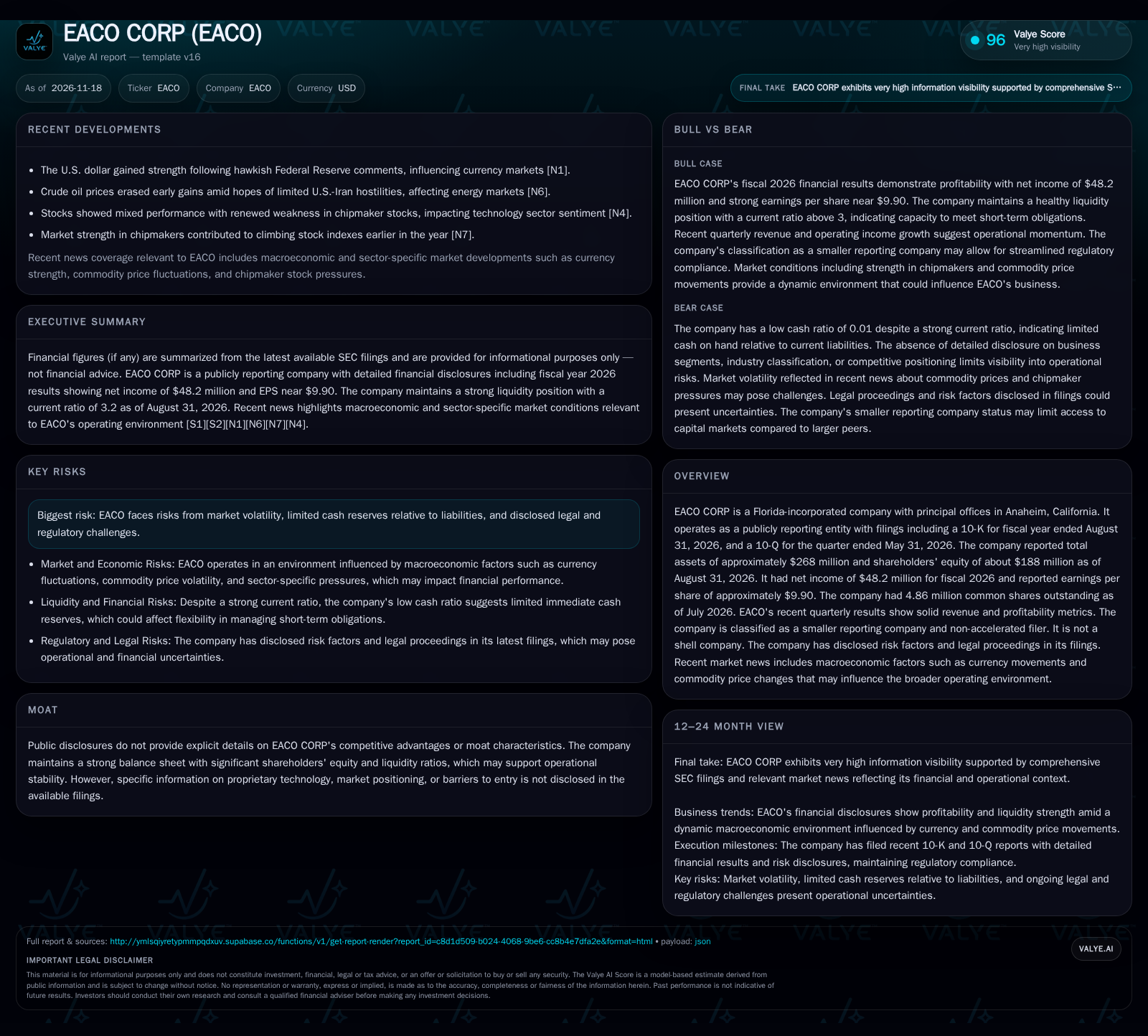
EACO CORP reported $48.2 million in net income for fiscal 2026 and maintains $188.5 million in shareholders’ equity, but its cash and cash equivalents stand at just $647,000 as of August 31, 2026. The company’s ability to convert accounting strength into sustained growth or resilience remains a central issue for investors. [S1] [S2]
EACO CORP stands out for its reported profitability and robust balance sheet, with $48.2 million in net income for fiscal 2026 and nearly $189 million in shareholders’ equity. Without explicit disclosure of its industry, business segments, or operational model, investors must weigh the implications of these financial metrics in an environment shaped by macroeconomic volatility and unresolved legal risks.
Financial Results Reveal Contrasting Strengths and Weaknesses
EACO CORP reported $48.2 million in net income and basic earnings per share of $9.90 for fiscal 2026, indicating substantial profitability relative to its share count of approximately 4.86 million. As of August 31, 2026, shareholders’ equity stood at $188.5 million, supported by total assets of $268 million. However, the company’s cash and cash equivalents were just $647,000, resulting in a cash ratio of 0.01 despite a current ratio of 3.2. This presents a picture of considerable accounting strength and operational profitability, but also a potential constraint on immediate financial agility, especially if the company faces liquidity needs or market shocks. The lack of long-term debt as of May 31, 2026, reduces financial risk from leverage but may also reflect a conservative or under-leveraged capital structure. Recent filings highlight legal proceedings and risk factors, adding layers of uncertainty that could become material if adverse outcomes arise. [S1] [S2]
The juxtaposition of strong shareholder equity and minimal cash reserves raises important questions about EACO’s capital allocation strategy.A reported cash ratio, despite a reported current ratio, may suggest that a significant portion of current assets is tied up in less liquid forms such as inventory or receivables. This composition can constrain the company’s ability to respond swiftly to unexpected expenses or investment opportunities. Moreover, the absence of long-term debt reduces financial risk but may limit the company’s capacity to leverage debt financing for growth or to buffer against cyclical downturns. The interplay between asset liquidity and capital structure is thus a critical dimension for evaluating EACO’s financial resilience.
Interpreting Profitability Amid Unclear Revenue Streams
EACO’s strong net income and reported current ratio suggest a business model capable of generating significant operating profits, but the absence of disclosed business segments or industry focus limits visibility into the underlying economic engine. Without details on whether EACO’s revenues are derived from manufacturing, distribution, services, or another activity, it is difficult to parse the mix of fixed versus variable costs or the degree of operating leverage. The company’s gross margin of $115.0 million on $371.1 million in net sales for the nine months ended May 31, 2026, implies a gross margin percentage slightly above 30%, which could reflect either value-added operations or distribution of higher-margin goods.
This could indicate either a deliberate inventory-heavy strategy (possibly to support customer service or bulk purchasing) or slow receivables collection, both of which carry different risks and capital needs. If EACO operates in a low-margin, high-volume sector, such as distribution, its ability to manage inventory cycles and credit terms becomes central to sustaining profitability. Conversely, if the company’s earnings are driven by higher-margin, project-based work, the timing of cash flows and contract structure would be critical to assess.
Understanding the nature of EACO’s cost structure is essential to assess the sustainability of its profitability. If fixed costs constitute a large portion of total expenses, the company may benefit disproportionately from incremental revenue growth through operating leverage, but also face higher risk during revenue contractions. Conversely, a predominantly variable cost base would imply greater flexibility but potentially lower margin expansion potential. Additionally, the company’s working capital management practices—such as inventory turnover rates and receivables collection efficiency—directly impact cash flow generation and financing needs. Without segment disclosures, investors must consider how these operational variables interact to influence EACO’s earnings quality and growth prospects.
Opaque Market Position Leaves Competitive Dynamics Unclear
With no explicit disclosure of business segments, product lines, or industry, EACO’s competitive landscape is not directly defined in the available reports. If the company is engaged in wholesale distribution, as its asset structure might suggest, its competitors could include regional and national distributors, potentially facing pressure from both suppliers and customers on pricing and terms. In such a scenario, scale, logistics capabilities, and supplier relationships would be key sources of advantage, but these are not established in the filings.
Alternatively, if EACO operates in a specialized manufacturing or service niche, proprietary know-how, customer switching costs, or regulatory barriers could provide a moat. However, the lack of disclosed intellectual property, brand assets, or recurring-revenue models in the public filings means these characteristics cannot be confirmed. The company’s status as a smaller reporting company may indicate a focus on niche or regional markets rather than national scale, which could limit exposure to larger, well-capitalized competitors but also cap growth opportunities.
The lack of transparency into EACO’s market positioning complicates the assessment of its competitive advantages and barriers to entry. If the company operates in a commoditized industry with low differentiation, competitive pressures could compress margins and necessitate continuous investment in cost reduction or scale economies. Alternatively, if EACO’s business model involves specialized products, proprietary processes, or unique customer relationships, these factors could create sustainable moats that support pricing power and customer retention. Evaluating the company’s potential for innovation, customer concentration risk, and exposure to regulatory changes would also be important to understand its long-term competitive dynamics.
Unlocking Value Through Improved Working Capital Efficiency or Asset Monetization
A favorable outcome for EACO would arise if it can convert its robust asset base and reported profitability into stronger operating cash flows and greater potential financial flexibility. If EACO is able to grow revenue without a commensurate increase in working capital needs, operating leverage could drive further margin expansion.
Confirmation of this scenario would come from future filings showing: (1) higher cash and cash equivalents relative to current liabilities, (2) improved operating cash flow, and (3) stable or rising gross and operating margins. Disclosure of business segment performance, recurring customer contracts, or successful entry into higher-margin businesses would further reinforce this thesis. Conversely, continued low liquidity or increased reliance on short-term financing would undermine the upside case.
Sustained Profitability with Ongoing Liquidity Management Challenges
This scenario would be confirmed by steady net income and gross margins in future filings, coupled with a consistently low or only modestly reported liquidity-ratio trends. If EACO continues to avoid long-term debt and manages to fund operations internally, it could maintain operational stability, but the absence of industry-leading potential financial flexibility would keep it reliant on stable market conditions and effective execution. Any new disclosure clarifying the company’s business model or segment economics would help refine this base view.
Liquidity Shortfalls Amplify Risk in Volatile Markets
This risk would be confirmed by filings showing negative operating cash flow, rising short-term borrowings, or disclosures of delayed payments to suppliers and creditors. A deterioration in gross or operating margins, or the crystallization of legal liabilities, would further pressure the company’s financial position. Lack of transparency on core operations or segment results would compound investor uncertainty in this scenario.
Factors That Will Define EACO’s Long-Term Value Creation
Trends in cash and cash equivalents relative to current liabilities—future filings showing improvement would support the thesis of increasing financial agility.
Operating cash flow generation and its alignment (or divergence) from reported net income—if disclosed—would clarify the quality of earnings.
Inventory turnover and accounts receivable collection periods—a useful metric would be disclosed working capital metrics or turnover ratios.
Any new disclosure of business segments, industry classification, or revenue by product/service line would help test the company’s underlying economic model.
Updates on legal proceedings, contingent liabilities, or risk factor developments in SEC filings could materially shift the risk profile.
Gross and operating margin trends in future periods—sustained or improving margins would support the case for durable profitability.
Evidence of new or expanded credit facilities, or changes in financing structure, would illuminate management’s approach to liquidity and growth.
Disclaimer: This is research-only, informational analysis and not investment advice. It may include AI-generated interpretation and general industry context. Always verify important details using primary sources.

Comments