
Forestar Group: Strategic Leverage and Risk in the D.R. Horton Orbit
Forestar’s deep integration with D.R. Horton delivers stable demand and operating scale, but also constrains independence and exposes the company to amplified risks from housing market cycles, supply chain pressures, and concentrated customer exposure. Recent financials show strength, but the sustainability of margins and growth will hinge on macro conditions and Forestar’s ability to manage inventory and diversify its customer base.
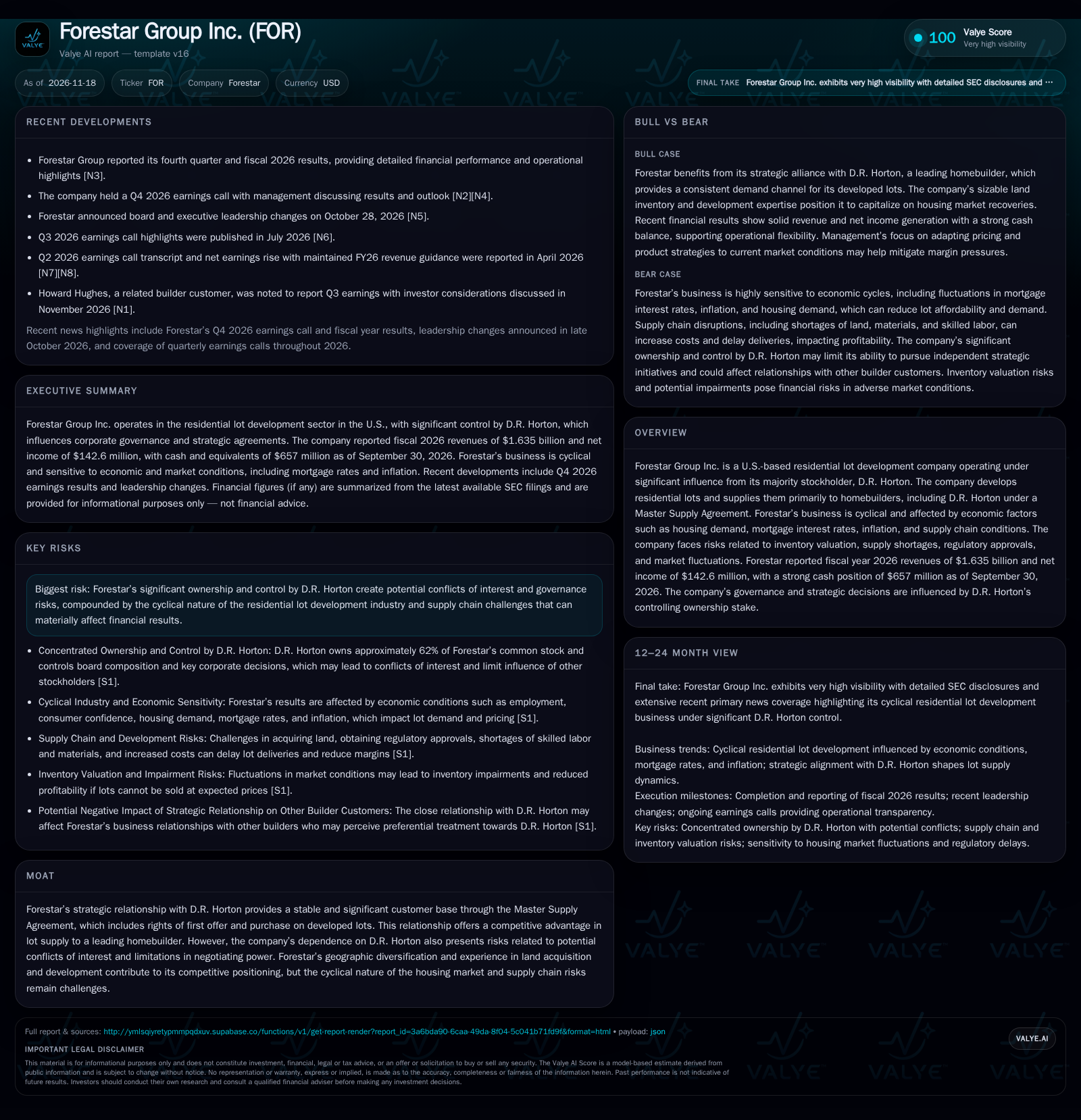
Forestar reported FY26 revenues of $1.635 billion and net income of $142.6 million, with a reported cash position and a Master Supply Agreement underpinning lot sales to D.R. Horton [S1]. The company’s fortunes are closely tied to U.S. housing cycles and D.R. Horton’s priorities, raising both opportunity and risk. Inventory valuation, supply chain disruptions, and limited strategic autonomy are material watchpoints.
Forestar Group stands at a unique intersection in the U.S. residential lot development industry: it is both a scale operator and a quasi-captive supplier, thanks to the controlling ownership and purchasing power of D.R. Horton. As the housing cycle turns and supply chain pressures persist, the company’s future performance will depend on how it navigates these intertwined benefits and constraints.
Recent Financial Performance and Strategic Dependency Define the Landscape
The company reported cash and liquidity metrics for the period; these figures do not by themselves establish operating runway, investment capacity, financial flexibility, or financing capacity. [S1] D.R. Horton’s approximately 62% ownership gives it effective control over Forestar’s board and major strategic decisions, cementing a Master Supply Agreement that grants D.R. Horton rights of first offer and purchase on developed lots [S1]. This deep integration shapes both the opportunity set and the risks: while it secures a reliable demand channel, it also constrains Forestar’s autonomy and may influence its dealings with other homebuilders.
Lot Development Economics: Fixed Costs, Cyclicality, and the Leverage of Scale
Forestar’s core business—acquiring, entitling, developing, and selling residential lots—features high upfront land and development costs, with returns realized only as lots are sold to homebuilders. The company’s economics are fundamentally volume-driven: higher lot sales and development activity spread fixed costs over more units, boosting margins in upcycles. Pricing is influenced by regional housing demand, local competition, and broader macro factors such as interest rates and consumer confidence. The Master Supply Agreement with D.R. Horton likely provides some visibility and volume stability, but the terms are set at market rates, which means Forestar’s margins can still be pressured in downturns or competitive markets.
Variable costs—including land development, regulatory approvals, and construction inputs—can rise rapidly in periods of supply chain stress or labor shortages.
The capital-intensive nature of lot development imposes a significant barrier to entry, but also means that Forestar must carefully balance investment timing with market demand to avoid liquidity strain. If interest rates rise, the cost of financing land acquisitions and development projects increases, potentially compressing returns unless offset by higher lot prices or volumes. Moreover, regulatory environments vary widely by region, affecting entitlement timelines and costs; thus, Forestar's ability to navigate local land use policies and community engagement processes becomes critical. Efficient project sequencing and cost control can mitigate some cyclicality, but the inherent lag between land purchase and lot sale exposes the company to market shifts that can quickly erode projected margins.
Structural Advantages and the Limits of Captivity
Forestar’s principal advantage is its preferred-supplier status to D.R. Horton, the nation’s largest homebuilder, which ensures a steady baseline of demand and reduces sales risk. This relationship can support scale efficiencies and potentially favorable access to land acquisition opportunities. Geographic diversification and long-standing development expertise further strengthen its position relative to smaller or less integrated lot developers.
However, this captive dynamic also introduces vulnerabilities. Other large homebuilders may be reluctant to engage with Forestar, perceiving the D.R. Horton relationship as a source of competitive disadvantage or potential conflict. This could limit Forestar’s ability to diversify its customer base, making it more exposed to D.R. Horton’s own cycles and strategic priorities. Alternative lot suppliers—including independent land developers, integrated homebuilders with in-house land teams, and regional players—offer substitutes, particularly in attractive or high-growth markets. The cyclical and fragmented nature of land development means barriers to entry are not insurmountable, and local market conditions can shift rapidly.
Forestar’s integration with D.R. Horton provides scale benefits, but the captive relationship may limit its strategic agility. For instance, if D.R. Horton adjusts its geographic focus or product mix, Forestar may need to realign its land portfolio accordingly, potentially incurring repositioning costs or foregoing opportunities in emerging markets. Additionally, the perception of Forestar as primarily a D.R. Horton supplier could deter other homebuilders from engaging, reducing competitive tension that might otherwise drive innovation or pricing flexibility. In markets where multiple lot developers compete, Forestar’s ability to leverage data analytics, optimize land acquisition strategies, and improve operational efficiency will be crucial to maintaining cost leadership and defending market share against both integrated homebuilders and independent developers.
Housing Recovery and Execution Unlock Margin Expansion
A favorable scenario for Forestar would see U.S. housing demand accelerate, supported by declining mortgage rates, improved consumer confidence, and demographic tailwinds. In this environment, D.R. Horton’s continued expansion would translate into higher lot absorption, allowing Forestar to increase volumes and potentially command better pricing on its developed lots. If supply chain pressures ease and regulatory approvals become more predictable, development timelines could shorten, further boosting returns on invested capital.
Operational leverage would be significant in this scenario: fixed land and development costs would be spread over greater unit sales, driving margin expansion. Forestar’s sizable cash balance could enable opportunistic land acquisitions or accelerated development in high-demand regions, compounding growth. Evidence supporting this trajectory would include sustained increases in lot sales volumes, stable or rising average selling prices, margin improvement, and positive commentary from D.R. Horton on continued lot needs. A rise in non–D.R. Horton customer share would further validate Forestar’s broader market appeal.
Enduring Cyclicality, Steady Volumes, and Margin Vigilance
The most plausible path is that Forestar continues to operate as a scaled, efficient lot developer with moderate growth, closely aligned to D.R. Horton’s needs and the broader housing cycle. Revenues and margins may fluctuate with macro conditions—such as interest rates and housing affordability—but the Master Supply Agreement provides a demand floor. Inventory risk remains, especially in markets facing oversupply or regulatory bottlenecks, but management’s ability to match lot development pacing with builder demand could mitigate major impairments.
Margins remain in a historical range, with periodic cost pressures offset by scale and operational discipline. Confirmation would come from stable quarterly revenues, consistent lot deliveries, and absence of significant inventory write-downs. Any meaningful change in the mix of customers—especially if non–D.R. Horton sales rise—would indicate a shift in the risk/reward profile.
Housing Downturn and Inventory Impairments Erode Returns
A negative scenario would unfold if U.S. housing demand declines sharply due to rising mortgage rates, economic slowdown, or persistent inflation. In this environment, D.R. Horton may scale back lot purchases, leaving Forestar with excess inventory and low lot absorption. Supply chain disruptions or regulatory delays could further slow development and increase holding costs, heightening the risk of inventory impairments.
Falling lot values would force Forestar to take write-downs, directly impacting net income and potentially eroding equity if prolonged. The company’s reliance on D.R. Horton would become a liability if the latter shifts strategy, consolidates lot sourcing, or renegotiates contract terms. Evidence of this downside would include declining revenues, margin compression, rising inventory balances, impairment charges, and negative revisions to lot delivery or revenue guidance.
Signals That Will Test Forestar’s Resilience and Strategic Latitude
Quarterly lot delivery volumes and average selling prices: Persistent growth or contraction would be the clearest indicator of demand and pricing power.
Inventory balances and any disclosed impairments: Rising unsold lots or material write-downs would signal demand weakness or misjudged development pacing.
Proportion of sales to D.R. Horton versus other builders: A shift toward greater customer diversification would reduce concentration risk and test Forestar’s broader market competitiveness.
Gross margin trends: Sustained margin expansion or contraction, if disclosed, would reveal the net impact of pricing, costs, and operational leverage.
Land acquisition costs and development timelines: Escalating costs or delays due to supply chain or regulatory factors could pressure returns.
Management commentary on housing market outlook and D.R. Horton’s lot needs: These qualitative signals will clarify visibility on forward demand.
Board or executive changes: Further leadership transitions could foreshadow shifts in strategy or risk appetite.
Disclaimer: This is research-only, informational analysis and not investment advice. It may include AI-generated interpretation and general industry context. Always verify important details using primary sources.

Comments