
Clearthink 1 Acquisition Corp.: The Clock Starts on a Financial Services SPAC with Experienced Hands but No Target
Clearthink 1 Acquisition Corp. enters the SPAC landscape with a sizable trust account and a management team steeped in financial services, but as yet, no identified acquisition target. The pathway from cash shell to value creation will depend on sourcing a compelling deal before the 2027 deadline, leveraging management’s network, and navigating inherent sector and SPAC risks.
Clearthink 1 Acquisition Corp. (CTAA) is a newly formed SPAC focused on acquiring a high-growth financial services company. Backed by $125 million in trust and led by a seasoned management team, CTAA has until November 2027 to identify and close a deal or return capital to shareholders. The absence of a current target leaves execution risk high, with the ultimate outcome hinging on management’s ability to source, negotiate, and consummate an attractive business combination in a competitive SPAC environment. [S1] [S2]
Clearthink 1 Acquisition Corp. (CTAA) exemplifies the current generation of sector-focused SPACs, combining a substantial trust account with a management team anchored in financial services expertise. With $125 million raised and a clearly defined mandate to seek high-growth opportunities in the sector, CTAA’s future now hinges on its ability to translate potential financial flexibility and industry relationships into a successful business combination before the November 2027 deadline. The absence of a current target injects real execution risk, but also preserves optionality as management scans a dynamic landscape for the right opportunity.
Where Clearthink 1 Acquisition Corp. Stands Now: Capital, Mandate, and the Search for a Deal
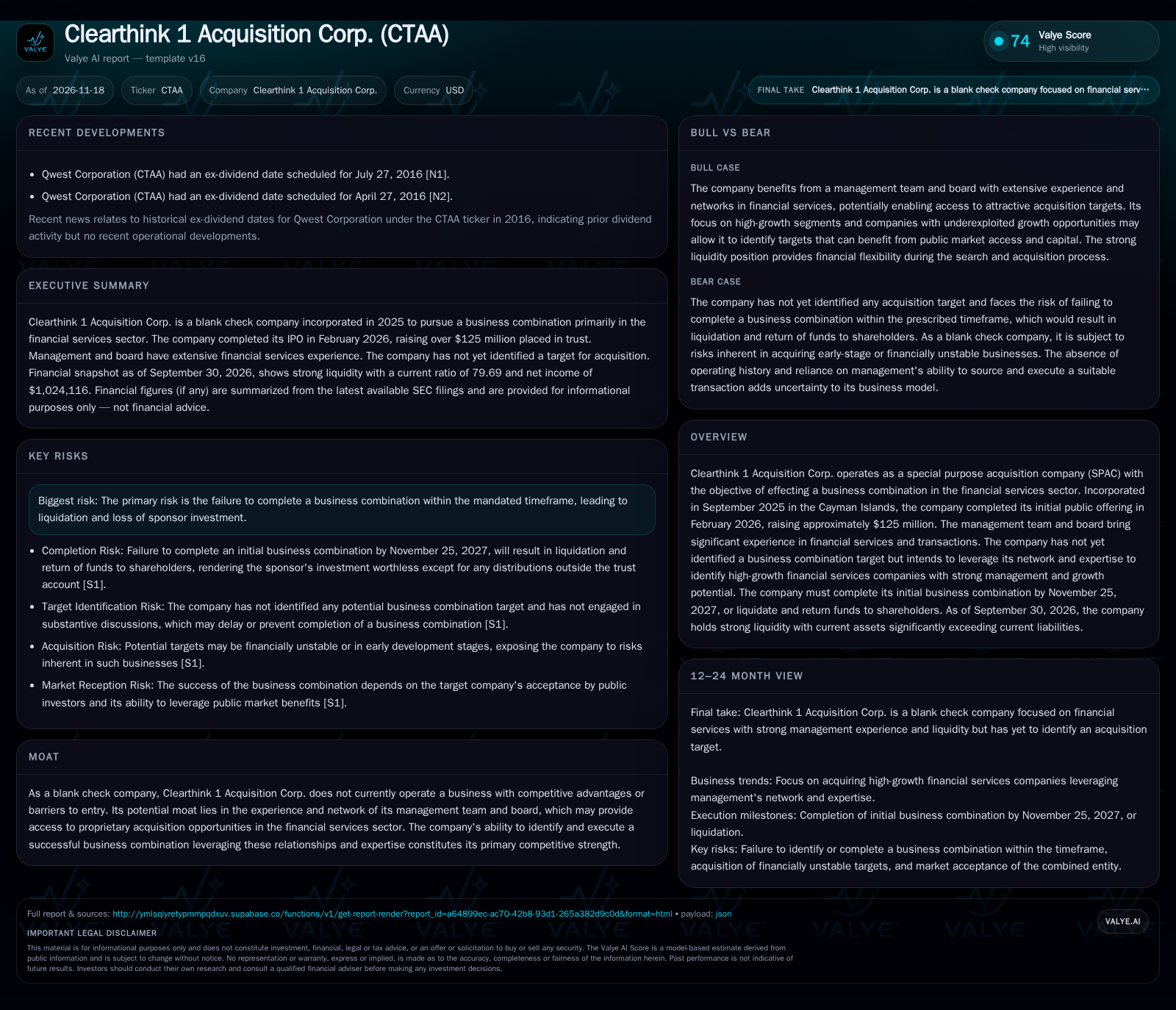
Clearthink 1 Acquisition Corp. is a blank check company incorporated in September 2025 and completed its IPO in February 2026, raising approximately $125.15 million alongside $3.15 million from a private placement, all held in trust. As of September 30, 2026, the company reported current assets of $1,441,982 and current liabilities of $18,096, resulting in a current ratio of 79.69. The company has not identified any business combination target and has not engaged in substantive discussions with potential targets. The management team, led by CEO William Brock and CFO Thomas Zipser, brings extensive financial services experience. CTAA’s operating window closes on November 25, 2027, at which point, if no deal is completed, the company will liquidate and return funds to shareholders. [S1] [S2]
The company reported cash and liquidity metrics for the period; these figures do not by themselves establish operating runway, investment capacity, financial flexibility, or financing capacity. The large pool of capital is available, but the absence of a target means the company is still at the starting gate, and the clock is ticking toward a hard deadline.
SPAC Economics: How Value Is Created (or Lost) in the Blank Check Model
A SPAC like CTAA generates value by identifying, acquiring, and transitioning a private company—typically one that is high-growth or underexploited—into a public market vehicle. The money is not made through operations, but rather through the accretive impact of a successful deal: the acquired business gains access to public capital and a listed currency, while existing SPAC shareholders and sponsors benefit from any uplift in the combined entity’s value.
The economics hinge on deal quality, structure, and post-merger performance. Sponsors typically receive founder shares or warrants that magnify returns if a deal succeeds, but become worthless in liquidation. The trust account, while substantial, is essentially held in escrow for shareholders and cannot be used for operations or investment until a deal is closed. Expenses incurred pre-deal are usually covered by sponsor capital or minor interest income.
Operating leverage only materializes post-combination if the acquired company has scalable economics. Until then, fixed costs are minimal by design. However, the timing and structure of the acquisition—purchase price, use of proceeds, dilution from redemptions or PIPE financing—will determine whether value creation accrues to public shareholders, sponsors, or the acquired business’s legacy owners. If redemptions are high or the target is overvalued, the economics can quickly turn unattractive.
Access, Networks, and the Realities of the SPAC Competitive Set
Clearthink 1 Acquisition Corp. operates in a crowded and competitive SPAC market, particularly in the financial services sector, which has seen substantial sponsor and investor interest. The main differentiator for CTAA is its management team’s experience and network within financial services—a resource that could provide proprietary access to attractive, off-market deals. However, this is a potential rather than a proven advantage until a specific transaction is sourced.
Competition comes not only from other SPACs, but also from private equity, venture capital, and strategic buyers all targeting high-growth financial services businesses. Many targets now have multiple suitors, driving up valuations and compressing the window for due diligence. Additionally, the recent wave of SPACs has led to some deal fatigue among both targets and investors, increasing selectivity and scrutiny at the time of merger announcement and de-SPAC process.
Substitute mechanisms, such as direct listings or traditional IPOs, remain available to high-quality targets, putting further pressure on SPAC sponsors to offer compelling terms and demonstrate value beyond just capital.
If the Right Target Emerges: Leveraging Expertise for a Value-Accretive Combination
The upside scenario for CTAA is predicated on leveraging its management’s network to source a proprietary or underappreciated financial services target with strong growth prospects, operational strengths, and a clear rationale for going public via SPAC. In this scenario, the deal is structured to minimize shareholder redemptions and dilution, perhaps supported by a PIPE investment or strategic partnership.
Execution would require identifying a target with scalable economics and a differentiated business model—such as a fintech, specialty lender, or asset-light platform—where public market access and sponsor expertise accelerate growth or unlock operational improvements. Confirmation of this scenario would come from the announcement of a high-quality, well-received merger with low redemption rates, strong PIPE participation (if disclosed), and favorable market reaction. Early signs would also include management commentary on proprietary sourcing and the presence of respected co-investors.
Most Likely Outcome: A Competitive Search and Conventional Deal Dynamics
The most plausible path for CTAA is a competitive search process, where management reviews a broad array of potential targets and ultimately negotiates a business combination with a mid-tier financial services company. The deal may not be proprietary, and valuation could be pressured by competitive bidding or the need to close within the SPAC’s time window.
This scenario would likely involve some degree of shareholder redemptions, potentially requiring additional PIPE capital or revised terms to ensure deal completion. The success of the post-combination entity would then hinge on its operational execution and investor appetite for the sector at the time of closing. Evidence confirming this scenario would include a deal announcement with standard SPAC terms, moderate redemption rates (if disclosed), and a transaction rationale focused on sector growth or platform synergies.
How Failure to Find a Target or a Poor-Quality Deal Could Destroy Value
The principal risk for CTAA is the inability to identify and close a suitable business combination before the November 2027 deadline, resulting in liquidation and the return of trust capital to public shareholders. In this outcome, sponsors lose their at-risk capital and any upside from founder shares or warrants. Public shareholders are made whole on their trust proceeds, but lose any optionality on a deal premium.
A related risk is the pursuit of a marginal or overvalued target under time pressure, leading to high redemptions, dilution, or a de-SPAC that is poorly received by the market. This could result in value destruction for both sponsors and public shareholders, especially if the acquired business underperforms or faces post-merger operational challenges. Confirmation of this downside would include repeated extensions without a deal, a last-minute or controversial target, or a transaction with high redemptions and tepid market response.
Milestones That Will Determine Whether CTAA Can Deliver on Its SPAC Promise
Announcement of a letter of intent or definitive agreement for a business combination—timing, target profile, and sector relevance will be crucial.
Level of shareholder redemptions at the time of deal approval and closing, if disclosed, as high redemptions can undermine transaction economics.
PIPE (private investment in public equity) participation or other external financing commitments accompanying the deal, if disclosed.
Quality and track record of the target company's management team, as well as their rationale for choosing the SPAC route.
Valuation multiples relative to comparable public companies and recent SPAC transactions in the financial services sector.
Any extensions to the SPAC’s 2027 deadline or changes in deal structure that signal challenges in sourcing or completing a transaction.
Market and investor reaction post-announcement, including share price movement and analyst/investor commentary.
Evidence of proprietary sourcing advantage or unique access enabled by the sponsor’s network, if described in transaction materials.
Disclaimer: This is research-only, informational analysis and not investment advice. It may include AI-generated interpretation and general industry context. Always verify important details using primary sources.

Comments