
Sonos: Platform Expansion, Competitive Tensions, and the Levers for Sustainable Audio Ecosystem Value
Sonos exits a period of net losses with renewed profitability, product innovation, and platform upgrades—but faces persistent threats from deep-pocketed rivals, supply chain volatility, and the fragility of premium consumer discretionary demand.
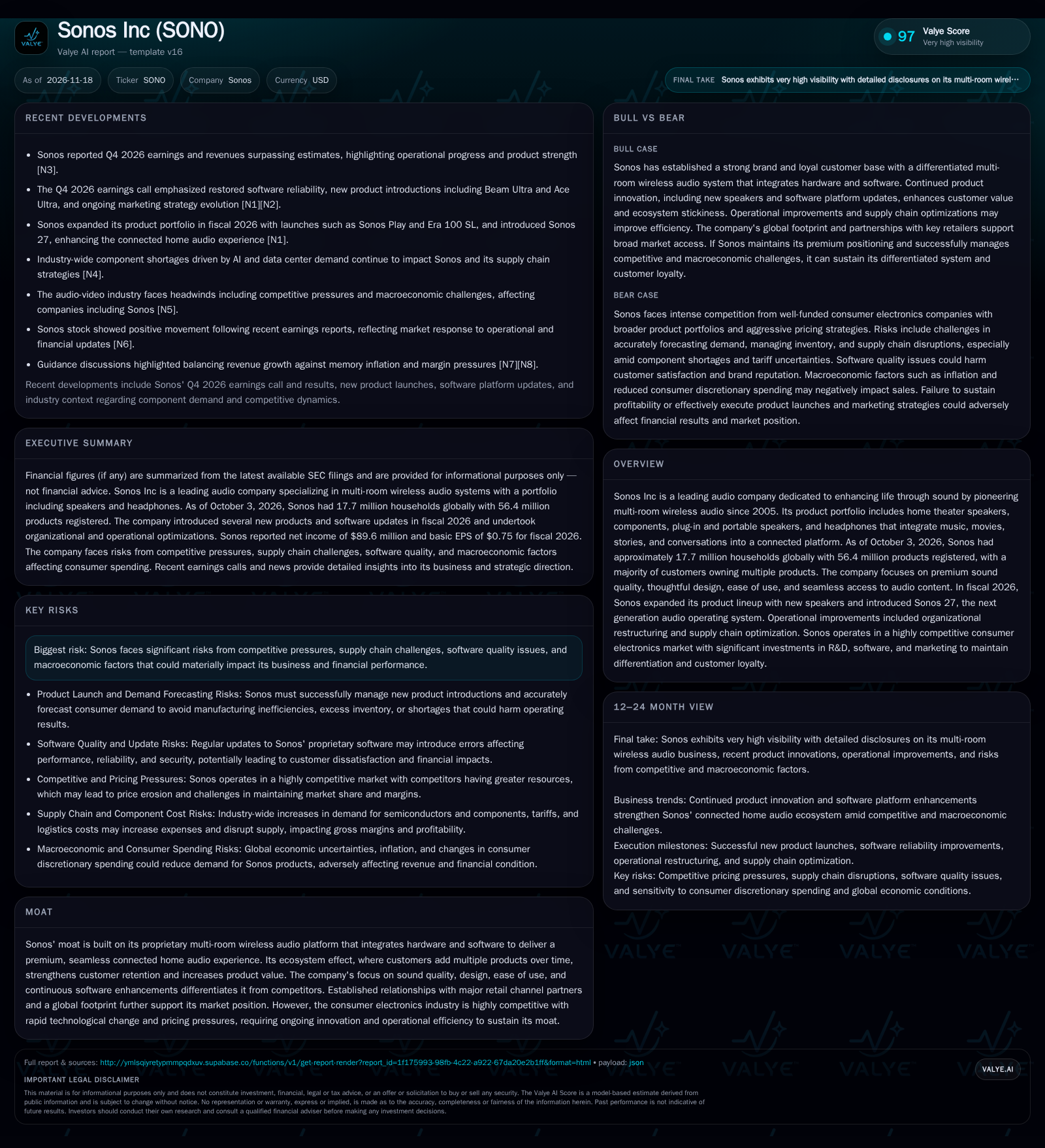
Sonos achieved a return to profitability in fiscal 2026, driven by new product launches, software platform upgrades, and operational restructuring. The company's differentiated multi-room audio ecosystem now spans 17.7 million global households, but it remains exposed to competitive pricing, macroeconomic pressures, and supply chain constraints. The path forward hinges on sustained product innovation, software reliability, and the ability to defend its premium system economics against larger consumer electronics players and market volatility. [S1] [N3]
Sonos enters fiscal 2027 with renewed momentum, having restored profitability after years of losses and expanded its installed base with both hardware and software innovations. The company’s multi-room audio platform, now present in 17.7 million households, demonstrates strong customer stickiness—yet Sonos’ premium positioning is constantly tested by aggressive competition, supply chain disruptions, and the unpredictable tides of global consumer spending. The next phase will test whether operational improvements and platform differentiation can sustain growth and margin resilience in an industry notorious for rapid commoditization and margin compression. [S1] [N3]
Profitability Returns Amid Product Expansion and Operational Restructuring
Sonos reported net income of $89.6 million and basic EPS of $0.75 for fiscal 2026, marking a significant turnaround from previous years of net losses and reducing its accumulated deficit to $22.5 million. This profitability coincided with a wave of new product introductions—including the Beam Ultra, Ace Ultra, and the Sonos 27 audio operating system—which collectively aim to enhance the value and differentiation of the Sonos platform. The company’s global installed base now stands at 17.7 million households, with 62% of those owning multiple Sonos products, signaling robust ecosystem engagement and cross-sell potential. Operationally, Sonos undertook a major corporate restructuring and exited a contract manufacturing partnership in 2026 to improve supply chain efficiency and cost structure. Together, these shifts position Sonos to compete on both innovation and operational execution, but expose it to the dual risks of execution missteps and intensifying external pressures. [S1] [N1] [N3]
How Sonos Monetizes Its Ecosystem: Hardware-Driven Revenue, Margin Levers, and the Role of Software
Sonos’ revenue model remains anchored in hardware sales—primarily all-in-one speakers and home theater soundbars—supplemented by a growing portfolio of headphones and portable devices. The company’s economics are characterized by a high degree of operating leverage: significant upfront investment in R&D, software development, and marketing is spread across a global installed base, while incremental hardware sales can drive meaningful margin expansion if fixed costs are controlled. The multi-product ownership rate (62% of households with more than one Sonos device) suggests that customer lifetime value is enhanced by ecosystem lock-in and network effects, as each additional device increases the utility and stickiness of the platform.
Sonos’ gross margins are sensitive to input costs—particularly semiconductors and key audio components—while its premium pricing strategy is constantly challenged by discounting and aggressive competition. The company’s proprietary software (Sonos 27 and ongoing platform updates) is central to both differentiation and ongoing engagement, but does not appear to generate direct recurring software revenue at this stage. Instead, software serves as a retention and upsell engine, supporting hardware sales and periodic device upgrades.
Capital requirements are moderate relative to traditional hardware manufacturing, as Sonos leverages contract manufacturing and focuses internal resources on design, software, and customer experience. The company’s supply chain optimizations and restructuring efforts in 2026 may reduce working capital needs and improve margin resilience, but the long-term sustainability of its economics will depend on maintaining product innovation, pricing discipline, and the perceived value of its tightly integrated ecosystem.
Defending Differentiation in a Crowded and Aggressive Consumer Audio Market
Sonos operates in a hyper-competitive environment, facing direct and indirect competition from consumer electronics giants such as Bose, Samsung (including Harman, Denon, JBL), Sony, Bang & Olufsen, Apple, Google, and Amazon. Many of these rivals have broader product portfolios, greater resources, and the ability to cross-subsidize audio hardware to drive ecosystem adoption for their own platforms (e.g., smart home, streaming, or voice assistants).
Sonos’ primary defense is its proprietary multi-room audio platform, which integrates hardware and software to deliver a seamless, high-quality experience. The company’s ecosystem approach—whereby customers add multiple devices over time—creates switching frictions and enhances retention, but these advantages are vulnerable to technological leapfrogging, commoditization, and aggressive price competition. Channel partners such as Best Buy and Amazon remain critical for distribution, but also pose risks if partners prioritize their own branded products or pursue margin-dilutive promotions.
The pace of innovation is a double-edged sword: while frequent product and software launches can reinforce differentiation, they also increase execution risk and require sustained investment. Sonos’ focus on software reliability and platform cohesion is essential, as any major misstep in updates or user experience could erode brand equity and open the door to defections—especially as rivals continue to improve their own wireless audio offerings.
Ecosystem Lock-In, Product Innovation, and Margin Expansion Drive Outperformance
A favorable outcome for Sonos would see the company leveraging its installed base and high multi-product ownership rate to accelerate cross-selling and periodic upgrades, driving both volume growth and higher average revenue per household. Continued product innovation—exemplified by the successful launches of Beam Ultra, Ace Ultra, and Sonos 27—could reinforce brand loyalty and differentiate Sonos from lower-priced alternatives. If operational restructuring and supply chain optimizations yield sustained margin improvements, Sonos could expand profitability even in a challenging macro environment.
This scenario would be confirmed by evidence such as: consistently rising average products per household; successful adoption and positive reception of new hardware and software releases; stable or expanding gross margins despite input cost pressures; and continued net income growth. Additional support would come from channel expansion, broadening geographic reach, and demonstrable gains in customer retention metrics (if disclosed).
The upside would be further validated if Sonos is able to introduce value-added software services or subscription features that generate incremental recurring revenue, deepening ecosystem lock-in and reducing reliance on episodic device sales.
Margin Stability and Modest Growth Amid Competitive and Macro Pressures
The most plausible near-term trajectory for Sonos is a continuation of modest growth in its installed base, supported by incremental product innovation and ongoing software updates. Revenue is likely to remain concentrated in hardware sales, with periodic spikes around major product launches and key retail promotions. Gross margins may fluctuate in response to component cost volatility and competitive pricing, but operational improvements and restructuring should provide some buffer against margin erosion.
In this scenario, Sonos maintains profitability but at levels sensitive to macroeconomic headwinds—such as inflation, tariffs, and consumer discretionary weakness—that can dampen demand for premium audio products. The company’s ecosystem stickiness cushions against sharp declines, but growth rates may be constrained by saturation in core markets and intensifying competition from both legacy audio brands and tech platform players.
Confirmation would come from stable or slightly increasing net income, a steady average number of products per household, and evidence that software platform reliability is maintained (as reflected in customer satisfaction or support metrics, if disclosed). Signs of pressure would include margin compression, inventory build-ups, or a slowdown in new product adoption.
Competitive Price Wars, Supply Chain Disruptions, and Software Missteps Erode Value
A negative scenario would unfold if Sonos is unable to defend its premium pricing in the face of aggressive discounting and feature catch-up from larger rivals. If competitors succeed in commoditizing multi-room audio or bundling similar functionality into broader smart home ecosystems, Sonos could face material market share loss and margin compression.
Additional downside risk stems from supply chain disruptions—such as ongoing component shortages, memory inflation, or logistics bottlenecks—that could result in inventory imbalances, delayed product launches, or higher input costs not fully passed through to consumers. Software quality issues or failed updates to the Sonos platform could trigger customer dissatisfaction, negative reviews, and increased returns, amplifying reputational risk.
This scenario would be confirmed by a decline in net income or a return to net losses, shrinking gross margins, rising inventory levels, or evidence of declining multi-product household penetration. Early warning signs could include negative channel feedback, deteriorating customer satisfaction, or significant product launch delays.
Milestones That Will Determine the Durability of Sonos’ Audio Ecosystem Advantage
Average number of Sonos products per household—a rising figure would reinforce ecosystem lock-in, while stagnation or decline could signal competitive leakage or market saturation (if disclosed).
Gross margin trends in the face of component cost inflation and competitive pricing pressures; sustained improvement would confirm operational leverage, while compression would indicate vulnerability.
Adoption rates and customer satisfaction for newly launched products (Beam Ultra, Ace Ultra, Sonos 27); strong uptake and positive feedback would validate innovation strategy.
Inventory levels and days sales of inventory—unexpected build-ups could point to demand mis-forecasting or supply chain stress.
Recurring revenue or software attachment rates, if Sonos introduces paid services or subscriptions—this would signal successful monetization beyond hardware.
Channel partner mix and concentration, especially the revenue share attributable to Best Buy and Amazon; increasing reliance or changes in partner strategy could impact margins and demand visibility.
Net income and EPS trends over the next several quarters—sustained profitability would provide confidence in the turnaround, while a reversal would raise questions about structural resilience.
Disclaimer: This is research-only, informational analysis and not investment advice. It may include AI-generated interpretation and general industry context. Always verify important details using primary sources.

Comments