
Envela Corp: Managing Luxury Recommerce Dynamics with Reported Liquidity Position and Strategic Focus
With a controlled ownership structure and exposure to shifting consumer preferences, the company’s future hinges on its ability to manage risk, authenticate value, and outmaneuver larger competitors in a rapidly evolving luxury and precious metals market.
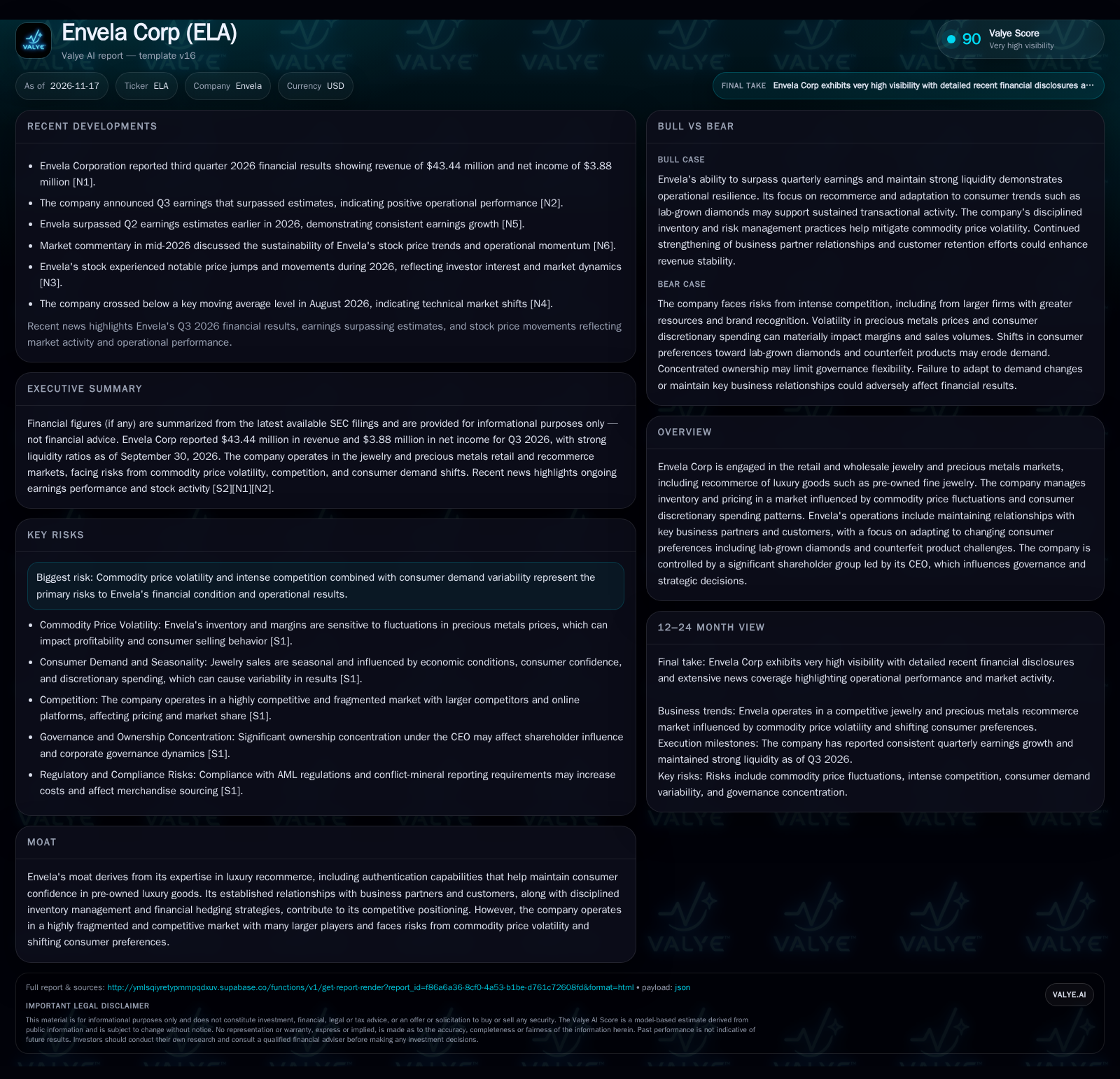
Envela Corp reported solid Q3 2026 results, with $43.44 million in revenue and $3.88 million in net income, while maintaining a strong current and cash ratio. The company’s positioning in luxury recommerce and precious metals retail offers opportunities for margin capture, but exposes it to commodity price swings, evolving consumer trends (including lab-grown diamonds), and intense competition from larger and online-focused peers. Ownership concentration and governance dynamics add another layer of risk and potential strategic inflexibility. The outlook depends on Envela’s ability to maintain trust in pre-owned luxury, manage inventory risks, and adapt to a changing retail landscape. [S2] [S1]
Envela Corp’s latest quarterly results showcase a company at the intersection of luxury recommerce, precious metals trading, and evolving consumer tastes. Yet, beneath the headline numbers lie meaningful risks: commodity price swings, the rise of lab-grown diamonds, and market share battles with larger, tech-enabled rivals. The company’s concentrated governance structure both enables rapid decision-making and raises questions about adaptability and alignment. The real test for Envela will be whether its authentication expertise, inventory management, and capital discipline can translate into sustained value as the luxury market transforms. [S2] [S1]
Robust Financial Results Amid Evolving Market Conditions
Envela Corp reported $43.44 million in revenue and $3.88 million in net income for the quarter ended September 30, 2026, translating to $0.15 in basic and diluted EPS [S2]. This marks the second consecutive quarter of earnings outperformance, suggesting operational strength and effective cost management [N2] [N5]. The company reported cash and liquidity metrics for the period; these figures do not by themselves establish operating runway, investment capacity, financial flexibility, or financing capacity. [S2]
These results matter in light of Envela’s exposure to commodity price volatility, discretionary spending cycles, and shifting consumer preferences—including the rise of lab-grown diamonds and the risk from counterfeit luxury goods [S1]. The company’s ability to outperform in this environment highlights its operational discipline but does not insulate it from sector headwinds or structural challenges in the luxury and precious metals markets.
Moreover, liquidity must be balanced against capital allocation decisions, such as investments in authentication technology or digital sales platforms, which could enhance competitive positioning but also increase short-term cash burn.
Envela’s Approach to Turning Inventory and Customer Confidence into Profits
Envela’s business model is built on sourcing, authenticating, and reselling pre-owned luxury goods and precious metals, alongside traditional retail and wholesale jewelry sales. Revenue is driven by inventory turnover, pricing spreads between acquisition and sale, and the ability to reliably authenticate and market high-value items. Margins are inherently volatile, as gross profit is sensitive to commodity price swings, competitive pricing pressure, and the cost of authentication and inventory management.
Fixed costs are present in the form of retail infrastructure, staff, and compliance, but the business remains relatively working-capital intensive due to the need to fund inventory. This creates both upside—when inventory values rise with commodity prices or consumer demand—and downside risk if prices fall or inventory becomes obsolete. Operating leverage can be favorable during high-demand periods, but the risk of overstocking or mispricing inventory is ever-present.
The sensitivity of Envela’s margins to commodity price fluctuations underscores the importance of dynamic pricing strategies and inventory hedging mechanisms. If the company can implement real-time market data analytics and predictive modeling, it may better anticipate price trends and adjust acquisition or sales timing accordingly, thereby mitigating margin erosion. Additionally, the cost structure’s fixed component implies that scaling revenue without proportional increases in fixed costs could improve operating leverage. However, this is conditional on maintaining inventory turnover rates that prevent capital lock-up and obsolescence. The balance between maintaining sufficient inventory breadth to meet diverse consumer preferences and avoiding overexposure to depreciating assets is a nuanced operational challenge requiring sophisticated demand forecasting and supply chain agility.
The Role of Authentication, Partnerships, and Scale in Competitive Positioning
Envela’s potential competitive advantages rest on its expertise in authenticating pre-owned luxury goods, established relationships with business partners and customers, and disciplined inventory management. These elements can help build consumer trust and support pricing power, especially in a market where concerns about counterfeit goods are rising.
However, the company operates in a highly fragmented market with competition from larger, better-capitalized retailers, online recommerce platforms, and direct-to-consumer digital marketplaces. Many of these competitors can leverage scale, brand recognition, and technology-driven efficiencies to compress margins and accelerate market share shifts. The threat from substitutes—such as lab-grown diamonds—could further erode the value proposition of traditional jewelry and pre-owned luxury goods. Envela’s moat, while real in its authentication capabilities and partner network, is not absolute and may be tested as consumer preferences evolve and digital-native competitors scale up.
Envela’s authentication capabilities serve as a critical differentiator in combating counterfeit risks, which have become more pronounced with the proliferation of online luxury marketplaces. The company’s ability to leverage proprietary or third-party verification technologies could enhance consumer confidence and justify premium pricing. However, sustaining this advantage depends on continuous investment in technology and training, as counterfeiters evolve their methods. Furthermore, partnerships with established brands or platforms could provide access to exclusive inventory sources or broaden customer reach, but such alliances may require concessions on margins or operational control. Scale advantages held by larger competitors enable them to absorb pricing pressures and invest in customer acquisition at scale, which could limit Envela’s market share growth unless it finds niche segments or service differentiators that are less price-sensitive or more relationship-driven.
Potential Gains from Enhanced Operational Discipline and Market Share Growth
A bullish scenario would see Envela leveraging its liquidity, authentication expertise, and partner relationships to capture a growing share of the luxury recommerce market. If the company can consistently source high-quality inventory, maintain consumer trust amid rising counterfeit risks, and adapt to shifts such as lab-grown diamond adoption (possibly by offering authenticated lab-grown products), it could see stable or expanding margins even if overall market growth is modest.
Evidence that would confirm this scenario includes continued earnings outperformance, stable or improving gross margins despite commodity volatility, and growing transaction volumes in both traditional and recommerce channels. Additional confirmation would come from successful expansion into new product categories, digital channel growth, or partnerships that enhance sourcing and authentication capabilities. Conversely, a failure to sustain margin or volume growth, or a spike in returns or inventory write-downs, would undermine this upside thesis.
Balancing Operational Capabilities Against Market Challenges and Governance Issues
The most plausible near-term outcome is that Envela maintains operational discipline—delivering consistent, if unspectacular, profitability—while navigating the persistent headwinds of commodity volatility, consumer demand shifts, and intense competition.
Confirmation of this scenario would be continued quarterly profitability, modest revenue growth in line with overall market trends, and reported liquidity position. Falsification would come from a sharp decline in demand for pre-owned luxury goods, loss of key business partner relationships, or the inability to maintain inventory value amid price swings. Governance-related friction—such as minority shareholder pushback or strategic inertia due to concentrated ownership—could also constrain adaptability and risk-taking.
Risks of Margin Pressure and Inventory Volatility in Luxury Resale
A bearish scenario could unfold if commodity prices decline sharply, consumer interest shifts rapidly toward lab-grown diamonds, or counterfeit issues undermine trust in the pre-owned market. In this case, Envela could face margin compression as inventory values drop and pricing power erodes. If competitors with greater scale or digital reach accelerate market share gains, Envela’s volume and profitability could suffer.
Indicators of this scenario playing out would include falling gross margins, inventory write-downs, declining transaction volumes, or a spike in returned or disputed merchandise. A deterioration in liquidity or the need for defensive capital raises would further signal stress. Governance rigidity—stemming from concentrated CEO control—could exacerbate downside risks if the company is slow to react to these external shocks.
Key Elements Influencing Envela’s Growth and Profitability in Luxury Recommerce
Quarterly gross margin trends—deterioration or resilience would reveal the company’s ability to manage commodity price swings and pricing pressure.
Inventory turnover rates—if disclosed—would indicate the effectiveness of sourcing and risk management in a volatile market.
Growth or decline in recommerce transaction volumes, especially in pre-owned luxury and lab-grown categories, would help test the company’s ability to adapt to changing consumer preferences.
Frequency and value of inventory write-downs or returns—if these rise, it could signal authentication or pricing missteps.
Any expansion into digital channels or new authentication partnerships—would demonstrate strategic adaptability and potential for scale.
Shifts in customer or business partner concentration—would highlight dependency risks or diversification progress.
Changes in governance structure or significant insider transactions—could affect strategic direction and minority shareholder influence.
Disclosure of customer retention or repeat purchase rates—would help measure the strength of Envela’s brand and customer relationships.
Disclaimer: This is research-only, informational analysis and not investment advice. It may include AI-generated interpretation and general industry context. Always verify important details using primary sources.

Comments