
MMA.INC: Participation-Focused Platform Seeks to Monetize the Global Martial Arts Community
Mixed Martial Arts Group Limited (MMA.INC) is betting on software, training programs, and blockchain-driven engagement to aggregate a fragmented combat sports industry—yet its path to sustainable profitability hinges on converting active users and verified academies into recurring revenue, all while managing persistent financial losses and liquidity strains.
MMA.INC is building an integrated digital platform for martial arts participation, not just viewership, with core products spanning gym management software, training programs, digital identity, and commerce. Its success depends on monetizing its growing base of gyms and students while navigating execution risks in new blockchain and Web3 features. Execution on these fronts, rather than top-line growth alone, will determine whether MMA.INC can achieve durable operating leverage.
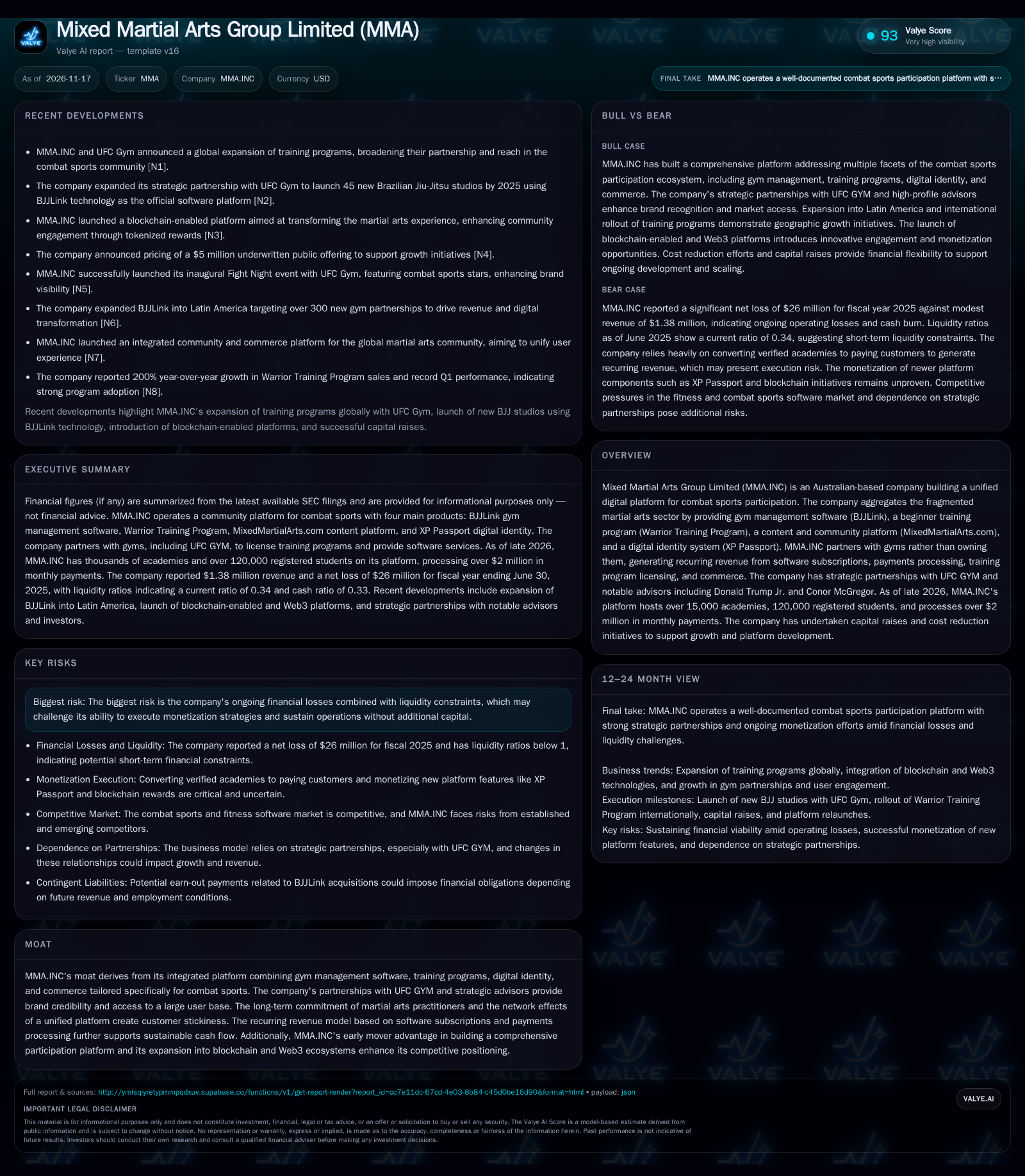
Mixed Martial Arts Group Limited (MMA.INC) is attempting to unify the global martial arts participation market through a suite of software, training programs, and digital engagement tools. With over 15,000 academies published on its platform, partnerships with UFC GYM, and recent expansions into Latin America and blockchain-based community features, MMA.INC has established a notable footprint. Yet, despite rapid network growth and strategic capital raises, the company’s path to sustainable profitability remains uncertain. Steep operating losses, low liquidity ratios, and the as-yet unproven monetization of new platform components mean that execution—not just audience growth—will determine the company’s trajectory.
Recent Expansion Highlights User and Academy Growth, But Losses Persist
As of September 2026, MMA.INC’s platform hosted 15,408 academies, with 1,148 verified and 400 paying academies, serving 120,048 registered students and 32,583 monthly active users. Payment volume processed through the platform hit $2.11 million in September 2026, annualized to $25.4 million, underscoring the potential scale of its transaction ecosystem. However, these volumes are not direct company revenue [S1].
The company’s Warrior Training Program, its largest revenue contributor, achieved 200% year-over-year sales growth and expanded both internationally and into new U.S. markets through UFC GYM partnerships [N1] [N8].
Despite these operational milestones, MMA.INC reported $1.38 million in revenue and a net loss of $26 million for the fiscal year ending June 30, 2025. [S1]
Recent efforts to reduce annualized cash operating costs by over $2.5 million and raise capital through a $5 million underwritten public offering and a $4 million private placement reflect ongoing attempts to shore up the balance sheet [S1] [N4].
Monetization Relies on Recurring Revenue from Software, Training, and Participation, But Operating Leverage Remains Elusive
MMA.INC's business model is built on aggregating the fragmented combat sports sector by providing software-as-a-service (SaaS) for gym management (BJJLink), licensing beginner training programs (Warrior Training Program), and enabling digital identity and community engagement through XP Passport and MixedMartialArts.com. Revenue streams are structured around recurring software subscriptions, payments processing, licensing, and commerce—particularly gear and apparel sales, which are fulfilled via partners to minimize inventory risk [S1].
The company’s economics hinge on converting a growing pool of verified academies into paying customers, and then scaling student engagement to drive both direct subscriptions and ancillary transaction volume. The recurring revenue model is designed to create operating leverage as fixed platform costs are spread across a larger user base. However, current financials suggest that scale efficiencies have yet to materialize: with $1.38 million in revenue against $26 million in net losses, fixed costs—largely in technology development, sales, and brand partnerships—are outpacing top-line growth [S1].
Payments volume ($2.11 million monthly) is a signal of ecosystem activity, but only a fraction is recognized as company revenue, depending on take-rates and contractual terms. The largest revenue driver remains the Warrior Training Program, which benefits from licensing deals with gyms but whose scalability and margin profile may be limited by the need for ongoing program support and instructor training [N8].
Capital expenditures are focused on technology platform development and acquisitions (notably BJJLink), while cost-control measures aim to improve cash burn. The company’s undrawn $5 million revolving loan facility offers some potential financial flexibility, but persistent operating losses raise questions about future funding needs [S1].
Integrated Platform and Strategic Partnerships Offer Differentiation, But Execution and Market Fragmentation Remain Key Challenges
MMA.INC positions itself as a one-stop digital platform for martial arts participation—distinct from pure content or streaming plays—by combining gym management, training, digital identity, and community functions. This breadth, combined with early-mover status and integration with UFC GYM’s global footprint, provides a potential moat through network effects and embedded switching costs for gyms and practitioners [S1] [N2].
Strategic advisors such as Donald Trump Jr. and Conor McGregor support brand visibility, while UFC GYM partnerships create a channel for rapid expansion and institutional credibility. However, dependence on these partnerships also represents a concentration risk: any change in the UFC GYM relationship could materially affect growth and revenue [S1].
The competitive landscape includes established fitness software vendors, specialty gym management platforms, and newer entrants leveraging mobile and social engagement. Barriers to entry are moderate, given the need for robust software, integrations, and compliance with payment and identity standards, but customer loyalty in the fitness sector can be fickle. MMA.INC’s blockchain and Web3 initiatives may differentiate the user experience, but the commercial value of these features is not yet proven [N3].
Fragmentation in the global combat sports market—by geography, discipline, and gym size—means that aggregation at scale is difficult, and local competitors may offer tailored solutions. MMA.INC’s ability to convert platform breadth into durable retention and pricing power remains to be validated.
Network Effects and Successful Monetization Unlock Profitable Scale
The favorable scenario involves MMA.INC leveraging its expanding academy and student base to accelerate conversion of verified academies into paying customers, while successfully layering on new revenue streams from digital identity, blockchain engagement, and commerce. The company’s partnership with UFC GYM enables rapid adoption of its training programs and software, driving up recurring subscription revenue and increasing transaction volume.
If blockchain-enabled features (such as tokenized rewards and XP Passport) gain traction, they could increase user engagement, retention, and create unique monetization opportunities—such as in-app purchases, premium memberships, or sponsored content. Integration of community and commerce features across a unified platform may enable cross-selling and upselling to both gyms and students, improving average revenue per user.
Confirmation of this scenario would require a sustained increase in the ratio of verified to paying academies, evidence of meaningful incremental revenue from new platform layers, and a narrowing of operating losses relative to top-line growth. Announcements of expanded multi-year contracts with major partners, successful international launches, and positive user engagement metrics would further support the thesis.
Slow Conversion and Execution Complexity Prolong Operating Losses
The most plausible outcome is that MMA.INC continues to grow its network of academies and students but faces slow conversion of verified accounts to paying customers, limiting recurring revenue growth. The company’s core software and training programs remain the main revenue drivers, but new features such as blockchain rewards and digital identity take longer to monetize and require additional investment.
Operating leverage remains elusive as fixed costs for platform development, sales, and support continue to outweigh incremental revenue. Partnerships with UFC GYM and other large gym networks provide a growth channel, but expansion into new geographies (such as Latin America) introduces operational complexity and competitive pushback.
Evidence confirming this scenario would include ongoing reports of net losses and low current ratios, a large but stagnant pool of non-paying verified academies, and incremental rather than step-change growth in reported revenue. Delays in monetizing new platform features or setbacks in international expansion would further support this outcome.
Liquidity Crunch or Partnership Loss Forces Retrenchment
In the adverse scenario, MMA.INC’s liquidity position deteriorates as operating losses persist and conversion of users to paying customers stalls. The company is unable to secure sufficient new capital or draw on its revolving facility in time, leading to cash flow shortfalls. Execution missteps—such as technical delays in new platform launches, or failure to deliver value to gyms—erode confidence among strategic partners.
A breakdown or renegotiation of the UFC GYM partnership could abruptly reduce the addressable market and undermine credibility, while competitive offerings attract away both gyms and students. Contingent earn-out liabilities related to acquisitions strain finances further, increasing the risk of covenant breaches or forced asset sales.
Confirmation of this scenario would be signaled by disclosures of missed payments, abrupt cost-cutting measures, layoffs, or write-downs; public loss of key partnerships; or adverse changes in credit terms. Regulatory or reputational setbacks tied to blockchain or tokenized features could accelerate user churn and limit future capital access.
Milestones and Metrics That Will Determine Whether MMA.INC Can Build a Durable Platform
The conversion rate of verified academies to paying academies—monthly and quarterly trends would help assess the effectiveness of go-to-market and retention strategies.
Growth in recurring revenue per academy and per active user, if disclosed, as an indicator of successful upselling and cross-selling across platform features.
Net monthly or quarterly churn among paying academies and registered students, which would clarify retention and user engagement.
The pace and success of monetization for XP Passport, blockchain rewards, and new commerce features—measured by incremental revenue or usage statistics.
Updates on the size, duration, and renewal of major partnerships, particularly with UFC GYM, including minimum commitments or exclusivity terms if available.
Operating cash flow trends relative to net loss and working capital movements, to gauge progress toward operating leverage and sustainable liquidity.
Progress on international expansion, especially the number of new gym partnerships and paying customers in Latin America and other new geographies.
Disclosures on contingent liabilities—specifically earn-out payments tied to BJJLink—and their impact on near-term potential financial flexibility.
Disclaimer: This is research-only, informational analysis and not investment advice. It may include AI-generated interpretation and general industry context. Always verify important details using primary sources.

Comments