
Cisco’s AI-Driven Growth Meets Supply Chain and Demand Volatility: Navigating Scale in a Shifting Infrastructure Landscape
Cisco’s double-digit product revenue surge in fiscal 2026 was powered by AI infrastructure demand, particularly from service providers and cloud markets. Yet, supply chain constraints, margin pressure, and unpredictable customer order cycles introduce complexity to sustainable profit expansion.
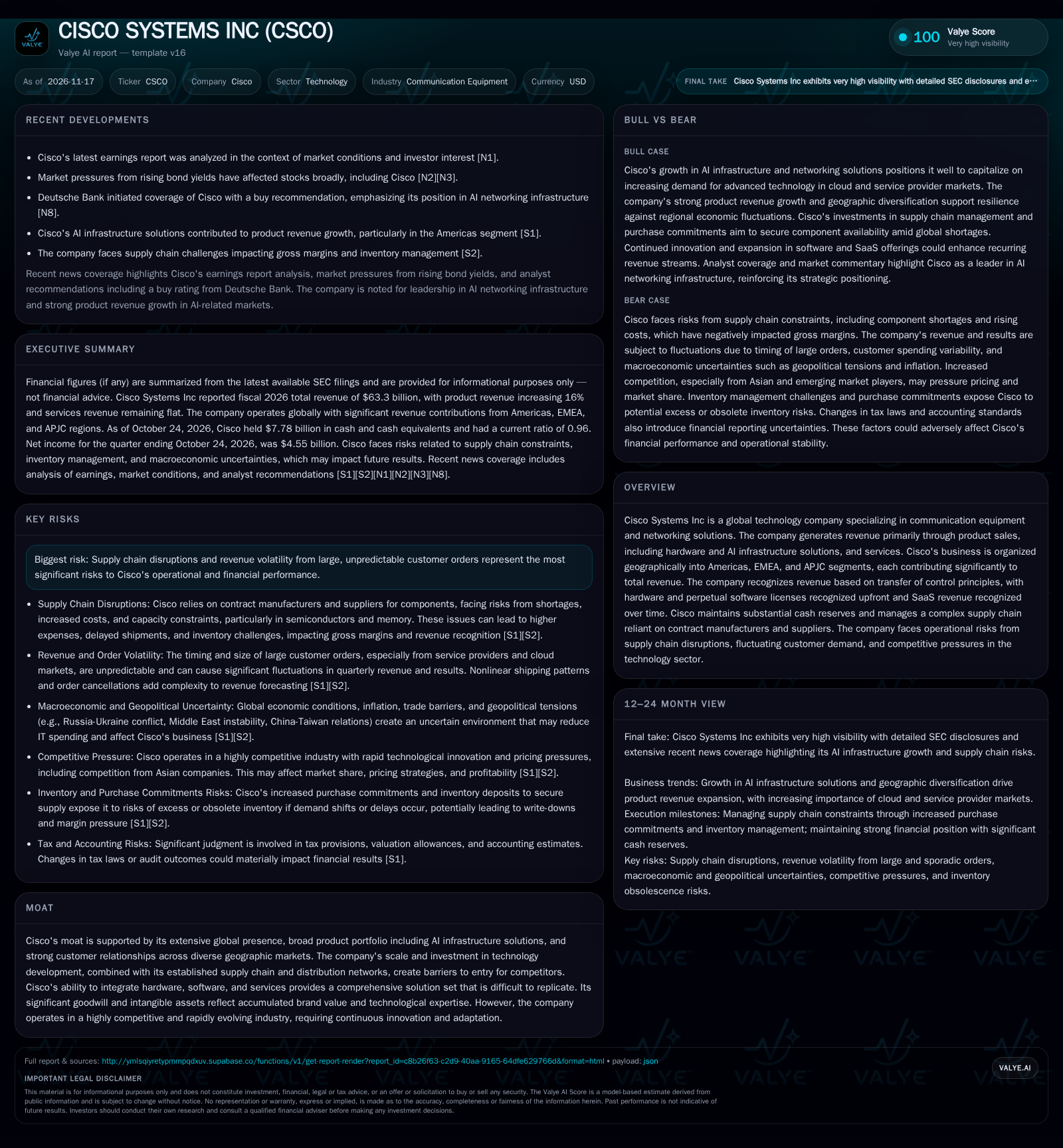
Cisco’s 16% product revenue growth in 2026 was driven by AI infrastructure solutions, but gross margins faced headwinds from supply chain disruptions and component costs. The company’s scale and geographic reach remain advantages, but volatility in large orders and intense competition challenge future visibility and margin resilience. Watch for AI adoption rates, inventory management, and competitive responses as key forward indicators. [S1] [S2] [N1] [N8]
Cisco’s 2026 results reflect a moment of both promise and complexity for the networking giant. Buoyed by strong AI infrastructure demand—particularly from hyperscale cloud and service provider customers—the company delivered robust product revenue growth across all major regions. However, this topline momentum has come with margin pressures as supply chain challenges and rising component costs persist.
AI Infrastructure Demand Fuels Topline, But Margin Pressures Persist
Cisco reported fiscal 2026 revenue of $63.3 billion, with product revenue rising 16% year-over-year to $48.3 billion, while services revenue was flat. This growth was broad-based across the Americas, EMEA, and APJC, with the Americas segment leading at $28.9 billion in product revenue—up 17%. The primary engine was demand for AI infrastructure solutions, especially among service provider and cloud customers. However, gross margins faced headwinds from ongoing supply chain constraints, particularly component shortages and higher input costs, which have required increased purchase commitments and inventory deposits with suppliers. Net income for the quarter was $4.55 billion, indicating that profitability has held up despite these pressures. [S1] [S2] [N1] [N8]
How Cisco Monetizes Networking: Volume, Mix, and the Fixed Cost Dilemma
Cisco’s revenue model is anchored in hardware and software sales, with upfront recognition for hardware and perpetual licenses and ratable recognition for SaaS contracts. The company’s economics are highly sensitive to product mix (AI vs. traditional networking), volume (driven by large enterprise, cloud, and service provider orders), and pricing power (increasingly challenged in a competitive and commoditizing market). Fixed costs—including R&D, supply chain infrastructure, and global sales—create operating leverage, but gross margin is pressured by rising component costs and the need to secure supply through advance purchase commitments. The flat trajectory in services revenue suggests that recurring, higher-margin streams are not yet offsetting the volatility of hardware cycles. Cisco’s large goodwill balance ($59.5 billion) underscores the cumulative impact of acquisitions and the company’s attempt to build a comprehensive solution stack, but also carries risk if future cash flows disappoint. Working capital management has grown more complex as the company pre-buys inventory to avoid shortages, increasing the risk of write-downs if demand shifts or supply chains normalize.
A critical dynamic shaping Cisco’s economics is the interplay between fixed and variable costs amid fluctuating demand. While fixed costs such as R&D and global sales infrastructure enable scale advantages, they also create operating leverage that can amplify margin swings when volume deviates from forecasts. This leverage means that managing demand variability becomes essential not only for revenue stability but also for protecting profitability. The company’s strategy to pre-purchase components and build inventory buffers, while mitigating supply risks, introduces additional working capital strain and potential obsolescence if demand softens or shifts. Therefore, the balance between securing supply continuity and avoiding excess inventory is a delicate one that requires sophisticated demand forecasting and supplier collaboration.
Scale, Integration, and the Battle for AI Networking Leadership
Cisco’s traditional advantages—global distribution, a broad product portfolio, and entrenched customer relationships—remain formidable. The company’s early leadership in AI networking infrastructure has reinforced its relevance to hyperscalers and service providers, who are racing to upgrade data centers for AI workloads. However, barriers to entry in core switching and routing are eroding as alternative vendors, especially from Asia, offer competitive products at lower price points, and software-defined networking (SDN) continues to shift value toward software and cloud-managed platforms. The competitive set spans legacy hardware vendors, cloud-native infrastructure players, and emerging AI networking specialists. Cisco’s ability to integrate hardware, software, and services remains a differentiator, but the question is whether this integration will drive sustainable stickiness and pricing power as customers demand open, interoperable solutions and as procurement cycles become more volatile.
The evolving competitive landscape also pressures Cisco’s traditional hardware-centric model as software-defined networking and cloud-based management platforms gain traction. Customers increasingly value flexibility, interoperability, and scalability, which can diminish the value premium of integrated hardware-software bundles. Cisco’s ability to maintain pricing power hinges on demonstrating differentiated value through seamless integration, advanced AI optimization features, and robust security capabilities. However, as open standards and multi-vendor environments become more prevalent, the company must navigate potential margin erosion and increased churn risk. The competitive threat from lower-cost Asian vendors is particularly acute in commoditized segments, requiring Cisco to selectively invest in innovation and customer engagement to defend its market share.
AI Infrastructure Supercycle Unlocks Sustained Growth and Margin Recovery
If the AI adoption curve accelerates among service providers, hyperscalers, and large enterprises, Cisco could see a multi-year supercycle in networking upgrades—driving both volume and mix shift toward higher-value, AI-optimized platforms. In this scenario, increased scale may allow Cisco to renegotiate supply contracts, easing margin pressure as component availability improves and costs normalize. Successful expansion of SaaS and software-driven offerings could further boost recurring revenue, smoothing out the hardware cycle’s volatility. Confirmation would come from continued double-digit product growth, improving gross margins, sustained order momentum in AI segments, and a rising share of revenue from ratable, software-based contracts. Falsification would occur if AI-related orders plateau or if gross margins remain depressed despite revenue growth, indicating that price competition or persistent cost inflation is eroding the incremental value of AI infrastructure.
Managing Through Cycles: Revenue Growth with Persistent Margin and Demand Volatility
The most plausible path is that Cisco continues to grow revenue—driven by ongoing, if lumpy, demand for AI infrastructure—but faces ongoing challenges balancing scale with profitability. Supply chain constraints and input cost volatility may persist, requiring careful inventory and purchase commitment management. Large customer orders, especially from hyperscalers and telcos, will continue to drive quarter-to-quarter swings, making forecasting and operational planning difficult. Services and SaaS revenue may gradually increase but are unlikely to fully offset hardware cyclicality in the near term. Evidence for this scenario would include continued strong but uneven product growth, stable or slightly pressured gross margins, and periodic inventory adjustments. Falsification would be visible if either revenue or margin volatility increases sharply, or if services/software growth fails to materialize, leaving Cisco more exposed to hardware cycles.
Supply Chain Disruptions and Demand Reversals Trigger Margin Compression
A more adverse scenario would see persistent or worsening supply chain disruptions—whether through geopolitical events, further semiconductor shortages, or supplier concentration—forcing Cisco to absorb even higher input costs or delay shipments. If major customers delay or cancel large orders, the company could be left with excess inventory and locked-in purchase commitments, resulting in write-downs and significant margin compression. Escalating competition, especially from lower-cost or more agile vendors, could trigger price wars and further erode both revenue and profitability. Confirmation of this scenario would include declining gross margins, an uptick in inventory write-downs, slowing or negative product revenue growth, and increased volatility in quarterly results. Falsification would require stabilization in supply chains, improved inventory turns, and evidence of pricing discipline despite market pressures.
Supply chain disruptions could also exacerbate margin pressures through increased reliance on expedited shipping, higher logistics costs, and contractual penalties related to delayed deliveries. If semiconductor shortages persist or intensify, Cisco might face difficult trade-offs between fulfilling high-margin AI infrastructure orders and managing overall product mix profitability. Additionally, prolonged inventory imbalances could force aggressive discounting or write-offs, further compressing margins. From a demand perspective, if economic headwinds or customer budget constraints lead to delayed network refresh cycles, Cisco’s exposure to hardware cyclicality would intensify. In such an environment, the company’s fixed cost base could become a liability, reducing potential financial flexibility and potentially necessitating restructuring or cost containment measures to preserve earnings quality.
Signals That Will Shape Cisco’s AI Infrastructure Trajectory and Margin Profile
Growth rate and composition of product revenue attributable specifically to AI infrastructure solutions—if disclosed—would clarify the sustainability of current momentum.
Quarterly gross margin trends, especially as supply chain conditions evolve and input costs fluctuate.
Inventory levels and days inventory outstanding, particularly in the context of increased purchase commitments and supplier deposits.
Order flow from hyperscale cloud and service provider customers, including any disclosure of contract duration, backlog, or order pipeline.
The mix and renewal rate of SaaS and software-based revenue versus upfront hardware sales.
Competitive win/loss rates in major networking infrastructure deals, especially in AI-related projects—if disclosed.
Any changes in supply chain strategy, such as new supplier agreements or shifts in sourcing geographies in response to geopolitical risk.
Disclosure of inventory write-downs or reversals of purchase commitments that could indicate over-extension or demand miscalculation.
Disclaimer: This is research-only, informational analysis and not investment advice. It may include AI-generated interpretation and general industry context. Always verify important details using primary sources.

Comments