
RetinalGenix: Ambition at the Intersection of Ophthalmic Diagnostics and Data—But Liquidity Dictates the Timeline
RetinalGenix Technologies Inc. is advancing an integrated platform for early detection and management of ocular and systemic diseases, with upcoming launches in genetic testing and remote retinal imaging.
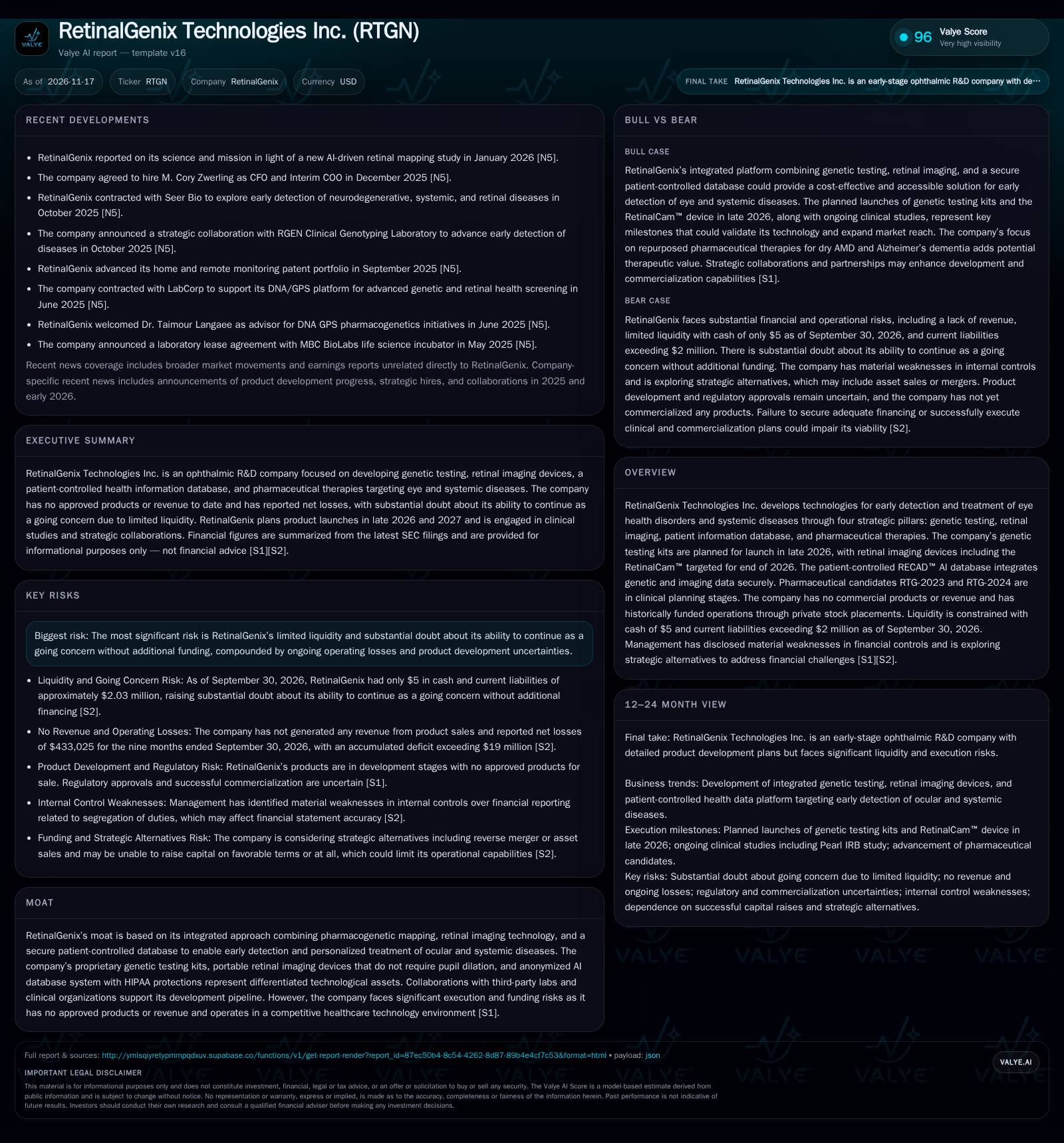
RetinalGenix Technologies Inc. targets early detection of eye and systemic diseases through genetic testing, portable retinal imaging, a patient-controlled AI database, and new pharmaceutical therapies. The company plans initial product launches in late 2026 but currently has no approved products or revenue. As of September 30, 2026, RetinalGenix had only $5 in cash against over $2 million in current liabilities, raising substantial doubt about its ability to continue as a going concern. Strategic alternatives, including mergers or asset sales, are under consideration as the company seeks critical funding to advance its ambitious roadmap. [S1] [S2]
RetinalGenix Technologies Inc. is attempting to bring an ambitious, integrated solution to the early detection and management of eye and systemic diseases, combining genetic testing, portable retinal imaging, AI-driven data management, and novel pharmaceutical candidates. While the planned product launches could unlock new diagnostic and monitoring paradigms—especially for underserved populations—the company’s immediate future is overshadowed by acute liquidity issues and the absence of commercialized products. Unless RetinalGenix secures substantial funding or a strategic transaction, its vision is at risk of being curtailed before reaching the market.
Liquidity Collapse and Imminent Strategic Crossroads
As of September 30, 2026, RetinalGenix Technologies Inc. reported just $5 in cash and current liabilities of approximately $2.03 million, leaving its current and cash ratios effectively at zero. The company has not generated any product revenue to date and posted a net loss of $433,025 for the first nine months of 2026. Management has publicly acknowledged 'substantial doubt' about the company’s ability to continue as a going concern and is actively considering strategic alternatives, including a reverse merger, asset sale, or other transactions to address these financial challenges. Material weaknesses in internal controls over financial reporting, specifically around segregation of duties, further emphasize the operational strain. This combination of financial distress and operational risk is thesis-defining: the company’s technical ambitions are fundamentally constrained by the urgent need for capital and structural remediation. [S2]
Integrated Platform Economics: High Potential, Unproven Model
RetinalGenix’s business model aspires to blend multiple high-value healthcare verticals: genetic testing (with GPS oral swab kits), portable retinal imaging devices (including the home-use RetinalCam™), a secure AI-driven patient data platform (RECAD™), and proprietary pharmaceutical candidates. Each element individually can support premium pricing, especially in specialty diagnostics and therapeutics, but the real economic promise lies in integration—enabling bundled offerings, richer data-driven insights, and potential recurring revenue from database access or remote monitoring.
However, the company’s economics are entirely theoretical at present. There is no evidence yet of pricing, reimbursement strategy, or commercial partnership structure. Fixed costs are likely substantial given ongoing R&D, regulatory, and infrastructure needs, while variable costs for genetic kits and imaging hardware may benefit from scale but could be high in initial production runs. The pharmaceutical pipeline, if advanced, would require significant capital for clinical trials—typically the most capital-intensive phase for a biotech. RetinalGenix’s capital needs are thus acute: without a major infusion, the economics of scale and operating leverage remain aspirational rather than actionable.
The integration of multiple diagnostic modalities and therapeutic avenues presents both operational complexity and opportunity cost considerations. For instance, coordinating regulatory pathways across genetic testing, medical devices, and pharmaceuticals requires distinct expertise and timelines, which could strain limited management bandwidth and capital allocation. Moreover, the bundled platform approach may face challenges in aligning reimbursement codes and payer acceptance across diverse service categories, potentially delaying revenue realization. A phased commercialization strategy that prioritizes one segment to establish clinical credibility and cash flow before layering additional components might mitigate risk and enhance investor confidence. Conversely, simultaneous multi-front development could accelerate market differentiation if adequately funded and executed.
Differentiation Hinges on Integration and Data, but Execution and Funding Remain the Bottleneck
RetinalGenix enters a crowded and rapidly evolving field. In genetic screening for ocular disease, there are both established labs and emerging digital health startups. Retinal imaging is dominated by large device manufacturers, with portable and AI-enabled solutions gaining traction. The pharmaceutical pipeline faces entrenched competition and regulatory hurdles.
The company’s potential edge lies in integrating genetic, imaging, and patient-controlled data into a HIPAA-compliant, interoperable platform—a combination not yet widely commercialized in ophthalmic care. If executed, this could create switching frictions for clinicians and patients due to the value of longitudinal, multi-modal data. The anonymized, patient-centric database could also underpin future partnerships or licensing. However, these advantages are not self-reinforcing unless the company can achieve initial market traction and demonstrate clinical and economic value. The lack of financial resources not only limits go-to-market execution but also undermines the credibility of the platform’s long-term competitive moat.
The reliance on data integration as a competitive moat underscores the importance of network effects and data quality. If RetinalGenix can amass a sufficiently large and diverse patient dataset, it could leverage machine learning to refine predictive algorithms and personalize diagnostics, creating barriers to entry for competitors. However, this advantage is contingent on patient consent frameworks, data interoperability standards, and cybersecurity robustness, all of which require ongoing investment and regulatory compliance. Additionally, the platform’s success depends on clinician adoption, which may be hindered by workflow disruption or skepticism toward AI-derived insights. Strategic collaborations with key opinion leaders and healthcare institutions could facilitate validation and acceptance, but such partnerships often demand extended timelines and resource commitments.
Funding Unlocks Platform Launch and Early Adoption Momentum
The most favorable scenario involves RetinalGenix securing sufficient capital—via strategic investment, merger, or asset sale—to enable the late-2026 and 2027 launches of its genetic testing kits and RetinalCam™ device. Early clinical validation from the Pearl IRB study and successful initial deployments in target markets (such as community clinics, assisted living centers, and optometry offices) could drive rapid pilot adoption. If the company can demonstrate improved early detection rates or patient outcomes, it may attract reimbursement support and interest from larger healthcare partners.
Confirmation would include: closing a material funding round or partnership, publicized commercial launches with named accounts, positive interim data from the Pearl IRB study, and early database utilization metrics (if disclosed). Falsification would occur if no funding is secured, launches are indefinitely delayed, or initial uptake is negligible despite product availability.
Prolonged Funding Search, Delayed Launches, and Uncertain Commercialization Timeline
The most plausible near-term outcome is a continued search for capital, with product launches slipping beyond the stated late-2026/2027 timeline. In this scenario, RetinalGenix may reduce operating expenses, defer clinical studies, and seek to maintain core IP and personnel while negotiating with potential partners or acquirers. The lack of revenue and ongoing losses would persist, and the company’s ability to remain a going concern would hinge on incremental financing or a strategic transaction.
Evidence confirming this scenario would include ongoing disclosures of material weakness, further delay announcements, and partial asset monetization efforts. A reversal would require an unexpected capital infusion or clear evidence of accelerated commercial progress.
Liquidity Exhaustion Forces Fire Sale or Wind-Down
In the adverse scenario, RetinalGenix fails to secure any near-term funding or partnership, exhausting its remaining liquidity and defaulting on obligations. The company may be forced into a distressed asset sale, reverse merger on unfavorable terms, or outright wind-down. Product development would halt, and IP or data assets could be sold at a fraction of invested capital. Stakeholders would likely experience significant value impairment, with little to no realization of the company’s integrated platform vision.
This outcome would be confirmed by bankruptcy filings, asset sale announcements at distressed prices, or formal delisting and cessation of operations. Averted only if an unexpected capital source materializes or a buyer sees strategic value in the company’s pipeline.
Concrete Milestones That Will Determine RetinalGenix’s Survival and Strategic Value
Closure of a material financing round, strategic partnership, or asset sale—public disclosure would be a leading indicator of operational runway.
Announced timing and actual delivery of the genetic testing kit and RetinalCam™ commercial launches—delays or cancellations would signal execution risk.
Interim results or enrollment progress from the Pearl IRB study—a useful metric would be study enrollment rates, data quality, and early outcome signals.
Disclosure of initial customer or distribution agreements in target settings (e.g., clinics, pharmacies, assisted living)—would help test early market traction.
Progress updates (if disclosed) on the RECAD™ AI database buildout, including security certifications and integration milestones.
Remediation of internal control weaknesses—confirmation via improved audit outcomes or management commentary.
Ongoing liquidity and current liability disclosures—particularly if new working capital lines, equity raises, or bridge financing are secured.
Any regulatory or reimbursement milestones for pipeline pharmaceutical candidates—such as IND submissions or trial initiations.
Disclaimer: This is research-only, informational analysis and not investment advice. It may include AI-generated interpretation and general industry context. Always verify important details using primary sources.

Comments