
Clearfield, Inc.: Modular Fiber Deployment Solutions Confront Competitive Scale and Leadership Transition
Clearfield leverages modular, craft-friendly fiber connectivity products to serve broadband, data center, and wireless markets, but faces intense competition from larger incumbents and must navigate a pending CEO transition.
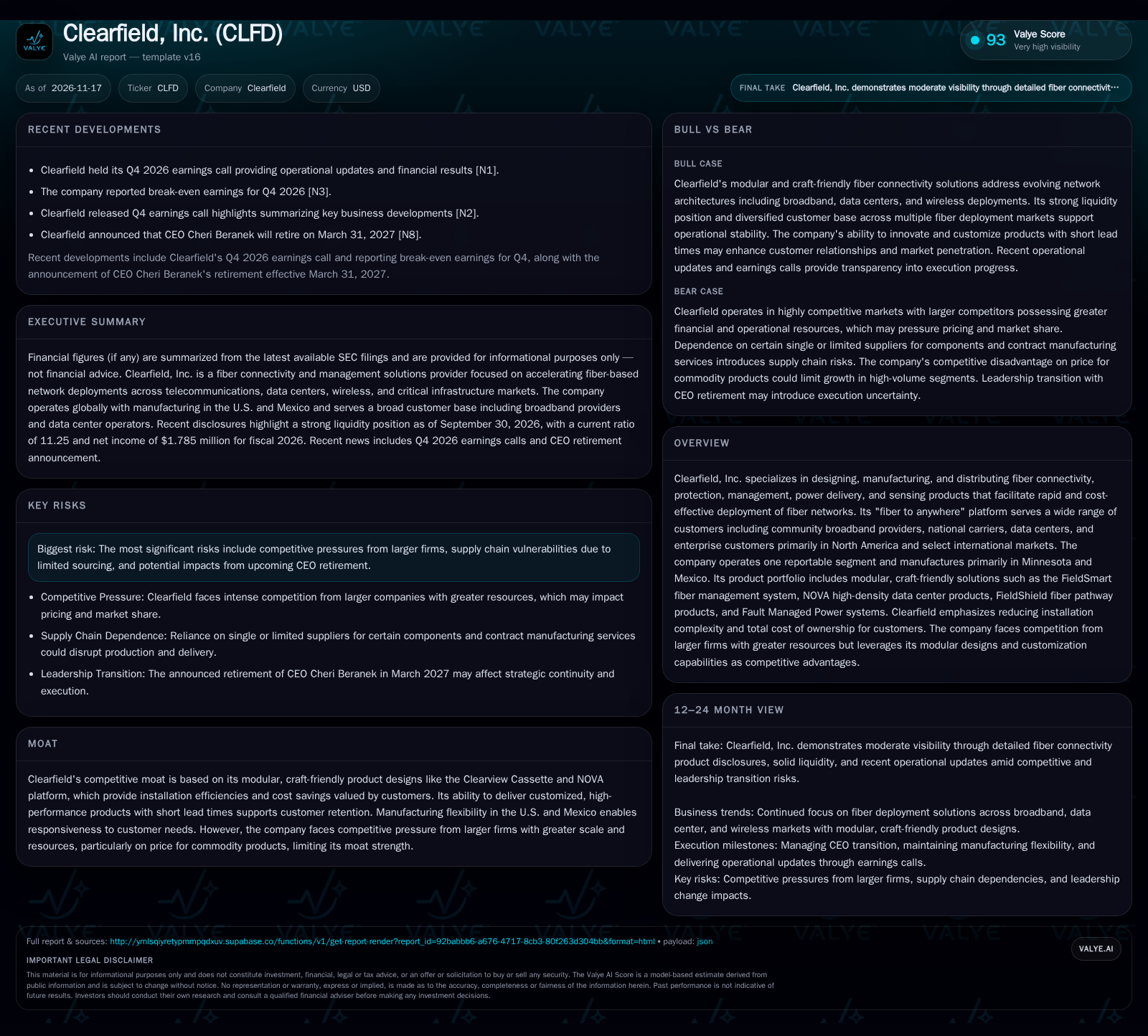
Clearfield, Inc. designs and manufactures modular fiber connectivity solutions targeting diverse telecom, data center, and broadband customers. As of September 2026, the company reported liquidity position and break-even Q4 results, but faces competitive and supply chain pressures, and will see CEO Cheri Beranek retire in March 2027. The company's ability to translate installation efficiencies and customization into sustained growth and margin improvement will be tested amid sector headwinds and shifting leadership. [S1] [N1] [N3] [N8]
Clearfield, Inc. stands at a crossroads in the rapidly evolving fiber connectivity landscape. Its modular, craft-friendly products are designed to accelerate fiber deployment for broadband, data center, and wireless applications—a value proposition that resonates with a broad customer base. However, the company’s recent break-even earnings, while supported by a reported balance sheet position, underscore the challenge of translating operational efficiencies into sustained profitability. As the telecom infrastructure market matures and CEO Cheri Beranek prepares to retire, Clearfield must defend its niche against larger, well-capitalized competitors while managing the risks of leadership transition and supply chain dependency. [S1] [N1] [N3] [N8]
Recent Earnings, Liquidity, and Leadership Transition: What Has Changed for Clearfield?
Clearfield reported net income of $1.785 million for fiscal 2026, with Q4 results essentially at break-even, reflecting a period of operational stability but also limited earnings momentum as the company adjusts post-sale of its Nestor Cables business. As of September 30, 2026, Clearfield holds $29.3 million in cash, $79.0 million in short-term investments, and reported liquidity-ratio trends of 11.25—metrics that suggest a conservative approach to liquidity and working capital. The company also announced that long-time CEO Cheri Beranek will retire in March 2027, signaling a significant leadership transition during a period of sectoral and competitive flux. These developments collectively heighten the importance of execution and strategic clarity as Clearfield navigates a maturing market and evolving internal dynamics. [S1] [N1] [N3] [N8]
How Clearfield’s Modular Approach Impacts Its Economic Model
Clearfield’s revenue model is built around the design, manufacture, and distribution of fiber connectivity, management, and power delivery products optimized for rapid deployment. The company’s craft-friendly, modular solutions—such as FieldSmart management systems and NOVA high-density platforms—are positioned to reduce installation time and total cost of ownership for customers, a selling point especially relevant to broadband and data center operators seeking to accelerate network rollouts.
In theory, this modularity and ease of installation could support premium pricing or improved margins relative to commodity fiber products, but the company's reported break-even Q4 suggests that either mix, volume, or pricing power has been insufficient to drive near-term profitability. Fixed costs are anchored by manufacturing facilities in Minnesota and Mexico, with additional variable costs tied to materials and contract manufacturing. The capital intensity of the business is moderate, with flexibility to adjust production through partnerships, but supply chain reliance on some single-source components introduces operational risk.
Operating leverage may be available if Clearfield can drive higher volumes of customized or value-added products, but intense price competition—particularly in high-volume, lower-margin segments—limits the extent to which scale alone can ensure margin expansion. The company reported cash and liquidity metrics for the period; these figures do not by themselves establish operating runway, investment capacity, financial flexibility, or financing capacity. [S1]
Competing on Customization and Speed—But Facing Scale and Price Pressures
Clearfield’s differentiation rests on its ability to deliver modular, craft-friendly, and customizable fiber connectivity solutions with short lead times. This positions the company well with customers who value installation efficiency and the ability to tailor deployments to specific network architectures, such as regional broadband providers or data center operators with unique needs.
However, the competitive landscape is dominated by larger incumbents with greater scale and financial resources. These larger players can leverage volume purchasing to reduce costs and exert downward pressure on pricing, particularly for commodity fiber products where Clearfield is at a disadvantage. In these segments, Clearfield’s ability to compete often relies on securing smaller, specialized projects or leveraging relationships with customers that prioritize service, flexibility, and rapid response over lowest price.
The risk is that, as the overall market matures and price becomes a more dominant factor—especially in government-subsidized broadband rollouts or large carrier projects—Clearfield’s niche advantages may be eroded unless it can continue to innovate or move up the value chain. Supply chain risks, particularly around single- or limited-source components, further constrain the company’s ability to respond quickly to large-scale opportunities or supply shocks. [S1]
If Modular Innovation Drives Market Share and Margins Higher
A favorable scenario for Clearfield would see its modular, craft-friendly products gaining wider adoption as network operators seek to accelerate fiber deployments with minimal labor and installation costs. In this scenario, the company leverages its reputation for customization and short lead times to win incremental share in both broadband and data center markets, particularly as smaller providers and edge deployments proliferate with the expansion of 5G and rural broadband initiatives.
Upside would be confirmed by evidence of sustained revenue growth, a rising proportion of sales from higher-margin, value-added products (such as NOVA or Fault Managed Power lines), and clear progress in expanding customer relationships beyond the traditional community broadband segment. Margin improvement and growing net income—especially if accompanied by announcements of large new contracts or partnerships—would further validate this thesis.
If the incoming CEO continues to prioritize innovation and operational agility, and if supply chain risks are managed effectively, Clearfield could achieve a virtuous cycle of growth and margin expansion that differentiates it from commodity-focused peers.
Incremental Progress Amid Margin Pressure and Execution Uncertainty
The most plausible scenario is one in which Clearfield continues to serve a diverse array of fiber deployment customers, maintaining its niche in modular, craft-friendly solutions but facing persistent pricing pressure from larger competitors. Revenue growth may be modest, with the company holding or slowly expanding share in segments where customization and rapid deployment are valued, but losing ground in price-driven, high-volume projects.
Margins remain under pressure as the mix shifts between value-added and commodity products, and as supply chain costs fluctuate. The leadership transition introduces execution risk—continuity of strategy and customer relationships will be critical.
Confirmation would come from relatively flat or modestly growing revenues, continued break-even or low single-digit net income, and stable but not rising gross margins. Delays in new product adoption or supply chain disruptions would further reinforce the base case. [S1] [N3] [N8]
Supply Chain Disruptions and Competitive Encroachment Erode Profitability
A downside scenario would see Clearfield’s supply chain vulnerabilities materialize—whether through disruptions in single- or limited-source components or rising input costs—hampering its ability to deliver products on time and eroding customer confidence. At the same time, larger competitors could intensify price competition, winning away key contracts as customers opt for lower-cost, higher-volume solutions.
Under these conditions, Clearfield could experience margin compression, revenue declines, and potentially negative operating income, particularly if fixed manufacturing costs cannot be scaled down quickly. Leadership transition risk could exacerbate execution challenges, especially if the new CEO is slow to establish credibility or if key customer relationships are lost during the handover.
Evidence supporting this scenario would include missed delivery targets, declining order volumes, falling gross margins, and management commentary highlighting supply chain or competitive stresses.
Testing the Thesis: What Will Determine Clearfield’s Next Phase?
Revenue growth rate by product line—particularly for modular, high-margin solutions like NOVA and Fault Managed Power—would help test whether Clearfield is moving up the value chain. (If disclosed)
Gross margin trends, especially in the context of mix shifts between value-added and commodity products, will indicate pricing power and cost management effectiveness.
Customer concentration metrics and new contract wins, especially in data center and enterprise markets, could signal broader adoption beyond the core broadband segment.
Supply chain stability and lead time performance, as evidenced by on-time delivery rates and inventory turnover, would provide early warning of operational risk.
Progress on leadership transition, including new CEO appointment, management continuity, and retention of key customer relationships.
R&D or product development pipeline disclosures—such as new modular platforms, sensing solutions, or integration-ready products—would clarify innovation momentum.
Any updates on major competitive wins or losses, particularly in large carrier or government-subsidized broadband projects, would test the defensibility of Clearfield’s niche.
Disclaimer: This is research-only, informational analysis and not investment advice. It may include AI-generated interpretation and general industry context. Always verify important details using primary sources.

Comments