
New Concept Energy: Real Asset Base, Revenue Concentration, and the Search for Scalable Profitability
The company’s path forward hinges on improving asset utilization, diversifying income streams, and overcoming inherent scale limitations.
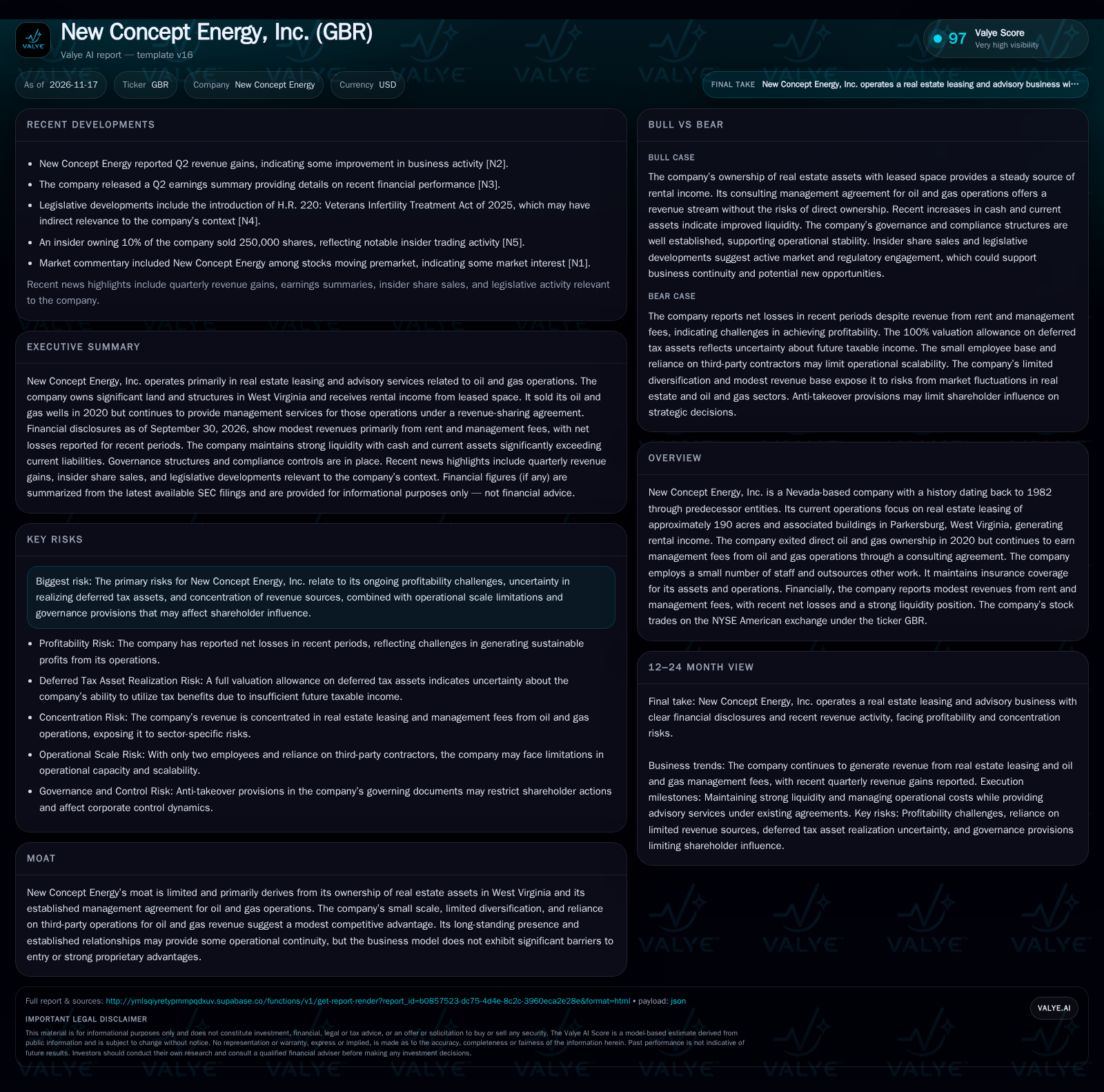
New Concept Energy’s business is anchored by West Virginia real estate and advisory fees from oil and gas management, producing limited but stable revenue streams. Despite a surge in liquidity, persistent net losses and a narrow operational focus raise questions about long-term profitability and value creation.
New Concept Energy, Inc. represents a micro-cap business built on tangible real estate assets and a legacy oil and gas management agreement. The company’s future depends on its ability to better utilize its real estate, expand or diversify its revenue base, and demonstrate cost discipline within a structurally lean operation.
Asset Holdings and Revenue Streams Define the Present Operating Picture
New Concept Energy’s core business currently revolves around the ownership of approximately 190 acres and 53,000 square feet of structures in Parkersburg, West Virginia, with about 16,000 square feet actively leased, contributing $103,000 annually in rental income [S1]. This real estate is the foundation of its recurring revenue stream. The company also receives management fees—set at 10% of revenue—from oil and gas wells it previously owned but divested in 2020, reflecting a shift to an asset-light, service-based model for this segment [S1]. For the quarter ended September 30, 2026, the company reported $37,000 in revenue (split between $26,000 from rent and $11,000 from management fees), with a net loss of $11,000; for the first nine months of 2026, revenue totaled $117,000 and net loss was $91,000, a deterioration from the prior year [S2].Cash and equivalents jumped to $2.26 million as of September 30, 2026, driven by undisclosed factors, resulting in an reported current ratio of 31 [S2]. An insider’s recent sale of 250,000 shares also brings shareholder sentiment and control into the spotlight [N5].
How Real Estate Leasing and Management Fees Shape the Economic Model
The company’s economic engine is powered by two main streams: rental income from its West Virginia property and management fees from oil and gas operations. Rental income is relatively predictable, but the property’s low occupancy rate (roughly 30% leased) suggests significant underutilization. If the company could increase leased space or raise rents, incremental revenue would have a high flow-through to operating income, given the fixed cost structure typical of property management. However, property maintenance, insurance, and administrative overheads still consume a meaningful portion of gross revenue, limiting margins.
The management fee arrangement—10% of revenue from legacy oil and gas wells—offers a low-risk, variable income source without the capital intensity or operational exposure of direct asset ownership. However, this revenue is contingent on the performance of third-party-operated wells, and the company has limited influence over production or pricing. Interest income from notes receivable adds a minor third leg to the business, but its scale appears immaterial. With just two employees, the company keeps personnel costs low but must rely on contractors, constraining scalability and potentially raising per-unit service costs.
Despite the surge in cash, the company has not deployed this capital into growth initiatives or material expansion, suggesting a cautious or constrained capital allocation posture. The 100% valuation allowance on deferred tax assets highlights persistent uncertainty over future profitability [S1] [S2].
Limited Moat: Asset Location and Legacy Relationships Offer Modest Defenses
New Concept Energy’s competitive positioning is rooted in its ownership of a single, concentrated real estate asset and its ongoing management agreement for oil and gas operations. The West Virginia location may provide some local advantage, but the property’s low occupancy and lack of geographic or asset diversification limit pricing power and resilience to market downturns. In the real estate leasing market, the company faces competition from regional commercial landlords, some with greater scale, broader tenant relationships, and more diversified portfolios.
The management fee stream is a legacy arrangement, unlikely to be easily replicated but also inherently finite and dependent on the continued operation of third-party wells. There is little evidence of proprietary technology, brand, or cost advantage. The company’s small size and low headcount reduce overhead but also limit its ability to pursue larger or more complex opportunities. In sum, its moat is narrow, based primarily on asset control and long-standing relationships rather than structural barriers to entry.
Unlocking Value Through Asset Utilization and Strategic Deployment of Cash
A favorable trajectory for New Concept Energy would involve materially increasing the occupancy rate of its Parkersburg property, either by securing new long-term tenants or repurposing space for higher-value uses. This could drive operating leverage, as incremental rental income would outpace the modest increase in associated expenses. If management redeploys its sizable cash reserves into selective property improvements, targeted acquisitions, or adjacent service offerings, this could further diversify and expand the revenue base.
A successful renegotiation or extension of the oil and gas management agreement, or the addition of new advisory contracts, could provide incremental high-margin income. Evidence confirming this scenario would include a sustained rise in rental revenue, announcements of new tenant signings or property upgrades, and clear disclosure of reinvestment or acquisition plans. Demonstrated progress toward profitability—especially if the company moves from net losses to break-even or positive operating income—would further validate the upside case.
Continued Modest Revenue, Ongoing Losses, and Limited Growth Initiatives
The most plausible near-term scenario is that New Concept Energy continues to generate modest rental and management fee income, with occupancy and fee levels largely unchanged.
Supporting evidence for this scenario would be sequentially flat or slightly fluctuating rental and management fee revenues, continued net losses of similar magnitude, and no significant announcements regarding property redevelopment, new tenants, or expansion into new lines of business. The company’s 100% valuation allowance against deferred tax assets would likely persist, and insider trading activity could continue to reflect limited near-term growth visibility.
Revenue Erosion, Asset Impairment, or Cash Drain Could Accelerate Value Risk
In a negative scenario, New Concept Energy could face declining rental income if existing tenants vacate or if local real estate demand weakens further. Similarly, a drop in production or pricing from the oil and gas wells under management could reduce fee income, given the company’s limited control over these assets. Fixed costs for property maintenance and insurance would then represent a higher proportion of a shrinking revenue base, potentially deepening net losses.
If the company were forced to tap its cash reserves to cover ongoing losses without a clear path to stabilization, or if asset impairment issues emerged (e.g., declining property values or unleased space requiring write-downs), the balance sheet advantage could erode rapidly. Evidence for this scenario would include reported declines in rental or management fee revenue, a rapid drawdown of cash reserves, new property vacancies, or disclosure of asset impairments or restructuring efforts.
Milestones and Metrics That Will Shape New Concept Energy’s Next Chapter
Occupancy rate and square footage leased at the Parkersburg property—changes here would be the most direct indicator of improved asset utilization and revenue potential (if disclosed).
Rental rate trends and average lease duration—shifts would reveal pricing power or tenant stability (if disclosed).
Management fee revenue from oil and gas operations—material changes could indicate renegotiated terms or new contracts.
Cash deployment for property improvements, acquisitions, or new ventures—capital allocation decisions would indicate growth intent or risk appetite.
Net profit/loss trajectory and operating margin—movement toward break-even or profitability would be a core validation point.
Insider trading activity and shareholder base changes—large transactions could signal shifting confidence or control dynamics.
Disclosure of plans to monetize or redevelop underutilized assets—strategic moves here could reshape the company’s profile.
Updates to the deferred tax asset valuation allowance—reduction would indicate increased confidence in future taxable income.
Disclaimer: This is research-only, informational analysis and not investment advice. It may include AI-generated interpretation and general industry context. Always verify important details using primary sources.

Comments