
Flag Ship Acquisition Corp: Business Combination Imperatives, Liquidity Strains, and the Delisting Countdown
The company’s ability to close a business combination before forced liquidation—and preserve shareholder value—now hinges on execution speed, capital access, and regulatory navigation.
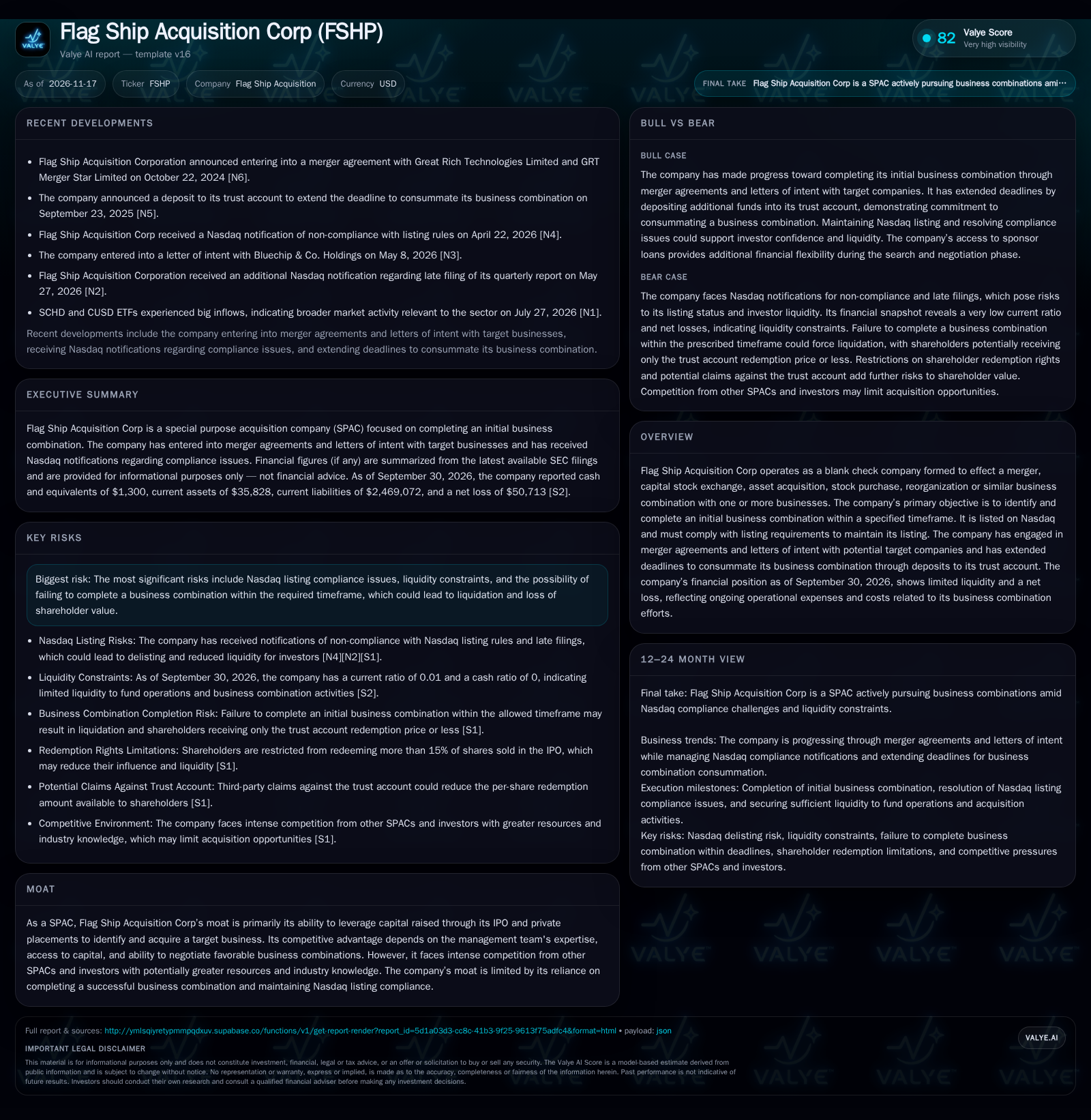
Flag Ship Acquisition Corp is a SPAC in the final stages of its business combination window, contending with critical Nasdaq compliance issues and a near-zero liquidity profile. With a merger agreement and a letter of intent in play, the company’s survival depends on consummating a deal before delisting or liquidation risks crystallize. Shareholder protections are limited, and trust account claims could further erode returns.
Flag Ship Acquisition Corp exemplifies the late-stage SPAC dilemma: the clock is ticking, liquidity has nearly evaporated, and regulatory pressures are mounting. The next several quarters will determine whether Flag Ship can deliver a deal—and preserve any upside for its public shareholders—or whether it will join the growing ranks of SPACs forced into liquidation amid eroding trust account protections and competitive deal-making headwinds.
Liquidity Collapse and Regulatory Pressure Define the Current Moment
[S2] [N4] [N2] The company has signed a merger agreement with Great Rich Technologies Limited and a letter of intent with Bluechip & Co. Holdings, but neither transaction is closed [N6] [N3]. To extend its business combination deadline, Flag Ship has made additional trust account deposits, but the company continues to operate at a net loss (–$50,713 for the period) [S2]. These facts set the stage for a high-stakes race: execute a business combination before regulatory or financial constraints force liquidation, with public shareholders facing restricted redemption rights and potential erosion of trust account value.
SPAC Economics: Fee Structures, Redemption Dynamics, and the Race Against Burn
Flag Ship’s business model is typical of post-IPO SPACs: it earns nominal interest income on trust assets but generates no operating revenue until a merger closes [S2]. Expenses—mainly legal, regulatory, and due diligence—are funded from limited working capital or sponsor loans, creating negative operating leverage as delays accrue. The company’s only meaningful assets are the trust account (originally $69 million post-IPO) and its listing status. The company reported a current ratio of 0.01 for the period. [S2]
Redemption dynamics play a central role. Public shareholders are limited to redeeming up to 15% of IPO shares, restricting their ability to exit if they disagree with the proposed deal or anticipate further deterioration [S1]. Claims against the trust account—such as unresolved liabilities or litigation—could further dilute redemption proceeds. The sponsor loan facility ($2 million maximum) provides a temporary bridge, but does not address the underlying capital deficit or provide funding for post-merger operations [S1]. In essence, Flag Ship’s economics are now a function of time-to-close versus cash-burn and regulatory deadlines.
The interplay between redemption limits and trust account claims introduces a complex risk-reward calculus for public shareholders. If the redemption cap is low relative to shareholder dissent, a significant portion of investors may be forced to remain invested in a potentially undervalued or distressed entity, amplifying downside exposure. Moreover, any claims against the trust account—such as indemnity obligations or unresolved legal disputes—effectively reduce the net assets available for distribution, further compressing returns. This dynamic incentivizes sponsors and management to expedite deal closure or secure alternative financing, but these efforts may come at the cost of dilutive financing terms or concessions to target companies, thereby impacting long-term shareholder value.
From a capital structure perspective, the reliance on sponsor loans as a stopgap financing mechanism is inherently limited. While these loans can provide incremental liquidity to cover immediate expenses or regulatory fees, they typically carry higher interest rates and repayment terms that may prioritize sponsor recovery over public shareholder interests. Additionally, the absence of operating revenue prior to a business combination means that any extended delays exacerbate cash burn without offsetting inflows, increasing the likelihood of financial distress. This scenario underscores the critical importance of managing operational expenses conservatively and exploring alternative financing avenues, such as PIPE investments, to bridge funding gaps while preserving shareholder equity.
Intense SPAC Competition and Diminishing Deal Quality
Flag Ship operates in a saturated SPAC ecosystem, where hundreds of blank-check companies are chasing a shrinking pool of attractive merger targets. Its primary competitive levers are its remaining trust capital, a Nasdaq listing (now at risk), and the perceived deal-making acumen of its sponsor team. However, regulatory non-compliance and a deteriorating balance sheet erode negotiating leverage with target companies, who may demand better terms or walk away entirely.
Other SPACs—especially those with more robust cash positions, cleaner regulatory records, or sector-specific credentials—are likely to outbid or outmaneuver Flag Ship for high-quality targets. The company’s focus on businesses with connections to the Asian market may provide some differentiation, but it also exposes the process to additional cross-border regulatory and diligence complexities. In the current environment, Flag Ship competes not just with other SPACs but also with private equity and strategic buyers, all of whom may offer more certainty or speed to closing.
The competitive disadvantage posed by regulatory non-compliance extends beyond immediate listing risks; it also signals governance and operational weaknesses to potential merger targets. Targets may perceive Flag Ship as a higher-risk partner, potentially demanding more stringent deal protections, higher valuations, or accelerated closing timelines, which may not align with Flag Ship’s constrained resources. Furthermore, the cross-border focus on Asian markets introduces additional layers of complexity, including differing regulatory regimes, cultural negotiation styles, and geopolitical considerations. These factors can prolong due diligence, increase transaction costs, and introduce uncertainties that further erode Flag Ship’s competitive positioning relative to domestic or sector-focused SPACs and strategic acquirers.
A Last-Minute Combination: What a Successful Close Would Require
The most favorable outcome for Flag Ship is a timely, shareholder-approved merger with a viable operating company—potentially Great Rich Technologies or Bluechip & Co. Holdings—before Nasdaq delisting or forced liquidation. This would require swift regulatory filings, target cooperation, and perhaps additional sponsor or PIPE (private investment in public equity) funding to bridge the liquidity gap.
Confirmation of this scenario would include: (1) the public announcement of a definitive business combination agreement with full deal terms; (2) SEC and shareholder approval within the current extension window; (3) evidence of additional capital commitments or waivers from the target to accommodate Flag Ship’s weakened cash position; and (4) Nasdaq granting continued listing subject to post-merger compliance. Falsification would be any further regulatory delays, withdrawal by target companies, or inability to secure shareholder approval due to unfavorable deal terms or redemption dynamics.
Merger Uncertainty Persists as Compliance and Cash Constraints Tighten
The most plausible outcome is continued uncertainty, with further delays in closing a business combination as compliance and liquidity headwinds intensify. Even with a signed merger agreement or LOI, regulatory reviews, shareholder votes, and necessary supplemental disclosures may push finalization beyond the extension window.
This scenario would be confirmed by ongoing Nasdaq warnings, additional trust account extensions (if permitted), and incremental sponsor loans to cover operating costs. Falsification would occur if the company either (a) closes a deal ahead of deadline or (b) receives a formal delisting or liquidation notice, triggering redemption and trust account disbursement procedures.
Liquidation and Erosion of Shareholder Value Loom Without a Timely Deal
The adverse scenario is that Flag Ship fails to consummate a business combination before deadlines or is delisted by Nasdaq, forcing liquidation. In this case, shareholders would be entitled only to their pro rata share of the trust account, minus potential claims and unresolved liabilities [S1].
Confirmation would come from a formal delisting notice, liquidation filing, or public statement from management acknowledging the inability to secure a deal. Falsification would be any regulatory relief, successful capital raise, or accelerated deal closing that resets the business combination clock.
Milestones That Will Determine Flag Ship Acquisition’s Fate
Definitive merger agreement announcement with full terms and regulatory timeline.
Nasdaq responses to compliance plans, including any waivers or extensions granted.
SEC acceptance of merger-related filings and prompt scheduling of a shareholder vote.
Disclosure of PIPE or other supplemental financing to address post-merger capital needs, if any.
Changes in the trust account balance, including new claims or withdrawals, if disclosed.
Updates to the sponsor loan facility—drawdown amounts and remaining capacity, if disclosed.
Actual redemption rates at the time of shareholder vote, as this will affect post-merger float and capital structure.
Any formal notice of delisting or liquidation procedures initiated by the company or regulators.
Disclaimer: This is research-only, informational analysis and not investment advice. It may include AI-generated interpretation and general industry context. Always verify important details using primary sources.

Comments