
Dolby Laboratories: Licensing Strength, Platform Expansion, and the Leverage of Ubiquity in Audio-Visual Innovation
Dolby’s high-margin licensing engine is reinforced by industry-standard technology, a robust partnership with Meta, and a new CEO at the helm. The company’s future hinges on sustaining its integration into emerging device categories and navigating intensifying competition in audio-visual tech.
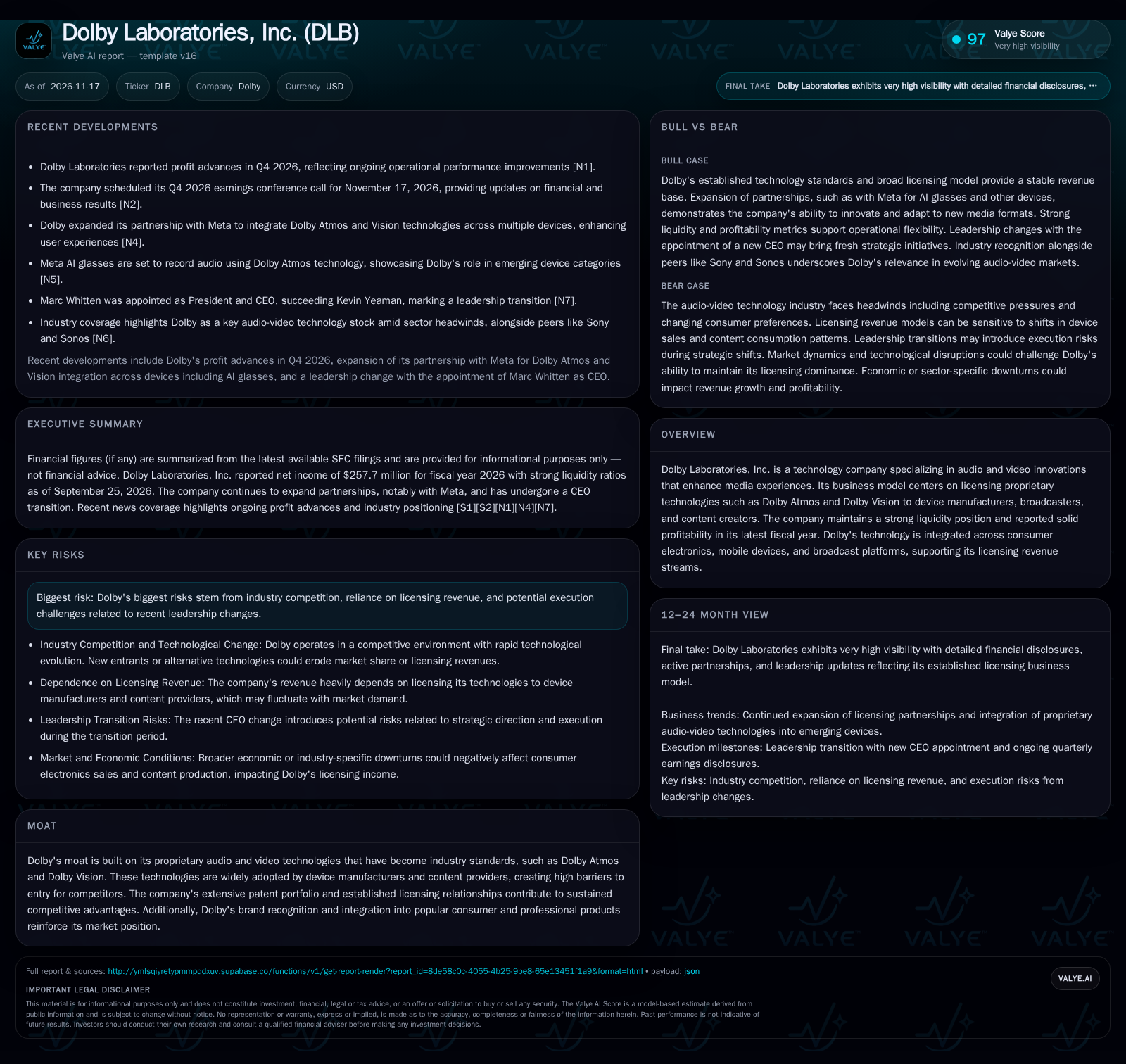
Dolby Laboratories reported $257.7 million in net income for fiscal 2026, with a reported cash position and a current ratio of 3.18 as of September 25, 2026. The company’s core revenue stream remains licensing audio and video technologies like Dolby Atmos and Vision, now expanding into Meta’s latest devices, including AI glasses. A CEO transition brings fresh leadership as Dolby faces sector headwinds and mounting competition. The sustainability of its licensing dominance will depend on continued technology adoption, successful new partnerships, and the ability to adapt to changing consumption patterns in media and devices. [S1] [N4] [N5] [N7]
Dolby Laboratories stands at a pivotal moment: its entrenched licensing model continues to deliver robust profitability, while its expanding technology partnerships—most notably with Meta—point toward new growth vectors in an evolving media landscape. The answer will hinge on both the resilience of its licensing engine and its ability to innovate into emerging platforms.
Recent Financial Performance and Strategic Inflection Points
Dolby Laboratories reported net income of $257.7 million for the fiscal year ending September 25, 2026, with basic earnings per share of $2.73 and diluted EPS of $2.70 [S1]. This profitability is supported by a reported liquidity position: $622.9 million in cash and cash equivalents, $0.5 million in short-term investments, and a current ratio of 3.18 [S1]. Beyond the financials, the company has expanded its partnership with Meta, integrating Dolby Atmos and Vision into a wider array of devices, including new AI glasses [N4] [N5]. Additionally, Marc Whitten’s appointment as President and CEO marks a leadership transition at a time of evolving industry dynamics [N7]. These facts collectively highlight Dolby’s operational strength, its push into next-generation device categories, and a potential strategic reorientation under new leadership.
Licensing Economics and the Leverage of Platform Integration
Dolby’s core business model centers on licensing proprietary audio and video technologies—most notably Dolby Atmos and Dolby Vision—to device manufacturers, streaming platforms, and content creators. This licensing model is inherently high-margin, as the company incurs relatively low incremental costs for each additional device or content stream adopting its technology. The majority of revenue flows through patent pools and bilateral agreements, with a minority coming from direct product sales and cinema revenue-sharing arrangements [S1].
The scalability of the licensing engine is a key economic advantage: as more manufacturers and platforms integrate Dolby technology, incremental revenue is generated with minimal additional cost. However, the model is volume-sensitive—revenue growth is tied to the adoption of Dolby-enabled devices and the expansion of addressable platforms. Recoveries from unlicensed or under-reported usage offer episodic revenue boosts, but are unpredictable and not a core growth driver. Dolby also participates in premium cinema through revenue-sharing, but this remains a smaller, lower-margin segment relative to licensing.
The company reported cash and liquidity metrics for the period; these figures do not by themselves establish operating runway, investment capacity, financial flexibility, or financing capacity. The challenge is maintaining licensing volumes as device categories evolve and alternative standards emerge.
The licensing model's dependence on widespread adoption across diverse device categories introduces both scalability opportunities and strategic risks. For instance, as Dolby extends into emerging segments like AI wearables and AR/VR devices, the heterogeneity of hardware capabilities and software ecosystems may affect integration complexity and adoption speed. The company must balance the cost-efficiency of licensing with the need for ongoing R&D investment to ensure compatibility and performance across evolving platforms. Moreover, the licensing revenue's sensitivity to macroeconomic cycles and consumer spending patterns on electronics could introduce variability, underscoring the importance of diversifying the licensing base across both premium and mid-tier devices to stabilize cash flows.
Defending the Standard: Dolby’s Moat and Emerging Competitive Threats
Dolby’s moat derives from its proprietary technologies—Atmos and Vision—which have become embedded standards across premium consumer electronics, streaming platforms, and cinemas. Its extensive patent portfolio and entrenched relationships with global manufacturers make displacement difficult, especially in segments where content creators and device makers prioritize quality and brand recognition.
However, the competitive landscape is dynamic. Alternative audio-visual standards, open-source codecs, and vertically integrated platform players (such as major smartphone or streaming ecosystems) represent credible substitutes. Companies like Sony, Sonos, and technology consortia continue to invest in rival technologies and may exert pricing or adoption pressure.
Switching costs for manufacturers are moderate but rise with deeper integration into content pipelines and user expectations. Still, the risk of standard fragmentation—especially as new device categories (e.g., AR/VR, AI glasses) proliferate—could erode Dolby’s dominance if alternative formats gain traction. Dolby’s ability to remain the preferred standard in these emerging platforms will be a critical test of its competitive durability.
Dolby’s entrenched relationships and patent portfolio provide a formidable barrier to entry, yet the pace of innovation in audio-visual technology demands continuous evolution. The rise of open-source codecs and royalty-free standards challenges the traditional licensing paradigm by offering cost advantages and greater customization flexibility to manufacturers. Dolby’s ability to sustain its moat may hinge on demonstrating clear value-added differentiation—such as superior quality, seamless integration, or enhanced user experience—that justifies premium licensing fees. Additionally, the company faces the strategic challenge of engaging with ecosystem players who might prefer vertically integrated solutions, potentially bypassing third-party licensors to control the entire user experience and cost structure.
Unlocking New Platforms: How Next-Gen Partnerships Could Accelerate Growth
A favorable scenario for Dolby sees its technologies becoming foundational in a new generation of connected devices—particularly as AR/VR, AI wearables, and smart home platforms mature. The expanded partnership with Meta, which brings Dolby Atmos and Vision to an array of devices including AI glasses, is an early signal of this dynamic [N4] [N5]. If major consumer electronics players standardize on Dolby for both audio and video across a widening range of products, licensing volumes could outpace the underlying device market growth.
Confirmation of this scenario would include rapid adoption of Dolby-enabled features in flagship devices beyond traditional smartphones and TVs, an accelerating cadence of partnership announcements, and a rise in recurring licensing revenue from new categories. Conversely, if alternative standards are adopted or if new device categories opt for in-house or open-source solutions, the upside would be capped.
In scenarios where Dolby successfully embeds its technologies as foundational components of next-gen device ecosystems, network effects could amplify its competitive advantage. As more manufacturers and content providers adopt Dolby standards, consumer expectations may coalesce around these formats, creating a virtuous cycle of demand and innovation. This dynamic could enable Dolby to negotiate more favorable licensing terms and expand into adjacent revenue streams such as software tools or developer platforms. However, achieving this outcome depends on Dolby’s agility in adapting its licensing frameworks and technology offerings to the unique requirements of emerging devices, including latency constraints, form factor limitations, and AI-driven content personalization.
Sustaining the Core: Licensing Resilience Amid Evolving Device Mix
The most plausible outcome is that Dolby maintains its core licensing strength in established categories—TVs, soundbars, streaming, and premium cinema—while gradually expanding into select new platforms. Revenue growth would track global consumer electronics trends, with episodic boosts from new device launches or content partnerships, but tempered by competitive pressure and intermittent device or content cycle downturns.
Evidence supporting this base case would include stable or modestly growing licensing revenue, continued profitability, and a steady cadence of technology integrations with leading device manufacturers. Signs of erosion would be a material decline in licensing volume, loss of flagship device design wins, or a marked shift toward alternative standards by key partners.
Maintaining steady licensing revenue amid evolving device mixes requires Dolby to strategically prioritize compatibility and interoperability. As device categories diversify, Dolby’s technology must integrate seamlessly with various operating systems, hardware architectures, and content delivery networks. The company’s capacity to provide flexible licensing models and developer support could influence adoption rates in nascent markets. Furthermore, sustaining profitability in this scenario involves managing the balance between protecting intellectual property and fostering broad ecosystem participation, which may necessitate calibrated pricing strategies and collaborative partnerships with device makers and content creators to mitigate competitive pressures without eroding margins.
Erosion of Licensing Dominance: What Could Undermine Dolby’s Model
The adverse scenario involves accelerating competitive encroachment and/or a structural shift in device and content standards away from Dolby’s proprietary technologies. If major manufacturers or streaming platforms pivot to alternative codecs—either for cost reasons, strategic independence, or due to regulatory or interoperability pressures—Dolby’s licensing volumes could contract more rapidly than device market trends.
This risk is amplified if fragmentation in emerging device categories (e.g., AR/VR, wearables) leads to a proliferation of proprietary or open-source solutions, bypassing Dolby standards altogether. Early warning signs would include a loss of renewal contracts, public defections by key OEMs, a sharp drop in licensing recoveries, or a decline in the company’s ability to command premium pricing for its technologies.
Evidence That Will Test Dolby’s Licensing Resilience and Expansion Ambitions
Adoption rates of Dolby Atmos and Vision in new device categories (such as AI glasses, AR/VR headsets, or automotive platforms) as disclosed by the company or key partners.
Growth in licensing revenue attributable to emerging platforms versus traditional consumer electronics—if disclosed in segment reporting.
Retention and expansion of flagship manufacturer relationships, especially in competitive device launches.
Sustained or increased incidence of licensing recoveries, suggesting continued control over IP enforcement and under-reported usage.
Gross margin trends, which would indicate pricing power and mix shift between high-margin licensing and lower-margin product or cinema revenue.
Execution on new partnership announcements—particularly with platform players outside traditional consumer electronics.
Impact of CEO transition on strategic direction and operational execution, as reflected in public communications and subsequent business development activity.
Disclaimer: This is research-only, informational analysis and not investment advice. It may include AI-generated interpretation and general industry context. Always verify important details using primary sources.

Comments