
F5, Inc.: Platform Integration, Cybersecurity Fallout, and the Shifting Economics of Application Delivery
F5, Inc. enters 2027 with a robust financial profile, renewed buyback authorization, and momentum in systems growth—yet it faces reputational and operational headwinds from a major cyber breach and the rising complexity of AI-driven security. The company’s future will be shaped by its ability to monetize converged solutions, manage risk, and defend its position as application environments fragment and threats intensify.
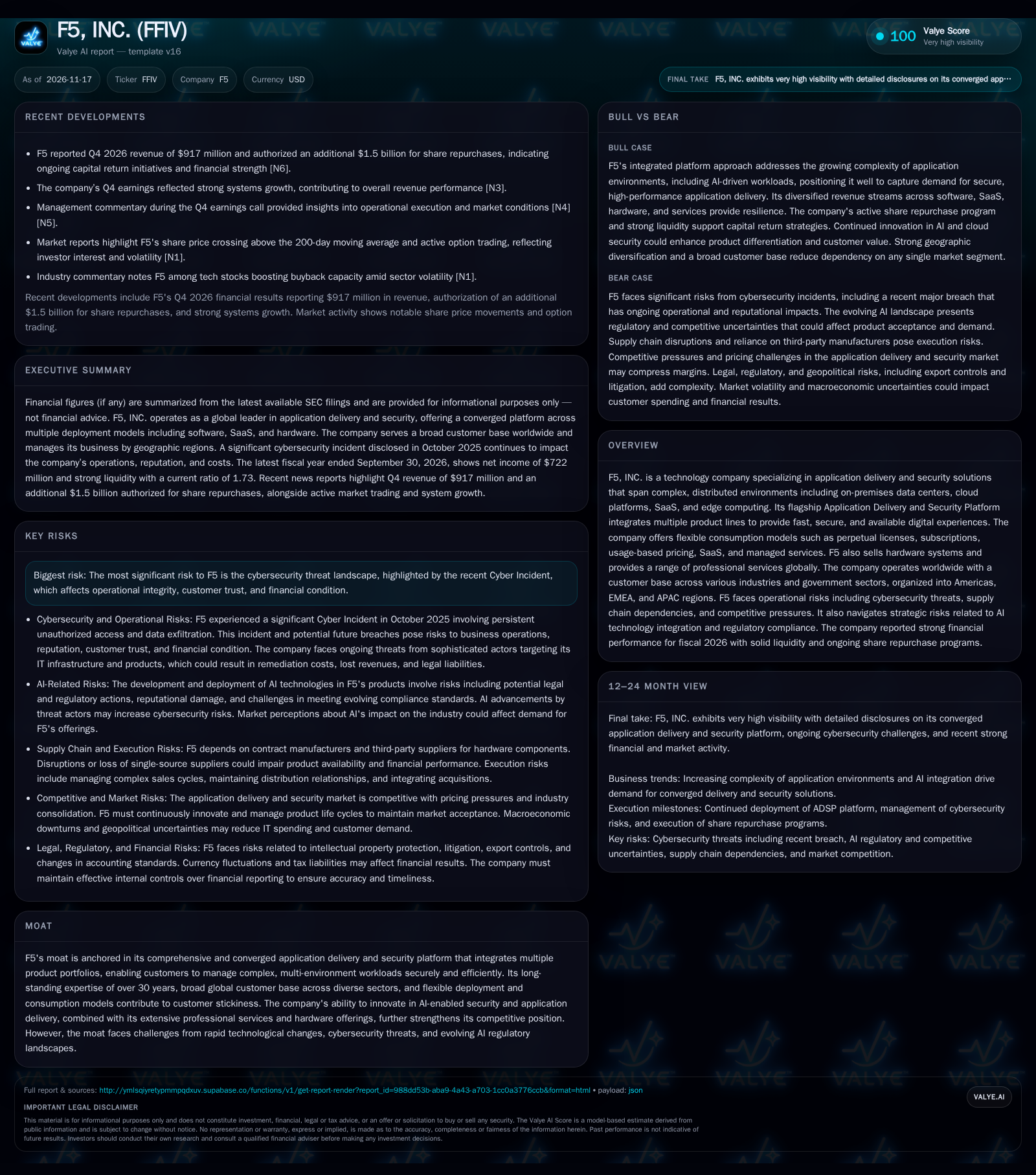
F5, Inc. reported strong Q4 2026 systems growth and maintains a reported cash position with $1.59 billion in cash and equivalents. The company authorized an additional $1.5 billion for share repurchases and posted net income of $722.1 million for fiscal 2026. However, the fallout from a major cyber incident in 2025 continues to affect operations and reputation. The company’s next phase hinges on successfully executing its integrated platform strategy, managing cybersecurity risk, and responding to competitive and technological shifts in application delivery and security markets. [S1] [N3] [N4] [N5]
F5, Inc. stands at a strategic inflection point as it leverages its converged platform to address the increasing complexity of digital application environments. However, the lingering effects of a major 2025 cyber incident—amid rising AI-driven threats and regulatory scrutiny—underscore the importance of risk management and trust in the company’s future value proposition. F5’s ability to convert platform breadth into sustainable, defensible economics will define its competitive standing as enterprise IT rapidly evolves. [S1] [N3] [N4] [N5]
Recent Performance, Buyback Expansion, and Cybersecurity Headwinds: The Material Facts
F5, Inc. reported Q4 2026 revenue of $917 million, reflecting strong systems growth that contributed to overall momentum for the fiscal year. Net income for the year reached $722.1 million, with basic EPS of $12.68. As of September 30, 2026, the company’s cash and equivalents totaled $1.59 billion, yielding a current ratio of 1.73 and a cash ratio of 0.88. Alongside this, F5’s board authorized an additional $1.5 billion for share repurchases, amplifying its capital return program. [S1] [N3]
The company continues to face operational and reputational impacts from a major cybersecurity incident disclosed in October 2025, involving unauthorized access and data exfiltration. This breach has ongoing implications for customer trust, future remediation costs, and F5’s positioning as a security provider. [S1]
F5’s Application Delivery and Security Platform (ADSP) now integrates its BIG-IP, NGINX, and Distributed Cloud portfolios, offering customers a unified solution across on-premises, cloud, SaaS, and edge environments. This convergence is central to F5’s growth narrative and product differentiation strategy. [S1]
How F5’s Platform Model Could Drive Profitable Growth—And Where Frictions Remain
F5’s economic engine is built on a diversified mix of revenue streams: traditional perpetual hardware and software licenses, recurring subscriptions, usage-based pricing, SaaS, and managed services. The company’s pivot toward integrated solutions and flexible consumption models aims to capture a greater share of customer IT spend as application environments proliferate and security requirements intensify.
Historically, hardware sales provided upfront revenue and high gross margins, but these are increasingly complemented or supplanted by software and SaaS offerings that offer multi-year, recurring revenue potential. The move to subscriptions and usage-based pricing could increase revenue visibility and customer lifetime value, but also exposes F5 to competitive pricing dynamics and potential margin compression if software attach rates or renewal rates underperform.
Operating leverage is plausible as the business scales software and cloud offerings, since incremental delivery costs for software and SaaS are typically lower than for hardware. However, the company’s ongoing need to invest in R&D (particularly in AI and security analytics), maintain global service and support capacity, and remediate the cybersecurity breach may constrain margin expansion in the near term.
Capital requirements are moderate for a software-centric platform, with most investment directed toward product development and cloud infrastructure partnerships rather than physical assets. However, significant share repurchases suggest F5 sees limited need for cash redeployment toward transformative M&A or major organic expansion at this stage. [S1] [N3]
Defending the Moat: Integration, Switching Frictions, and the Battle for Application Security
F5’s competitive position rests on its ability to deliver a unified platform that simplifies the deployment, management, and security of applications across fragmented IT environments. Integration of BIG-IP, NGINX, and cloud-native offerings is designed to could increase switching costs, as enterprise customers value stability, policy consistency, and operational efficiency in mission-critical workloads.
Customer stickiness is enhanced by F5’s global support network, professional services, and the complexity of unwinding embedded infrastructure. However, these switching frictions are not insurmountable, especially as cloud-native competitors, hyperscale cloud providers, and security-focused upstarts offer modular, API-driven alternatives that promise lower cost and easier adoption.
The market for application delivery and security is highly competitive, with pricing pressures, rapid innovation cycles, and frequent vendor consolidation. F5 must continuously invest to maintain product relevance, defend against margin erosion, and differentiate on features such as AI-driven threat detection, scalability, and regulatory compliance. The recent cyber incident may erode perceived trust and provide an opening for rivals to challenge F5’s reputation as a security leader. [S1]
If Platform Convergence Drives Adoption: What a Win Looks Like
A favorable outcome for F5 would involve accelerated adoption of its integrated Application Delivery and Security Platform, with customers standardizing on F5 for both legacy and cloud-native workloads. This could drive higher attach rates for software and services, reduce churn, and enable price realization for advanced security and AI-powered analytics.
Evidence supporting this scenario would include sustained double-digit growth in subscription and SaaS revenues, rising software gross margins, and increasing multi-year contract wins or extensions. Expansion of large enterprise and public sector accounts, particularly those migrating complex workloads to hybrid or multi-cloud environments, would further validate the platform strategy.
F5’s ability to contain costs related to the cyber incident—demonstrated by stable or improving operating margins and reduced remediation expenses—would reinforce confidence in management’s execution. Positive analyst or customer commentary on the effectiveness and ease-of-use of the converged platform would also signal traction.
Platform Evolution Meets Persistent Headwinds: The Most Plausible Trajectory
The most likely scenario is a mixed environment: F5 continues to grow its software and SaaS segments, but faces uneven uptake as some customers remain on legacy hardware or shift to alternative cloud-native solutions. Platform integration drives incremental cross-sell and higher retention among large, complex customers, but pricing pressure and competitive alternatives limit outsized share gains.
Remediation and reputational costs from the 2025 cyber incident persist, but are gradually absorbed into the operating base. Share repurchases support EPS, but do not fundamentally alter the long-term growth trajectory absent organic acceleration or transformative M&A.
Confirmation of this scenario would come from mid-single-digit revenue growth, stable or slightly improving operating margins, and continued but decelerating hardware sales as the product mix shifts. If disclosed, customer retention rates and software revenue mix would be useful indicators of underlying momentum.
Breaches, Margin Pressure, and Platform Disruption: The Bearish Chain of Events
In a negative scenario, the reputational and operational fallout from the 2025 cyber incident proves more severe than anticipated, leading to customer defections, lost contract renewals, and increased scrutiny from regulators. Costs associated with legal claims, warranty remediation, and security hardening erode profitability.
Simultaneously, F5 may face intensifying competition from cloud-native security vendors, hyperscalers expanding their own application delivery portfolios, and disruptive new entrants leveraging AI to undercut traditional architectures. If F5 is unable to keep pace with innovation or respond to evolving regulatory requirements, its platform could lose relevance in key market segments.
Confirmation of this scenario would include declining revenue, margin compression, accelerated churn of large enterprise or public sector clients, and negative customer or analyst sentiment regarding F5’s security credibility or product roadmap. Material increases in legal or regulatory costs would further reinforce the risk.
What Will Validate or Challenge F5’s Platform Thesis in the Next Year?
Sustained growth in software, SaaS, and recurring revenue as a percentage of total revenue, if disclosed, would indicate successful platform transition.
Trends in operating margin and remediation costs related to the cyber incident will clarify whether F5 is absorbing or struggling with breach fallout.
Hardware systems revenue trajectory—does it stabilize, decline, or rebound as customers pivot to integrated solutions?
Customer retention, churn, or renewal rates (if disclosed) among top enterprise and public sector accounts would help test switching friction and competitive pressure.
Gross margin trends by segment (hardware vs. software/SaaS) would shed light on mix shift and pricing power.
New large enterprise, government, or regulated industry wins—especially for integrated ADSP deployments—would signal market acceptance.
Disclosures of regulatory or legal costs, settlements, or new compliance mandates stemming from the breach would clarify downside risks.
Commentary on AI-enabled product launches or adoption rates, and any related regulatory or reputational challenges, would help gauge future differentiation.
Disclaimer: This is research-only, informational analysis and not investment advice. It may include AI-generated interpretation and general industry context. Always verify important details using primary sources.

Comments