
Lantern Pharma: AI-Driven Oncology Ambitions Confront Clinical, Financial, and Market Listing Stressors
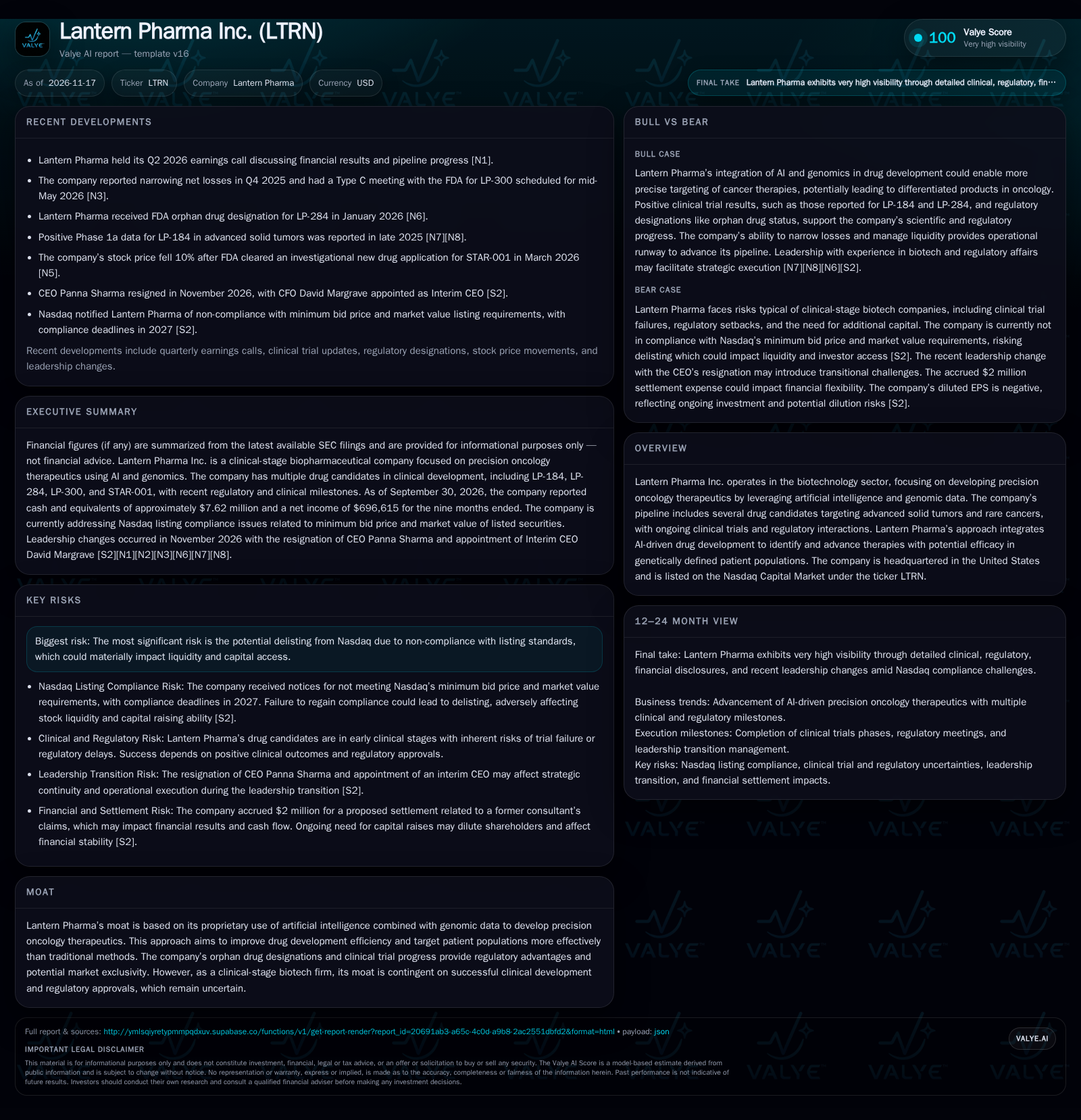
Lantern Pharma is advancing a pipeline of AI-enabled oncology therapeutics, achieving FDA orphan drug designation for LP-284 and positive Phase 1a data for LP-184.
Lantern Pharma is advancing a pipeline of AI-enabled oncology therapeutics, achieving FDA orphan drug designation for LP-284 and positive Phase 1a data for LP-184. However, leadership transition, a $2 million settlement accrual, and ongoing Nasdaq non-compliance introduce uncertainty. [S2]
Lantern Pharma stands at a pivotal juncture in the volatile landscape of clinical-stage oncology drug development. The company’s AI- and genomics-driven approach to precision therapeutics has yielded recent regulatory and clinical milestones, such as FDA orphan drug designation for LP-284 and positive Phase 1a results for LP-184. The next 12–18 months will test Lantern’s ability to translate platform promise into durable value.
Recent Milestones and Setbacks Define Strategic Inflection Point
Lantern Pharma’s recent developments highlight both forward progress and material headwinds. The company secured FDA orphan drug designation for LP-284 in January 2026, a development that could facilitate expedited review and extended market exclusivity if clinical success is achieved. Positive Phase 1a data for LP-184 in advanced solid tumors, reported in late 2025, further substantiates the platform’s potential to generate differentiated assets. However, operational challenges are mounting: CEO Panna Sharma resigned in November 2026, replaced by CFO David Margrave as interim CEO, and the company accrued a $2 million settlement expense tied to a former consultant’s claims. Most pressingly, Lantern is currently non-compliant with Nasdaq’s minimum bid price and market value listing requirements, facing compliance deadlines in 2027. These developments set a complex backdrop for Lantern’s near-term execution. [S2] [N6] [N7] [N8]
AI-Driven Pipeline Economics: Promise, Costs, and Dilution Pressures
Lantern Pharma’s business model relies on the capital-intensive economics of clinical-stage drug development, compounded by the unpredictability of regulatory outcomes and the high fixed costs of running trials. By leveraging AI and genomics, Lantern aims to identify and advance oncology drug candidates more efficiently than traditional approaches—potentially improving probability of technical and regulatory success, and reducing R&D cycle time. If successful, this could yield a portfolio of precision therapies targeting genetically defined subpopulations, which often command premium pricing and benefit from orphan drug exclusivity.
Revenue generation remains prospective; the company has not reached the commercialization stage for any asset. The current cost structure is dominated by R&D and G&A, with the recent $2 million legal settlement further pressuring near-term cash flow. As of September 30, 2026, Lantern reported $7.62 million in cash and equivalents, $10,882 in short-term investments, current assets of $8.41 million, and current liabilities of $5.65 million—yielding a current ratio of 1.49 and cash ratio of 1.35. The company reported cash and liquidity metrics for the period; these figures do not by themselves establish operating runway, investment capacity, financial flexibility, or financing capacity. Ongoing negative diluted EPS underscores the ongoing need for external funding, whether via dilutive equity raises or partnerships. [S2]
Can AI-Enabled Precision Carve Sustainable Oncology Differentiation?
Lantern’s competitive thesis rests on its proprietary use of AI and genomics to accelerate identification and development of cancer therapeutics for well-defined patient subsets. This strategy could, in principle, deliver faster proof-of-concept, reduce development costs, and enable targeting of rare or refractory tumors that are underserved by standard-of-care regimens. The recent orphan drug designation for LP-284 and positive Phase 1a data for LP-184 illustrate this approach.
However, the competitive landscape in precision oncology is crowded and dynamic. Larger biopharma players and other AI-driven startups are pursuing similar strategies, often with deeper pockets and more extensive clinical infrastructure. Barriers to entry are moderate: while proprietary algorithms and accumulated genomic datasets offer some defensibility, ultimate sustainable advantage will depend on clinical and regulatory success, as well as the ability to translate platform insights into commercially viable drugs. Regulatory designations (orphan, fast-track, etc.) provide time-limited exclusivity but do not guarantee market adoption or payer acceptance. Without near-term clinical wins or partnerships, Lantern’s competitive position remains more potential than proven.
Catalysts for a Platform Breakout: What Would Signal a Virtuous Cycle?
The upside scenario for Lantern Pharma is predicated on a sequence of favorable developments: continued positive clinical trial readouts (especially Phase 2 or registrational data for LP-184, LP-284, or LP-300), further regulatory designations, and the forging of value-adding partnerships or licensing deals. If AI-enabled drug candidate selection consistently yields assets with superior efficacy or safety profiles in genetically defined populations, Lantern could attract strategic attention from larger biopharma or secure non-dilutive funding.
Evidence that would confirm this scenario includes: (1) successful advancement of one or more candidates into late-stage trials, (2) announcement of out-licensing or co-development deals with upfront or milestone payments, (3) positive regulatory feedback or fast-track designations beyond orphan status, and (4) improved financial metrics driven by collaboration revenue or non-dilutive financing. Demonstrated ability to narrow operating losses without sacrificing pipeline momentum would further validate the model.
Navigating the Next 18 Months: Execution Amid Capital and Listing Constraints
The most plausible scenario is one in which Lantern continues to advance its lead programs through early-stage clinical trials, but progress is incremental and punctuated by capital raises and ongoing Nasdaq compliance efforts. Regulatory and clinical milestones—such as further Phase 1/2 data for LP-184 or LP-284—could incrementally de-risk the story, but are unlikely to transform Lantern’s economics until at least one candidate enters pivotal trials or secures a commercial partnership.
This scenario would be confirmed by steady, if unspectacular, clinical progress; periodic equity offerings or warrants; and continued scrutiny from Nasdaq regarding listing compliance. Falsification would come from either a major clinical failure, inability to raise capital, or regulatory setbacks that delay or derail the pipeline.
Cascading Risks: Delisting, Dilution, and Clinical Setbacks
The adverse case for Lantern Pharma is a convergence of negative catalysts: failure to regain compliance with Nasdaq listing standards, forcing a delisting that materially impairs liquidity and investor access; inability to secure sufficient capital at reasonable terms, leading to operational cutbacks or forced asset sales; and/or disappointing clinical or regulatory outcomes that undermine confidence in the platform’s core thesis.
Confirmation of this scenario would include: (1) formal Nasdaq delisting, (2) distressed or highly dilutive financings, (3) negative or inconclusive trial results for key assets, and (4) protracted leadership instability or loss of key scientific personnel. In this environment, Lantern’s ability to continue as a going concern could be called into question, with limited optionality for shareholders.
Milestones That Will Test Lantern Pharma’s Precision Oncology Strategy
Progression of LP-184, LP-284, and LP-300 into later-stage (Phase 2/3) clinical trials, including updated timelines and enrollment figures, if disclosed.
Regulatory developments, such as additional orphan, fast-track, or breakthrough therapy designations for pipeline assets.
Details and timing of any announced partnering, licensing, or co-development agreements that provide non-dilutive capital or external validation.
Updates on Nasdaq listing status, including any reverse splits, appeals, or compliance measures taken to maintain listing.
Cash burn trends and explicit disclosures regarding projected runway under various development scenarios, if disclosed.
Material changes in leadership, R&D staffing, or board composition that could affect strategic continuity.
Clinical data releases (efficacy, safety, biomarker-driven outcomes) that directly impact the perceived value of the AI/genomics platform.
Disclaimer: This is research-only, informational analysis and not investment advice. It may include AI-generated interpretation and general industry context. Always verify important details using primary sources.

Comments