
Griffon’s Pure-Play Transformation: Focus, Scale, and the Levers for Durable Value in Building Products
After divesting non-core operations and forming strategic joint ventures, Griffon Corporation is now a focused leader in North American building products, leveraging strong brands, exclusive retail partnerships, and proprietary platforms. The company’s streamlined portfolio, robust manufacturing and distribution footprint, and emphasis on innovation position it to capture both cyclical upswings and incremental market share, but concentrated customer exposure and competitive pressures remain central watchpoints.
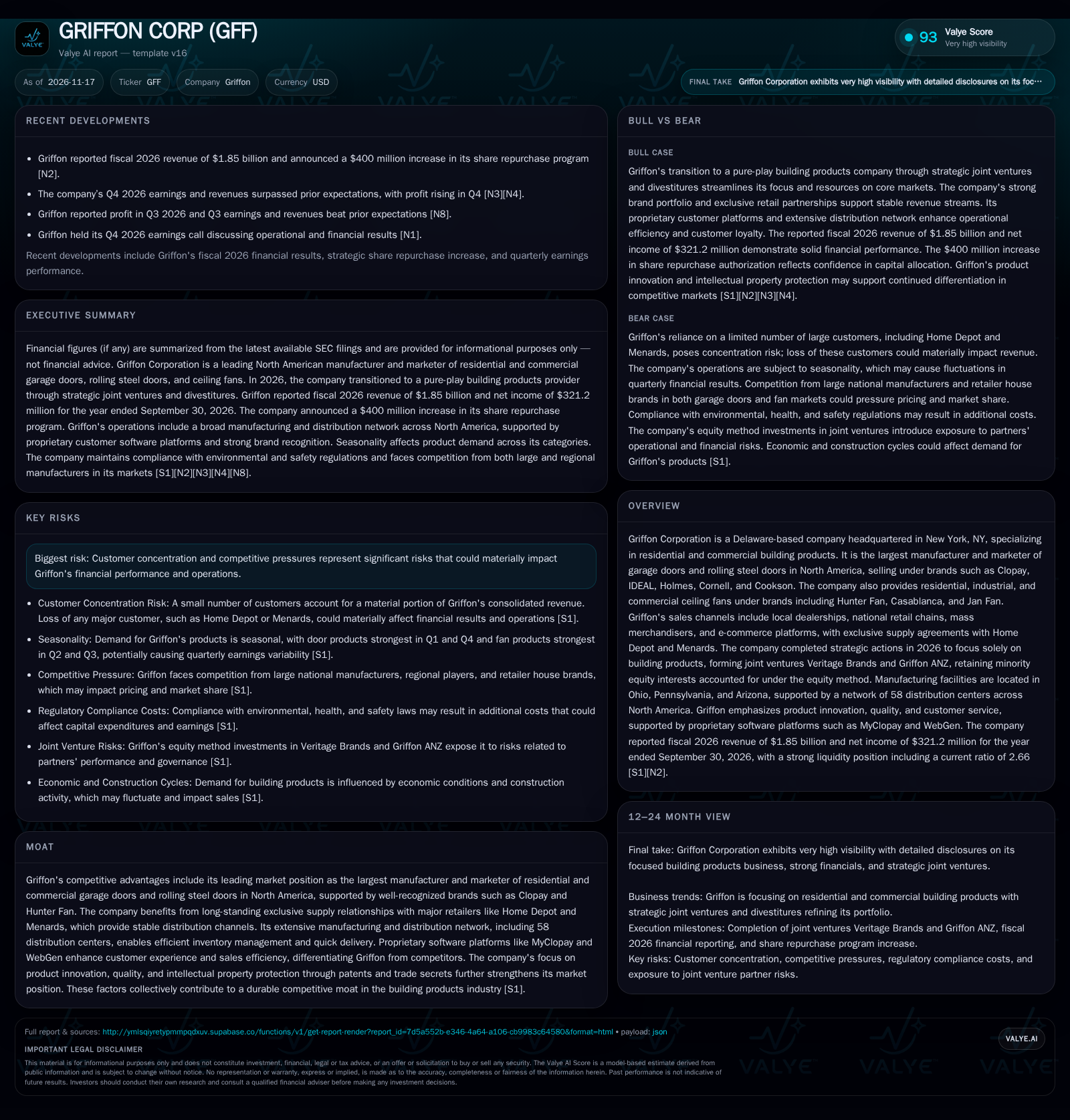
Griffon Corporation’s 2026 pivot to a pure-play building products model—centered on garage doors, rolling steel doors, and ceiling fans—has yielded strong financial results and operational focus. Exclusive retail relationships, proprietary software, and a broad distribution network underpin current performance, while the $400 million share repurchase authorization signals capital allocation confidence. However, revenue concentration and intense competition from both national and private-label players pose ongoing risks. Monitoring customer mix, margin resilience, and joint venture outcomes will be critical to assessing Griffon’s durability and upside.
Griffon Corporation’s 2026 strategic transformation completed its evolution from a diversified industrial conglomerate to a focused building products powerhouse, with operations now concentrated in garage doors, rolling steel doors, and ceiling fans. The company’s streamlined structure, bolstered by exclusive retail partnerships and proprietary digital platforms, has delivered strong financial results and operational clarity. Yet, this high-visibility model also sharpens exposure to customer concentration and competitive intensity, making Griffon’s next phase of growth dependent on its ability to deepen channel resilience, defend margins, and extract incremental value from its brand and distribution advantages.
2026 Restructuring, Financial Results, and Strategic Signals
Griffon Corporation’s 2026 fiscal year marks the first full period as a pure-play building products provider after divesting non-core segments and forming joint ventures for AMES North America and AMES Australasia, retaining minority equity interests in each [S1]. This transition has clarified the company’s operational focus and reporting structure. For the fiscal year ended September 30, 2026, Griffon reported $1.85 billion in revenue and $321.2 million in net income—figures that reflect the new, streamlined scope [N2]. Management’s confidence is further signaled by a $400 million increase in the share repurchase program, and both Q4 and Q3 2026 earnings beat expectations, suggesting operational momentum [N3] [N4] [N8]. These developments matter because they redefine Griffon’s financial base, risk profile, and capital allocation priorities, setting a new baseline for future performance and strategic evaluation.
How Griffon’s Building Products Model Generates Profits—and Where Leverage Lies
Griffon’s post-divestiture economics are anchored in high-volume, brand-driven manufacturing and distribution of garage doors, rolling steel doors, and ceiling fans. The company leverages a mix of fixed-cost manufacturing assets—facilities in Ohio, Pennsylvania, and Arizona for doors, and distribution centers for fans in Mississippi and Tennessee—against a broad North American customer base. The principal raw material, galvanized steel, introduces input cost volatility, but scale procurement and inventory management can partially mitigate margin swings. Product mix is critical: premium branded doors and fans likely carry higher margins than mass-market SKUs, and innovation or proprietary features (e.g., smart-enabled fans or custom door finishes) can support pricing power if successfully differentiated.
Exclusive supply agreements with Home Depot and Menards provide volume stability but may pressure margins due to concentrated buyer power. Proprietary platforms such as MyClopay and WebGen are designed to improve sales efficiency and customer experience, potentially lowering selling costs and increasing dealer stickiness. Griffon’s revenue is subject to pronounced seasonality—door demand peaks in Q1/Q4, fan sales in Q2/Q3—necessitating working capital flexibility and agile production planning [S1]. Operating leverage is significant: fixed manufacturing costs mean incremental sales above breakeven can drive substantial profit flow-through, but sharp volume declines could compress margins rapidly. The company reported cash and liquidity metrics for the period; these figures do not by themselves establish operating runway, investment capacity, financial flexibility, or financing capacity. [S1]
Brand Power, Retail Exclusivity, and the Threat of Substitution
Griffon’s principal competitive advantages stem from its leading market share in North American garage and rolling steel doors, supported by brands like Clopay and IDEAL, and in the ceiling fan market through Hunter Fan and Casablanca [S1]. Deep relationships with national retailers—most notably exclusive supply agreements with Home Depot and Menards—provide visibility and shelf space that smaller competitors may struggle to match. The company’s 58 distribution centers enable rapid fulfillment and local service, which can be a differentiator in project-driven categories where delivery time is critical.
However, these advantages are counterbalanced by the risks of customer concentration: a loss or renegotiation of a major retail contract could materially impact revenue and pricing terms. Competition is fierce, with both large national manufacturers and private-label/house brands (often retailer-controlled) pressuring margins. In fans, independent manufacturers and emerging smart-home entrants threaten to commoditize traditional segments. Substitution risk is also present in both categories—contractors and end-users can switch to alternative brands or materials if price/value equations shift. Griffon’s focus on product innovation and proprietary customer platforms is aimed at defending share and margin, but continued investment is required to stay ahead of both legacy and digital-native rivals.
Leveraging Scale, Innovation, and Channel Strength for Share Gains
In a favorable scenario, Griffon leverages its focused portfolio, brand equity, and proprietary digital platforms to drive above-market growth and margin expansion. Continued innovation—such as new product introductions, smart features, or design customization—could command premium pricing and deepen customer loyalty, especially if integrated into the MyClopay and WebGen platforms. Exclusive retail partnerships may yield incremental volume as Home Depot and Menards expand store counts or e-commerce penetration.
Operating leverage could amplify profit growth if throughput increases, given the fixed-cost base of manufacturing and distribution. The company could also benefit from construction cycle tailwinds: a sustained upturn in residential or commercial building activity would lift demand for both doors and fans. Equity method investments in the Veritage Brands and Griffon ANZ joint ventures could become meaningful contributors if those businesses outperform or are monetized. Confirmation of this scenario would include sustained revenue and earnings beats, margin improvement despite raw material volatility, new supply agreements or expanded retailer partnerships, and evidence of successful new product launches or market share gains.
Sustaining Profitable Operations Amid Seasonality and Channel Dependence
The most plausible outlook is that Griffon maintains steady, profitable operations in its core building products markets, with results tracking general economic and construction cycles. The company’s exclusive retail relationships provide baseline volume and visibility, but pricing remains competitive, and margin upside is limited by both concentrated customer leverage and input cost fluctuations. Product innovation and proprietary platforms continue to differentiate Griffon enough to retain share, but not enough to materially expand margins against national and private-label competition.
Seasonality and economic sensitivity drive quarter-to-quarter variability, but over a cycle, the company generates solid cash flow and returns capital through share repurchases. Joint ventures deliver some equity income but are not transformative. Evidence supporting this scenario would include stable gross and operating margins, moderate revenue growth in line with construction activity, and continued capital returns. A deviation—such as a major retailer loss, sustained margin erosion, or outsized joint venture losses—would challenge the base case.
Customer Concentration, Margin Compression, and Execution Missteps as Value Risks
The primary risk scenario centers on Griffon’s exposure to a handful of large customers. If Home Depot, Menards, or another key partner were to reduce volume, shift to private-label sourcing, or renegotiate terms, Griffon could face abrupt revenue loss and downward pricing pressure. This could be exacerbated if competitors—either established brands or new entrants with disruptive offerings—gain traction in core categories, leading to market share loss.
Raw material cost spikes, especially in galvanized steel, could further compress margins if not offset by pricing or procurement strategies. Execution risk is present if the company underinvests in product innovation or fails to adapt to shifting consumer/contractor preferences (e.g., smart-home integration in fans or doors). Problems at the joint venture level could also create unexpected equity losses or reputational harm. Confirmation of a downside scenario would include announced loss of a major contract, sustained margin declines, negative surprises from joint ventures, and/or working capital stress from mismatched inventory or receivables.
Milestones and Data Points That Will Shape Griffon’s Strategic Trajectory
Changes in the customer mix or concentration, especially any shifts in the proportion of sales to Home Depot, Menards, or other major partners, if disclosed.
Gross and operating margin trends, particularly in relation to raw material price movements and product mix.
Evidence of new or renewed exclusive supply agreements with major retailers, or expansion into additional channels (including e-commerce growth).
Rates of product innovation and successful launches, such as new smart-enabled fans, custom door offerings, or enhancements to the MyClopay and WebGen platforms.
Performance of equity method joint ventures (Veritage Brands and Griffon ANZ), including reported equity income, asset sales, or buyouts.
Quarterly working capital metrics—especially inventory turns and days sales outstanding—to assess operational efficiency and cash conversion.
Market share data in core door and fan categories, if disclosed, or third-party estimates to track competitive position.
Any regulatory developments or compliance costs that could impact capital allocation or earnings.
Disclaimer: This is research-only, informational analysis and not investment advice. It may include AI-generated interpretation and general industry context. Always verify important details using primary sources.

Comments