
reAlpha Tech: AI-Driven Homebuying Platform Seeks Scale Amid Persistent Liquidity Strains
reAlpha Tech Corp. is betting on an end-to-end, AI-powered homebuying platform to disrupt U.S. residential real estate services.
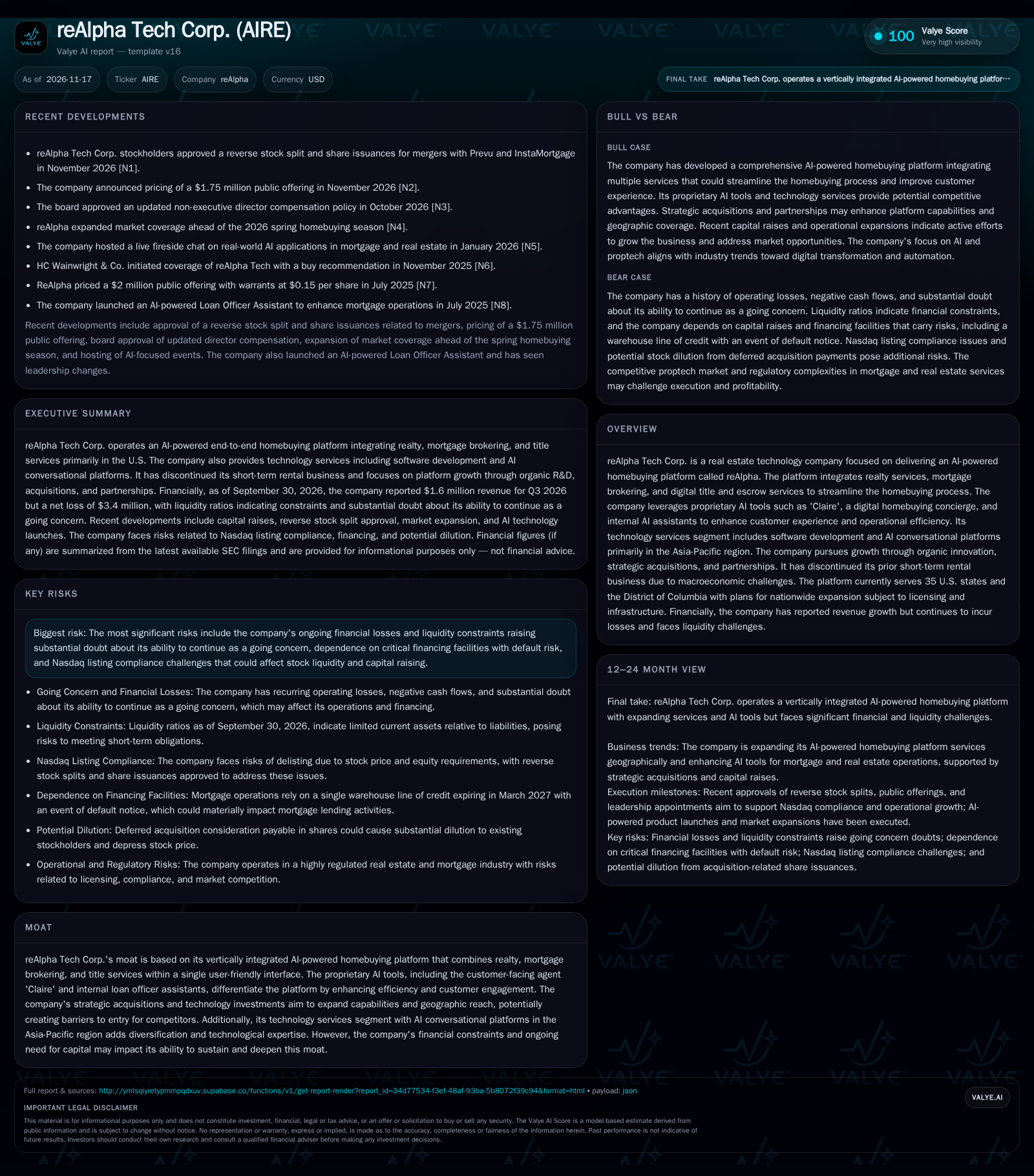
reAlpha Tech offers a vertically integrated, AI-enhanced homebuying platform that bundles realty, mortgage, and title services for U.S. consumers. [S1] [S2] [N2]
reAlpha Tech Corp. is positioning itself as a next-generation real estate technology firm, aiming to simplify and digitize the U.S. homebuying process through a proprietary, AI-driven platform. By integrating realty, mortgage, and title/escrow services and layering in both customer-facing and operational AI tools, reAlpha hopes to capture both share and margin in a fragmented, high-friction market. Investors must weigh the potential of reAlpha’s differentiated platform and expanding footprint against its acute financial risks and execution hurdles.
Operating Losses and Liquidity Crunch Define the Present Reality
As of September 30, 2026, reAlpha Tech Corp. reported $1,604,164 in revenue for Q3, but a net loss of $(3,424,950), with basic and diluted EPS of $(0.60). The balance sheet shows cash and equivalents of $687,606, current assets of $4.3 million, and current liabilities of $9.0 million, resulting in a current ratio of 0.48 and a cash ratio of just 0.08. The company has an accumulated deficit of $(66.9) million and has flagged substantial doubt about its ability to continue as a going concern. [S2]
To address these constraints, reAlpha completed a $1.75 million public offering in November 2026, supplementing earlier capital raises in 2025 and 2026. [N2] [N7] While the company has achieved geographic expansion—now operating in 35 states and D.C.—and launched new AI products, the financial runway remains short and highly contingent on ongoing access to external capital.
Bundled Homebuying Services: Margin Leverage or Race to the Bottom?
reAlpha’s business model is built around an integrated homebuying platform uniting realty, mortgage brokering, and digital title/escrow services. By bringing these services under one digital roof and leveraging proprietary AI (such as the 'Claire' concierge and an AI-powered Loan Officer Assistant), the company aims to both reduce customer friction and compress internal costs. In theory, this integration could yield higher customer lifetime value, improved conversion rates, and operational leverage as transaction volumes grow.
Revenue is primarily generated via commissions on realty and mortgage transactions, with the company offering up to 1.0% commission rebates for realty services and an additional 0.5% for bundled mortgage deals. This rebate structure is designed to attract customers but may also compress margins unless offset by higher volume and cross-sell rates. The technology services segment adds software development and AI conversational platforms (mainly in Asia-Pacific), providing some diversification and potential for higher-margin, recurring revenue streams.
However, fixed costs for technology development, regulatory compliance, and customer acquisition remain significant. The company’s move away from asset-heavy rentals reduces capital intensity, but the platform’s scaling economics depend on achieving sufficient transaction throughput to absorb fixed costs, a feat not yet demonstrated in the financials. Recurring losses and a need for continual capital infusions suggest that reAlpha has yet to achieve meaningful operating leverage. [S2]
Can AI-Enabled Integration Offset Proptech’s Relentless Competition?
reAlpha operates in a highly fragmented and competitive market that includes traditional brokerages, mortgage originators, title agencies, and a growing cohort of proptech and fintech entrants. Its main differentiators are the vertically integrated digital platform, proprietary AI tools that promise to streamline customer experience and back-office processes, and a broadening geographic footprint.
The AI-driven customer concierge ('Claire') and internal workflow automation may improve user engagement and operational efficiency. Yet, these features are not exclusive, as large incumbents and well-funded proptech competitors are rapidly integrating AI and digital tools into their own offerings. The commission rebate program is a customer acquisition lever but could trigger a race to the bottom on fees if not balanced by cross-sell or retention advantages.
Switching frictions in real estate remain high due to the one-off nature of home purchases, regional regulatory requirements, and the need for local expertise. This could help reAlpha retain customers during a transaction but makes recurring revenue and network effects harder to achieve compared to SaaS or pure digital platforms. The technology services segment (software and conversational AI in Asia-Pacific) provides some insulation from U.S. real estate cycles but is also exposed to global tech competition and margin pressure.
If Platform Integration Drives Volume and Cross-Sell, Margin Expansion Follows
In a favorable scenario, reAlpha’s AI-enabled platform attracts a growing base of homebuyers who value the convenience, transparency, and potential savings from bundled services. As customer acquisition scales, the company could see higher cross-sell rates—buyers using both realty and mortgage services—improving average revenue per user and enabling better absorption of fixed technology and compliance costs.
Successful expansion into additional states and the deepening of AI-driven process automation could further reduce per-transaction costs, while technology services (including third-party software and conversational AI) begin to contribute recurring, higher-margin revenue streams. This, in turn, may allow the company to moderate commission rebates over time, supporting margin expansion.
Confirmation of this scenario would require evidence of growing transaction volume on the platform, rising cross-sell rates, improving gross margin, and a narrowing of operating losses relative to revenue. Announcements of new strategic partnerships, licensing wins, or successful AI-driven product launches with measurable adoption would further bolster the thesis.
Expansion Continues but Operating Losses Persist Without Structural Change
The most plausible near-term outcome is that reAlpha continues to expand platform availability and invest in AI enhancements, but struggles to achieve the transaction volumes and margin improvements necessary for self-sustaining operations. Customer acquisition through rebates and bundled offers may drive some growth, but high fixed costs, regulatory hurdles, and intense competition limit operating leverage.
Marginal improvements in technology services revenue and operational efficiency may slow, but not eliminate, cash burn. The company remains reliant on periodic capital raises to fund operations, with ongoing risks of dilution and potential Nasdaq compliance issues if financial metrics do not improve. This scenario would be confirmed by continued negative free cash flow, repeated equity offerings, and a lack of clear progress toward operating breakeven.
Failure to Secure Funding or Address Default Triggers a Strategic Reset
The adverse pathway is characterized by an inability to secure sufficient additional funding, either due to market conditions, dilution limits, or a deteriorating stock price. The company’s dependence on a single warehouse line of credit for mortgage operations—already subject to an event of default and expiring in March 2027—amplifies this risk. [S2]
Failure to resolve these capital constraints could force reAlpha to curtail operations, sell assets, or seek a strategic transaction under distressed conditions. Nasdaq delisting risk would further restrict access to capital, while deferred share-based acquisition payments could accelerate dilution. Evidence confirming this scenario would include default notices, abrupt reductions in service coverage, asset sales, or bankruptcy/restructuring filings.
Milestones That Will Determine Whether reAlpha’s Platform Vision Becomes Reality
Quarterly transaction volume and average revenue per user on the reAlpha platform—if disclosed—would provide direct evidence of scaling and cross-sell effectiveness.
Gross margin trends and operating expense leverage as the platform expands coverage and launches new AI tools.
Updates on the status and renewal of the warehouse line of credit for mortgage operations, including any cure of the event of default or new financing arrangements.
Progress toward positive free cash flow and reduction in quarterly net losses, signaling potential for operating self-sufficiency.
Evidence of successful nationwide licensing expansion and market share gains in newly entered states.
Adoption rates and revenue contribution from technology services, especially third-party software and conversational AI platforms.
Nasdaq listing compliance updates, including minimum bid, market cap, and shareholder equity thresholds.
Announcements of strategic partnerships, material customer wins, or additional AI-powered product launches that drive measurable adoption or revenue.
Disclaimer: This is research-only, informational analysis and not investment advice. It may include AI-generated interpretation and general industry context. Always verify important details using primary sources.

Comments