
La-Z-Boy Inc: Profitability Variability and Strategic Levers in a Shifting Furniture Market
La-Z-Boy Inc’s recent earnings volatility underscores the operational and market challenges facing legacy furniture brands. With positive net income in the latest quarter but a recent streak of profit retreats, the company’s financial stability and brand strength will be tested by evolving consumer preferences, channel dynamics, and cost structures.
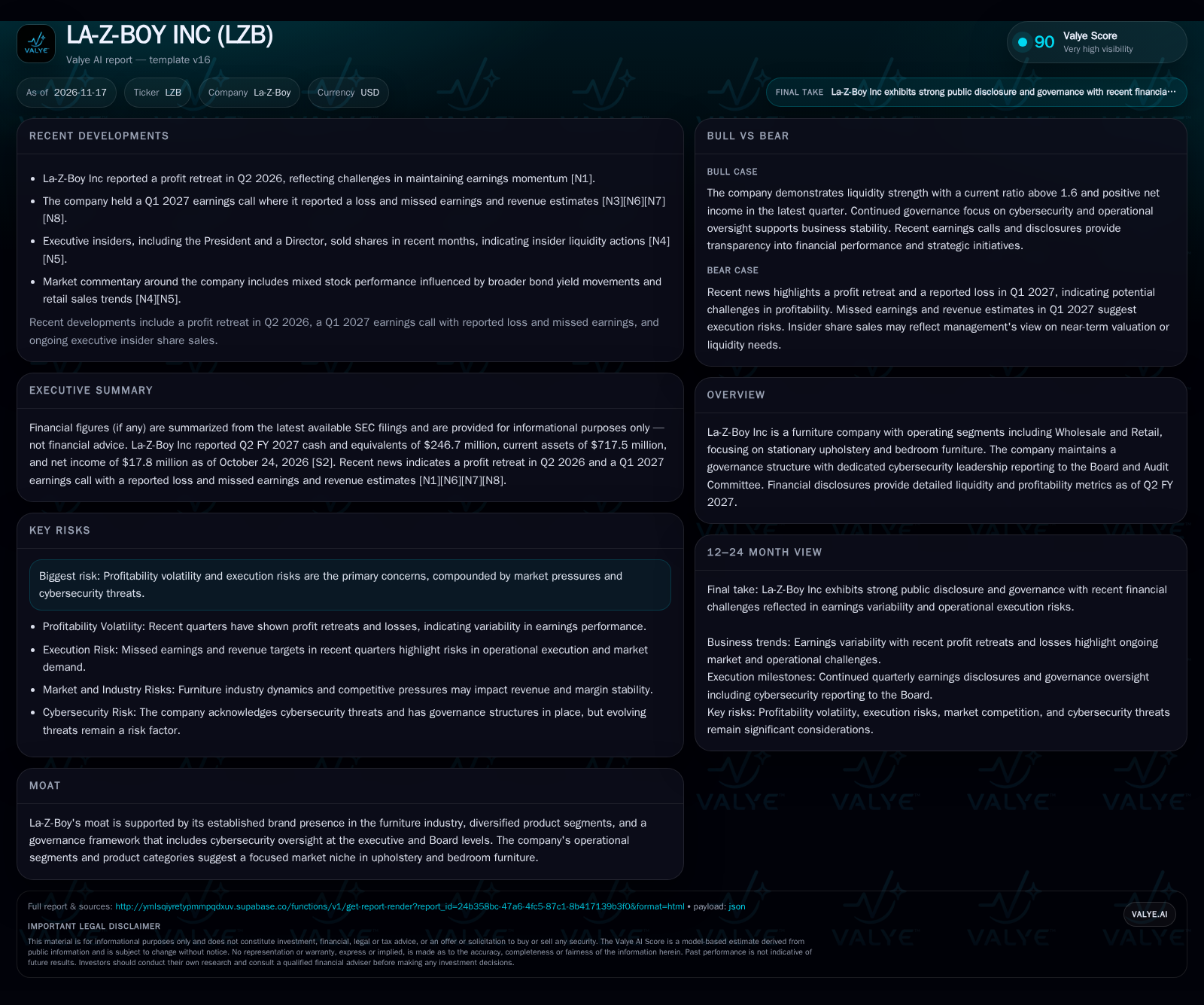
La-Z-Boy Inc reported Q2 FY 2027 net income of $17.8 million and reported liquidity-ratio trends of 1.62, but recent quarters included a loss and missed expectations. As the company navigates earnings volatility and insider share sales, key factors will be its ability to manage operational execution, adapt to industry shifts, and defend its niche in upholstery and bedroom furniture. [S2] [N3] [N8]
La-Z-Boy Inc’s recent financial disclosures paint a picture of a legacy furniture brand at a crossroads.Despite reporting a $17.8 million net income for Q2 FY 2027 and maintaining a reported current ratio, the company has also faced losses and missed earnings expectations in the preceding quarter. This mixed performance, coupled with insider share sales and a continued focus on cybersecurity governance, raises critical questions about La-Z-Boy’s ability to sustain profitability amid shifting industry dynamics, cost pressures, and evolving consumer behavior. The next phase for La-Z-Boy will likely hinge on operational execution, margin management, and its capacity to leverage its brand in a competitive, rapidly changing furniture market.
Recent Results Reveal Earnings Swings and Liquidity Position
La-Z-Boy Inc reported net income of $17.8 million for Q2 FY 2027, with basic and diluted EPS of $0.45 per share as of October 24, 2026. The company reported cash and liquidity metrics for the period; these figures do not by themselves establish operating runway, investment capacity, financial flexibility, or financing capacity. However, this quarter of positive profitability follows a Q1 FY 2027 loss and missed earnings and revenue estimates, highlighting significant earnings variability over recent periods. Additionally, executive insider share sales have occurred in recent months. While these sales do not confirm management’s motives, they can sometimes reflect internal views on valuation, liquidity, or risk. [S2] [N3] [N8]
How La-Z-Boy Generates Value: Segment Economics and Operating Leverage
La-Z-Boy operates through Wholesale and Retail segments, focusing on stationary upholstery and bedroom furniture. Revenue is typically generated through a mix of direct-to-consumer sales in its branded retail stores, wholesale distribution to independent retailers, and potentially e-commerce channels. The company’s gross margins are likely sensitive to input costs—such as raw materials, labor, and logistics—which can be volatile in the furniture sector. Fixed costs include manufacturing facilities, retail leases, and corporate overhead, creating potential for operating leverage if volumes rise. However, periods of demand softness can quickly expose unfavorable fixed-cost absorption, leading to profit swings. [S2]
La-Z-Boy’s ability to flex its cost structure—through supply chain management, variable labor, and discretionary marketing—will be central to managing margin volatility. The company’s brand enables some pricing power, but the competitive environment and consumer sensitivity to price can limit the extent to which cost increases are passed through. Product mix (e.g., higher-margin custom upholstery vs. lower-margin standard offerings) and channel mix (owned retail vs. wholesale) are critical levers for profitability, but detailed mix data is not disclosed in the supplied evidence.
An additional dimension to La-Z-Boy’s value generation lies in its supply chain resilience and sourcing strategies, which can materially affect cost volatility and inventory management. Given the furniture industry’s reliance on raw materials like wood, foam, and textiles, disruptions or price spikes can compress margins if not effectively hedged or mitigated. The company’s ability to negotiate favorable long-term contracts or diversify suppliers could provide a buffer against commodity price swings. Moreover, inventory turnover rates and working capital efficiency are critical, as excess inventory ties up cash and risks obsolescence, while stockouts can harm customer satisfaction and sales momentum.
The interplay between fixed and variable costs also influences La-Z-Boy’s operating leverage sensitivity. For instance, labor costs in manufacturing and retail are partially fixed, but the company may deploy flexible scheduling, temporary labor, or outsourcing to adjust capacity in response to demand fluctuations. Similarly, marketing expenditures might be scaled up to support new product launches or promotional campaigns but trimmed during slower periods. The extent to which La-Z-Boy can dynamically manage these cost elements without impairing brand equity or operational effectiveness will be pivotal in smoothing earnings volatility and sustaining profitability.
Defending the Brand: Competitive Moats and Market Pressures
La-Z-Boy’s established brand in upholstery and bedroom furniture provides some moat, particularly among consumers seeking comfort and reliability. The company’s vertically integrated model—owning both manufacturing and retail operations—can help control quality and customer experience, though it also raises fixed costs. Competition remains intense, with pressure from both legacy peers and digitally native brands that can disrupt traditional distribution models or offer direct-to-consumer value propositions.
Substitutes include both lower-cost mass-market furniture and premium lifestyle brands, as well as non-traditional players leveraging e-commerce and supply chain innovation. The industry is also exposed to cyclical swings in consumer confidence, housing turnover, and discretionary spending, all of which can impact demand. La-Z-Boy’s governance structure, including cybersecurity oversight, supports operational risk management but does not insulate the company from broader market or execution risks. [S1]
From a competitive standpoint, La-Z-Boy faces strategic choices about channel emphasis that affect its market positioning and margin profile. Owning retail stores offers control over customer experience and pricing but entails higher fixed costs and capital investment, whereas wholesale distribution provides broader reach with lower capital intensity but less direct customer interaction. The rise of e-commerce and omnichannel retailing introduces both opportunity and risk: investing in digital platforms can capture changing consumer behaviors but requires significant upfront costs and capabilities. Competitors leveraging advanced supply chain technologies or data analytics may achieve cost advantages or better customer targeting, challenging La-Z-Boy to innovate or risk market share erosion.
If Operational Execution and Brand Leverage Drive Margin Recovery
A favorable scenario for La-Z-Boy would see the company capitalizing on its brand strength and operational improvements to stabilize and expand margins. If management can optimize product and channel mix—emphasizing higher-margin offerings and owned retail while controlling input costs—the company could achieve more consistent profitability. Investments in digital capabilities, supply chain efficiency, or new product categories could further support top-line growth and operating leverage.
Confirmation of this scenario would come from several quarters of sustained earnings growth, improved gross and operating margins, and management commentary highlighting successful cost containment and demand resilience. Additional evidence would include stabilization or growth in same-store sales (if disclosed), higher average order values, and positive trends in customer retention. Insider share purchases or reduced insider selling could also signal increased management confidence.
Earnings Volatility Persists as La-Z-Boy Navigates Industry Headwinds
The most plausible near-term outlook is continued earnings variability, with La-Z-Boy’s profitability swinging in response to demand cycles, cost pressures, and competitive actions. Retail and wholesale segments may see uneven performance as consumers remain price sensitive and digital competitors vie for share.
Confirmation of this scenario would be ongoing quarterly profit swings, management guidance that remains cautious or emphasizes uncertainty, and continued insider sales. Falsification would require a clear, multi-quarter trend of margin improvement and stable top-line growth.
Demand Softness and Cost Inflation Drive Sustained Losses
In a less favorable scenario, a combination of weak demand, elevated input costs, and inability to pass on price increases could result in sustained losses for La-Z-Boy. Prolonged negative earnings could force management to take more drastic cost-cutting actions, such as closing underperforming stores, reducing headcount, or divesting assets. The company’s liquidity, while sufficient for near-term needs, could erode if losses persist and working capital requirements rise.
Evidence supporting this scenario would include consecutive quarters of net losses, downward revisions to management guidance, increased borrowing or asset sales, and further acceleration in insider share sales. Disclosures of store closures, restructuring charges, or negative operating cash flow would further confirm downside risks.
What Will Determine La-Z-Boy’s Next Chapter in the Furniture Industry?
Quarterly net income and margin trends—sustained improvement or continued volatility will clarify operating momentum. [S2]
Quarterly revenue growth and channel mix (owned retail vs. wholesale)—if disclosed, this would reveal whether La-Z-Boy is gaining or losing share in key segments.
Same-store sales and average order value in retail stores—if disclosed, these would indicate brand health and pricing power.
Gross margin and input cost commentary—look for management discussion on cost containment and pass-through ability.
Insider share activity—continued sales or a shift to insider buying may provide signals on management’s outlook.
Liquidity and working capital trends—monitor for signs of cash burn or rising short-term obligations. [S2]
Strategic investments or cost-cutting initiatives—announcements of new product lines, digital platforms, or restructuring actions would clarify management’s response to market conditions.
Cybersecurity disclosures or incidents—given explicit governance focus, any material events or enhancements would be relevant. [S1]
Disclaimer: This is research-only, informational analysis and not investment advice. It may include AI-generated interpretation and general industry context. Always verify important details using primary sources.

Comments