
AECOM’s Infrastructure Consulting Platform: Execution Complexities and Secular Demand Dynamics
The company’s challenge lies in converting scale and technical depth into sustainable margin expansion amid execution risk, evolving technology, and exposure to real estate cycles.
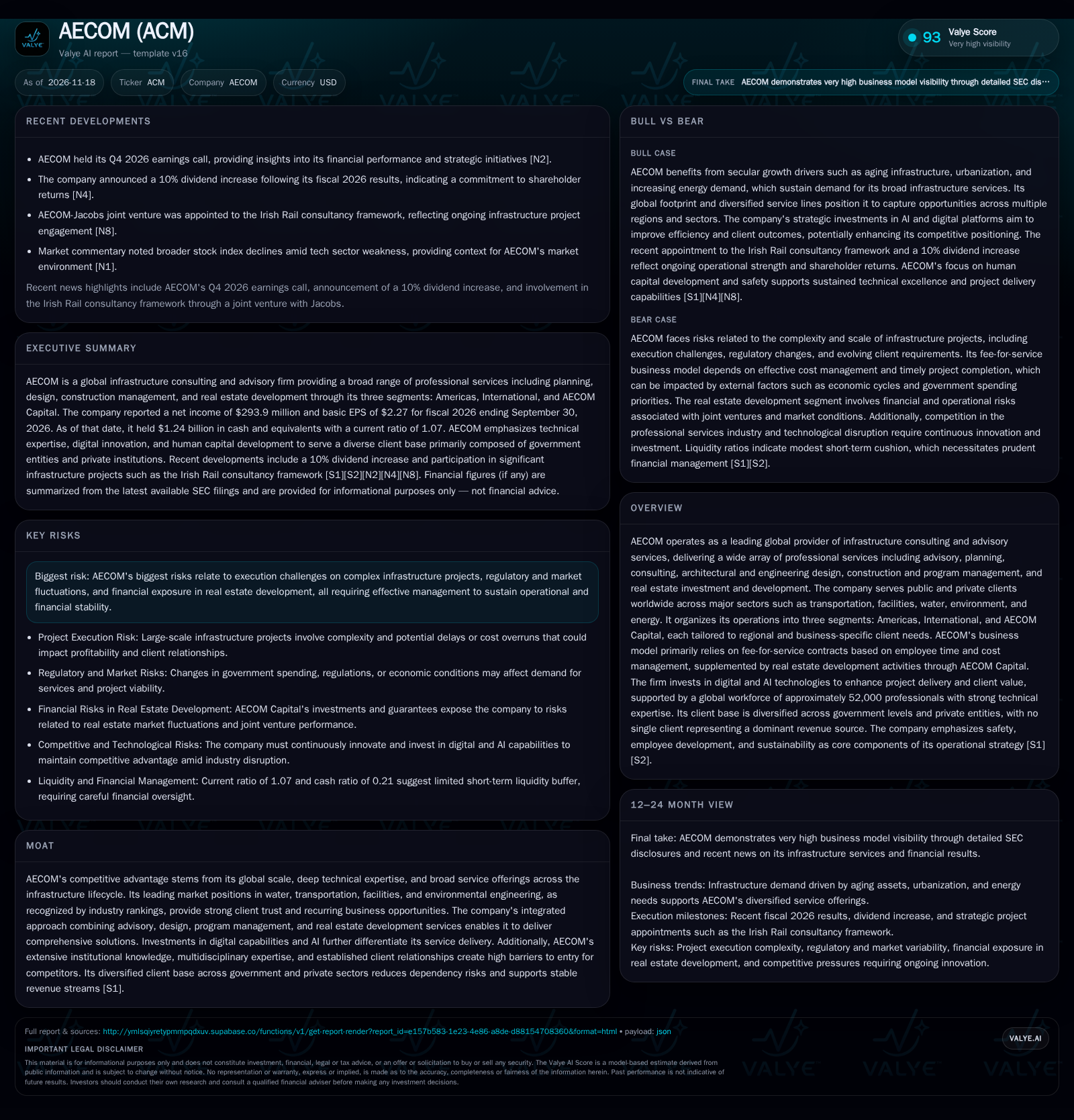
AECOM’s fiscal 2026 results highlight operational strength, with $293.9 million in net income, a 10% dividend increase, and a global workforce of 52,000. Strategic investments in digital and AI capabilities could drive efficiency, but margin expansion depends on disciplined project delivery and risk management. Recent project wins, such as the Irish Rail consultancy, reinforce franchise value but do not eliminate exposure to cyclical or project-specific shocks. [S1] [S2] [N2] [N4] [N8]
AECOM’s 2026 performance underscores both the resilience and complexity of its global infrastructure consulting platform. Yet, the path to sustainable margin improvement is shaped by project execution risk, technological disruption, and the capital intensity of its real estate arm. The company’s emphasis on digital innovation and human capital development may create future operating leverage, but short-term liquidity metrics and cyclical exposure warrant ongoing scrutiny.
Recent Results and Strategic Moves: What’s Changed for AECOM?
AECOM reported net income of $293.9 million for fiscal year 2026, with basic EPS of $2.27. As of September 30, 2026, the company held $1.24 billion in cash and equivalents, a current ratio of 1.07, and a cash ratio of 0.21. These metrics reflect a solid earnings year but point to a modest short-term liquidity buffer, highlighting the importance of disciplined financial management as the company navigates lumpy project cash flows and capital commitments [S1] [S2].
The company announced a 10% dividend increase, signaling management’s focus on shareholder returns in the wake of strong results [N4]. This move, while positive for income-oriented investors, also raises the bar for ongoing free cash flow generation given the capital needs of large infrastructure and real estate projects.
AECOM’s appointment, in joint venture with Jacobs, to the Irish Rail consultancy framework further demonstrates its ability to secure marquee projects and maintain relevance in the competitive European infrastructure market [N8]. This win underscores the company’s global reach and technical credibility, reinforcing its positioning as a preferred partner for complex, long-duration assignments.
Dissecting the Fee-Driven Engine: Revenue Streams, Margin Levers, and Capital Demands
AECOM’s core business is anchored in fee-for-service contracts—advisory, engineering, and program management—largely billed by the hour or project milestone. This model provides revenue visibility and downside protection in downturns, as contracts are often tied to essential infrastructure and government budgets. However, it also places a ceiling on margin expansion unless the company can systematically move up the value chain to higher-value consulting or secure larger program management mandates.
The real estate development activities housed within AECOM Capital (ACAP) introduce a different risk-reward profile: episodic, capital-intensive, and subject to real estate cycle volatility. While these projects can deliver outsized returns in favorable markets, they also require balance-sheet flexibility and expose AECOM to potential losses or working capital strain if project timing misaligns with broader market conditions.
Digital and AI investments, if successful, could shift the cost structure by automating routine design and project management tasks, enabling higher throughput per professional and potentially raising margins. However, realizing this operating leverage requires both adoption by clients and integration into complex delivery workflows—a process that is often slow and uneven across regions and service lines.
Global Scale and Technical Breadth: Sources of Advantage—But Not Moat Immunity
AECOM’s competitive strengths derive from its global workforce of 52,000, deep technical expertise, and broad service portfolio spanning transportation, water, environment, and facilities. Its ability to serve diverse public and private clients, with no single client representing over 10% of revenue, reduces concentration risk and provides resilience against isolated budget shocks [S1].
However, the professional services sector remains highly competitive. Peer firms—including other global engineering, construction, and design consultancies—can replicate much of AECOM’s service offering, especially on commoditized project scopes. The company’s edge is most durable where it combines multiple disciplines, leverages institutional knowledge, or wins long-duration program management roles that embed it within client workflows.
Technology and digital platforms are emerging as differentiators, but also as sources of disruption; clients increasingly demand integrated, data-driven project delivery, which may compress fees or reward those with proprietary digital capabilities. AECOM’s investments in AI and digital tools may help defend margins, but the question is whether these are sufficiently advanced or adopted to constitute a true barrier to entry.
How AECOM Could Translate Secular Demand and Digital Investment into Margin Expansion
In a favorable scenario, persistent secular tailwinds—such as global urbanization, energy transition, and the need to upgrade aging infrastructure—drive multi-year growth in both public and private project pipelines. AECOM’s diversified service offering allows it to capture share across geographies and sectors, while digital and AI investments enable the company to deliver projects faster and at lower cost, expanding margins even as competition intensifies.
The company’s ability to convert smaller advisory roles into larger program management contracts could boost revenue per client and increase stickiness. If ACAP’s real estate projects achieve timely exits at attractive valuations, this would supplement fee income with higher-margin development gains.
Evidence for this scenario would include sustained top-line growth above industry averages, rising segment margins, growing backlog of high-value program management contracts, and public disclosures of successful digital project delivery or proprietary software adoption.
Sustaining Relevance Amid Cyclical and Executional Realities
The most plausible near-term outcome is that AECOM maintains its position as a leading infrastructure consultant, with steady revenue growth tracking global infrastructure investment trends and government spending cycles. Margins remain stable or improve incrementally as digital initiatives yield modest cost savings and selected program management wins supplement traditional fee income.
Execution risk—project delays, cost overruns, or client scope changes—remains a persistent headwind, but is managed through established project controls and diversified client exposure. ACAP delivers periodic gains but also faces occasional write-downs or delays, consistent with the risk profile of real estate development.
This scenario would be confirmed by stable to slightly rising operating margins, continued backlog growth, and no material increase in project write-offs or litigation. Falsification would come from a major project failure, loss of a key client, or sustained margin compression despite digital investment.
Where Complexity and Cycles Could Undermine the Franchise
Adverse developments could arise from one or more large project failures—cost overruns, legal disputes, or delayed payments—eroding profitability and damaging client trust. A sharp downturn in public infrastructure spending, regulatory changes, or global economic weakness could compress the project pipeline and force price competition among peers.
If digital and AI investments fail to deliver tangible efficiency gains, AECOM may see flat or declining margins as labor costs rise and clients demand more for less. The real estate development arm could exacerbate downside risk if capital is locked in underperforming projects or if joint ventures trigger unexpected losses.
Confirmation of this downside would include a significant drop in backlog, rising project write-downs, negative free cash flow, or a forced cut to the dividend. Early warning signs would be a jump in litigation provisions, deteriorating client relationships, or evidence that digital initiatives are not translating into operational or financial improvement.
Milestones and Metrics That Will Shape AECOM’s Value Proposition
Backlog growth and composition by sector and geography—a key indicator of future revenue visibility and project mix.
Segment-level operating margin trends, especially in the Americas and International segments, to assess the impact of digital initiatives and project mix—if disclosed.
Frequency and magnitude of project write-offs, litigation, or performance penalties, as a proxy for execution discipline.
Capital deployment and return metrics for AECOM Capital projects, including realized gains/losses and capital-at-risk—if disclosed.
Client concentration and retention rates, particularly in government versus private sectors—a useful metric would be annual client churn, if disclosed.
Adoption rates and client case studies for digital and AI-enabled project delivery, to test whether technology is driving operating leverage.
Dividend payout ratio and free cash flow coverage, to monitor sustainability of shareholder returns.
Pipeline of large-scale, multi-year program management contracts, which could signal ability to move up the value chain and enhance margin profile.
Disclaimer: This is research-only, informational analysis and not investment advice. It may include AI-generated interpretation and general industry context. Always verify important details using primary sources.

Comments