
Enanta Pharmaceuticals: Patent Setbacks, Leadership Transition, and the Challenge of Converting R&D into Sustainable Value
Enanta faces a pivotal period marked by a major patent invalidation, ongoing net losses, and an imminent CEO retirement.
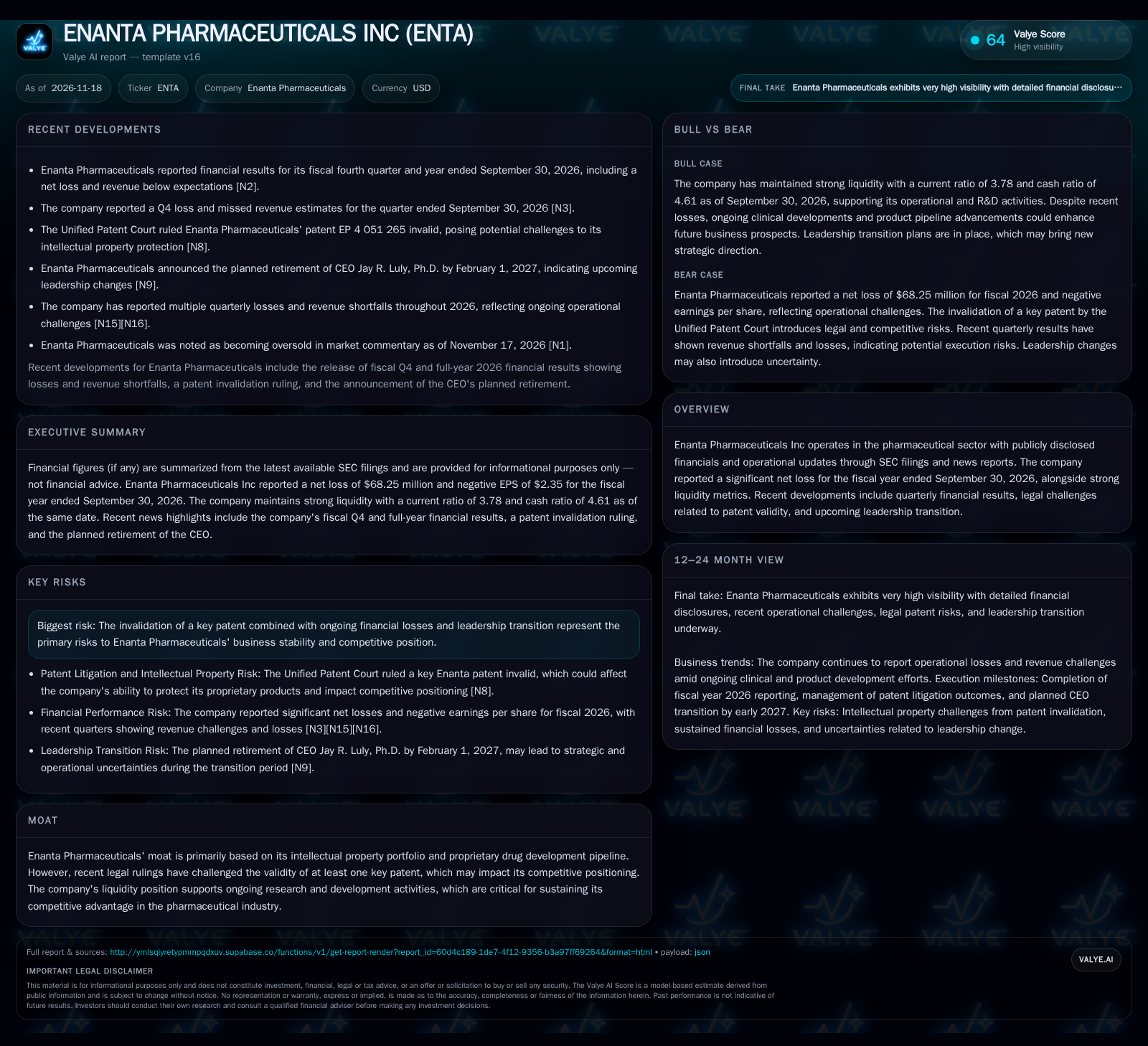
Enanta Pharmaceuticals reported a $68.2 million net loss for FY 2026 and faces the invalidation of a key patent, adding to competitive and legal pressures. However, leadership transition and uncertainty in the company’s IP position raise questions about the durability of its business model and future value creation. [S1] [N8]
Enanta Pharmaceuticals is entering a period of heightened uncertainty, driven by a combination of financial underperformance, a critical patent loss, and an impending CEO transition. While the company maintains reported liquidity position, these are not a substitute for durable commercial momentum. As Enanta shifts from its legacy hepatitis C royalties toward new virology and immunology programs, investors and stakeholders face key questions about the company’s ability to defend its intellectual property, execute on its R&D pipeline, and maintain strategic focus through leadership change.
Recent Losses, Patent Invalidation, and Leadership Change Define the Current Landscape
Enanta Pharmaceuticals reported a net loss of $68.2 million for the fiscal year ended September 30, 2026, with basic and diluted EPS of -$2.35 per share, and revenue below consensus estimates. As of the same date, the company maintained $20.27 million in cash and current assets of $206 million, yielding a current ratio of 3.78 and a cash ratio of 4.61. The company reported cash and liquidity metrics for the period; these figures do not by themselves establish operating runway, investment capacity, financial flexibility, or financing capacity. [S1] [N2] [N3]
A major legal development arrived with the Unified Patent Court’s invalidation of patent EP 4 051 265, which undermines part of Enanta’s IP protection and could expose the company to heightened competition or erode negotiating leverage for existing or future partners. [N8]
In parallel, CEO Jay R. Luly, Ph.D. plans to retire by February 1, 2027, introducing the prospect of strategic uncertainty at a moment when clear leadership is critical.
R&D-Driven Model: Capital Intensity, Revenue Volatility, and the Importance of Successful Pipeline Advancement
Enanta’s business model is classic for a small-to-mid-cap pharmaceutical company: large, recurring investments in research and development, with the goal of securing high-margin revenue from successful drug approvals or out-licensing deals. The company has historically benefited from royalties on hepatitis C therapies (notably the AbbVie collaboration for glecaprevir), but these revenue streams are mature and likely to decline as first-mover advantages erode and generic competition increases.
The economics of Enanta’s pipeline hinge on advancing candidates in RSV, SARS-CoV-2, HBV, and type 2 inflammatory disease through late-stage development and regulatory approval. These programs are capital intensive, with high fixed costs for clinical trials, regulatory compliance, and ongoing IP protection. Variable costs may remain low relative to potential revenue if a candidate succeeds, but the probability-weighted economics are volatile and heavily back-loaded.
Liquidity remains a short-term buffer, but sustained net losses—absent new approvals or successful out-licensing—could pressure the company to seek additional funding or partnerships. Commercialization (if independently pursued) would require significant investment in sales, marketing, and distribution infrastructure, while out-licensing would trade some margin potential for reduced risk and capital requirements.
Patent Portfolio Under Pressure Amid Crowded Virology and Immunology Markets
Enanta’s traditional moat is its intellectual property portfolio, especially patents protecting its chemistry-driven small-molecule drug candidates. The invalidation of patent EP 4 051 265 directly weakens this defense, potentially opening the door to generic or biosimilar competition and reducing the company’s ability to negotiate favorable licensing terms. [N8]
The markets targeted by Enanta’s pipeline—RSV, SARS-CoV-2, HBV, and type 2 inflammatory diseases—are highly competitive, with both large pharma and nimble biotech firms vying for share. In RSV, for example, recent FDA approvals of at-home combination diagnostics may accelerate test-to-treat models, but also intensify competition among oral antiviral developers. Large incumbents possess scale advantages in clinical execution, regulatory navigation, and commercialization, while smaller players may compete on speed and niche innovation.
If Enanta cannot restore or reinforce its IP moat, its negotiating position in future partnerships or out-licensing deals may be materially weakened. The upcoming CEO transition adds further complexity, as new leadership will need to articulate and execute a strategy for differentiation in these crowded markets.
Pipeline Success and Strategic Partnerships Could Shift the Trajectory
A favorable outcome for Enanta would involve one or more of its clinical pipeline candidates (such as the RSV or HBV programs) achieving positive late-stage trial results and advancing to regulatory approval. This could trigger milestone payments from partners or open the door to lucrative out-licensing agreements, providing near-term non-dilutive capital and longer-term royalty streams.
Success in restoring or defending other core patents would also strengthen the company’s negotiating leverage and IP moat. If the new CEO brings a track record of business development or operational excellence, Enanta could accelerate the formation of strategic alliances, joint ventures, or even attract acquisition interest from larger pharma players seeking pipeline assets.
Evidence that would confirm this scenario includes: announcements of successful Phase 2/3 trial results, new or expanded licensing agreements, and stabilization or growth in top-line revenue from new products or milestone payments. A rebound in market sentiment would likely follow such developments.
Continued Losses, Slow Pipeline Progress, and Uncertain Strategic Direction
The most plausible near-term scenario is that Enanta continues to burn cash on R&D as pipeline programs advance incrementally but without major clinical or commercial breakthroughs. Revenue from legacy hepatitis C royalties declines or remains flat, while new product launches are delayed by clinical, regulatory, or competitive hurdles.
The leadership transition may result in a period of strategic drift or cautious re-evaluation, further slowing decision-making. Without the protection of its invalidated patent, Enanta could face increased pricing pressure or lose out on potential licensing deals, as partners discount the value of weaker IP assets.
This scenario would be confirmed by persistently negative EPS, lack of major pipeline milestones, and muted business development activity. Liquidity would gradually erode, prompting potential cost cuts or the need for external financing if new partnerships or pipeline success do not materialize.
Accelerated Cash Burn, Erosion of IP, and Difficulty Attracting Partners or Capital
A bearish scenario would see Enanta’s R&D programs suffer clinical setbacks—such as failed trials or unfavorable data readouts—while the company’s weakened IP position deters potential partners. If the new CEO is unable to quickly establish credibility with investors or the scientific community, confidence in the company’s ability to execute could wane.
In this environment, legacy revenue from hepatitis C royalties could deteriorate faster than anticipated, and the company may be forced to cut R&D spending or seek dilutive financing on unfavorable terms. The risk of additional patent challenges or loss of exclusivity on other key assets would further erode the business case.
Confirmation of this scenario would come from negative clinical trial results, further legal defeats on the IP front, accelerated cash depletion, and a lack of new licensing or partnership deals.
Milestones That Will Determine Whether Enanta Can Rebuild Momentum
Progression of RSV and HBV candidates through late-stage clinical trials, with emphasis on Phase 2/3 data readouts and regulatory submissions (if disclosed).
Updates on the status and scope of remaining patent protections, as well as any appeals or new IP filings following the Unified Patent Court’s invalidation of EP 4 051 265.
Announcements of new or expanded licensing, co-development, or out-licensing agreements that would validate the commercial value of Enanta’s pipeline.
Evolution of top-line revenue, especially the emergence of new product or milestone revenue streams beyond legacy hepatitis C royalties.
Clarity and stability in strategic direction following the CEO transition, evidenced by public guidance or a refreshed R&D/commercialization roadmap.
Clinical trial initiation, enrollment, and completion rates for key pipeline programs—delays or accelerations here will be key signals.
Burn rate and liquidity trajectory, including any shifts in quarterly R&D spending, cash flows, or the need for external financing.
Disclaimer: This is research-only, informational analysis and not investment advice. It may include AI-generated interpretation and general industry context. Always verify important details using primary sources.

Comments