
Zone Frontier (CleanCore Solutions): Can Chemical-Free Cleaning Scale Beyond Early Contract Wins?
Zone Frontier (formerly CleanCore Solutions) has demonstrated momentum with a high-profile contract and sustainable cleaning deployments, but persistent losses and a competitive landscape raise questions about the economic viability and scalability of its chemical-free technology.
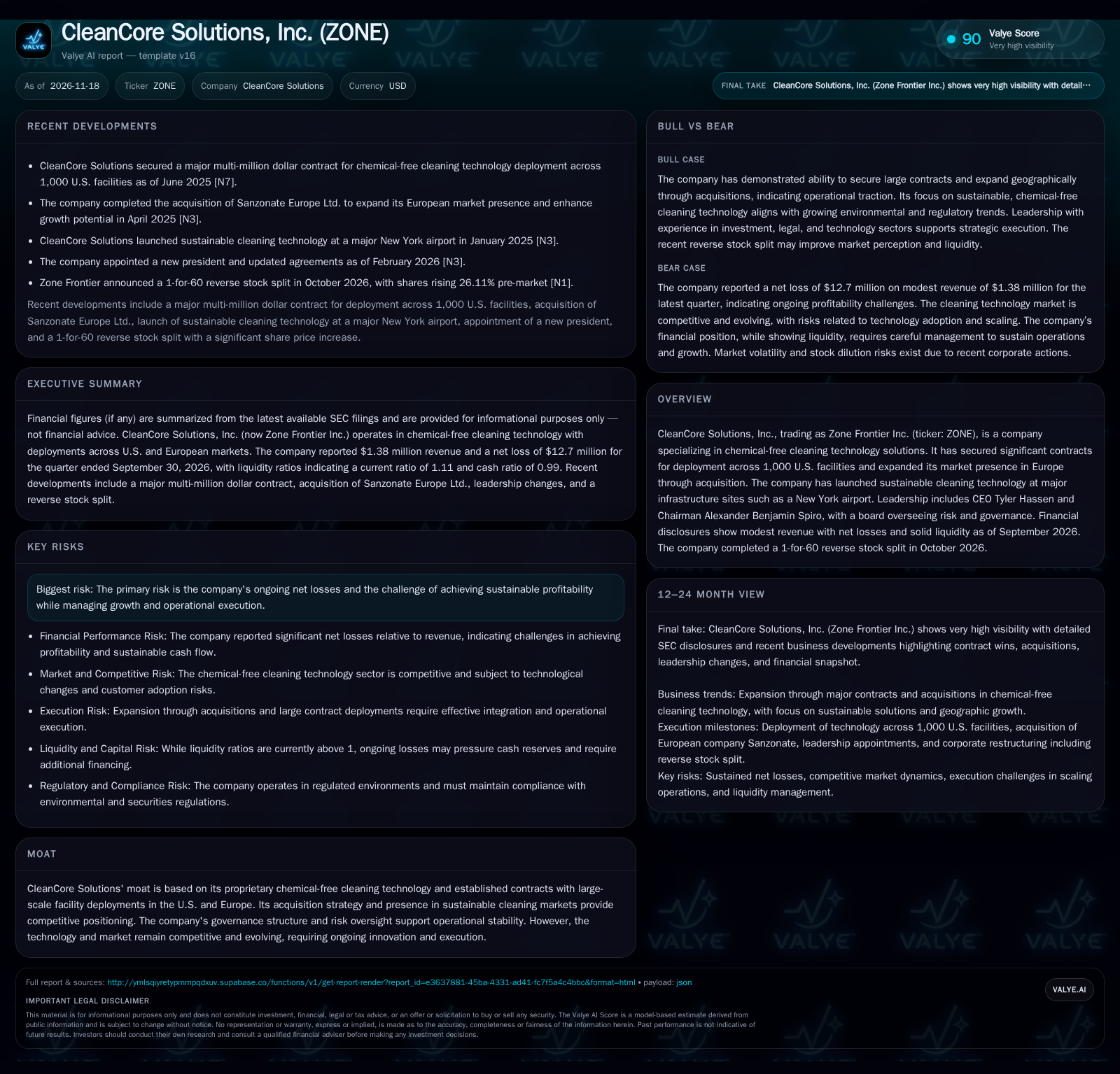
Zone Frontier (CleanCore Solutions) operates in the chemical-free cleaning technology space, reporting $1.38 million in revenue and a $12.7 million net loss for the September 2026 quarter. The company’s major contract for 1,000 U.S. facilities and its New York airport deployment signal commercial traction, but profitability and sustainable growth remain unproven amid ongoing losses and a competitive sector. Its recent reverse split and leadership changes reflect attempts to reset market perception and governance, but the path to durable value will depend on scaling deployments, improving unit economics, and managing liquidity pressures as losses persist. [S2] [N7] [N3] [N1]
Zone Frontier Inc. (formerly CleanCore Solutions) has positioned itself as a player in the chemical-free cleaning technology market, leveraging sustainability trends and regulatory tailwinds. The company’s high-profile contract wins—including a deployment across 1,000 U.S. facilities and a major New York airport—suggest early commercial traction. The question for investors is whether these early deployments can be scaled profitably, or if persistent losses and competitive pressures will undermine the business before it reaches critical mass. [S2] [N7] [N3] [N1]
Recent Contract Wins, Leadership Changes, and Financial Snapshot
Zone Frontier (CleanCore Solutions) entered into a major multi-million dollar contract for chemical-free cleaning technology deployment across 1,000 U.S. facilities as of June 2025, indicating that its solutions are being adopted at scale in institutional environments. The company also launched its technology at a major New York airport in January 2025, providing a high-profile proof point. [N7] [N3]
Despite these wins, Zone Frontier reported revenue of $1.38 million and a net loss of $12.7 million for the quarter ended September 30, 2026, with basic and diluted EPS of -$1.38. As of the same date, it held $72.9 million in cash and cash equivalents and had a current ratio of 1.11. [S2]
Leadership changes include the appointment of a new president and board updates as of February 2026, and the company executed a 1-for-60 reverse stock split in October 2026, with shares rising 26.11% pre-market post-announcement. [N1] [N3]
How Chemical-Free Cleaning Could Translate into Profitable Growth
Zone Frontier’s business model revolves around deploying proprietary chemical-free cleaning technology to large facilities, likely via direct sales, equipment leasing, or service contracts. The economics depend on the upfront cost of equipment, installation, and ongoing maintenance or service revenue. If the company’s technology can reduce clients’ long-term operating costs, regulatory exposure, or environmental liabilities, it could command premium pricing or capture share from traditional chemical cleaning providers.
However, the current $1.38 million in quarterly revenue against a $12.7 million net loss suggests either high fixed costs, low gross margins, or significant R&D and SG&A overhead relative to scale. Without clear disclosure of unit economics—such as hardware gross margin, service/recurring revenue mix, or customer payback periods—it remains uncertain whether the model offers operating leverage as deployments scale.
Given capital intensity in hardware manufacturing, installation, and support, Zone Frontier may face periodic funding needs if losses persist.
Evaluating Zone Frontier’s Edge in a Crowded Cleaning Tech Market
Zone Frontier competes in a fragmented and competitive cleaning technology market, facing rivals from both traditional chemical suppliers and emerging eco-friendly technology firms. Its claimed moat rests on proprietary chemical-free technology and large-scale contracts, which, if defensible, could provide switching costs for institutional clients wary of operational disruption.
However, barriers to entry in cleaning technology are generally moderate: established suppliers may adapt, and customers can be price-sensitive unless regulatory mandates or safety standards force adoption. The sector is also exposed to rapid technological substitution, with ongoing innovation in green chemistry and automation. Zone Frontier’s future advantage may depend on continued product differentiation, customer integration, and the ability to demonstrate superior cost or compliance outcomes.
The company’s high-visibility deployments (e.g., a major airport) may help build brand credibility, but the durability of relationships—whether multi-year contracts or one-off deployments—remains unclear from current disclosures.
Scaling Institutional Adoption: What Would a Winning Trajectory Look Like?
If Zone Frontier can convert its initial major contracts into recurring revenue streams, expand its customer base, and demonstrate cost savings or compliance benefits for clients, the company could achieve operating leverage. A favorable scenario would see repeat orders from large facility operators, new contract wins in regulated markets (e.g., hospitals, transportation hubs), and a growing installed base yielding service or consumable revenue.
Confirmation of this trajectory would include evidence of rising quarterly revenues, improving gross margins, and disclosure of multi-year, multi-site agreements with built-in renewals or escalators. Additional signals would be successful upselling to existing clients, geographic expansion, and positive customer testimonials or case studies documenting ROI.
Falsification would come from stagnating contract wins, declining revenue per deployment, or evidence that customers are not renewing or expanding usage after initial pilots.
Navigating the Chasm: From Early Traction to Economic Viability
The most plausible path is one where Zone Frontier continues to win some high-profile contracts but struggles to convert these into consistent, recurring revenue or to achieve sufficient scale to cover its cost base. Revenue may grow incrementally, but gross margins remain compressed due to hardware costs, competitive pricing, or the need for customer incentives.
In this scenario, the company remains dependent on periodic financing to fund operations as net losses persist. Modest improvements in efficiency or scale could slow cash burn, but without a step-change in contract volume or margin structure, profitability remains out of reach. Management may focus on operational discipline, cost control, and selective market expansion while seeking to validate its value proposition in additional verticals.
Confirmation would come from stable or slightly improving revenue and cash metrics without clear movement toward break-even, alongside ongoing but unspectacular contract announcements. Falsification would be a sharp reversal in contract pipeline, significant customer churn, or liquidity stress requiring dilutive capital raises.
Liquidity Pressures and Competitive Imitation Threaten Sustainability
The adverse scenario materializes if Zone Frontier is unable to convert early deployments into repeat business or broader market adoption, while losses remain elevated. Competitive entrants or incumbents may replicate chemical-free solutions, eroding pricing and customer stickiness. If regulatory or sustainability mandates fail to accelerate adoption, customer acquisition costs could rise and win rates fall.
Under these conditions, Zone Frontier may exhaust its reported liquidity position buffer, face challenges raising additional capital on favorable terms, and be forced to curtail R&D or sales investment. The risk of delisting, restructuring, or asset sales increases if the company cannot demonstrate a credible path to profitability or defend its differentiation.
Evidence supporting this scenario would include deteriorating revenue, rising net losses, inability to secure new large contracts, and warnings around going concern or capital needs.
What Will Determine Zone Frontier’s Breakout or Breakdown?
Quarterly revenue growth and segment mix—especially the proportion attributable to recurring service or maintenance contracts, if disclosed.
Gross margin trends, particularly any evidence of margin expansion as deployments scale or as service revenue rises.
Contract renewal rates, follow-on orders, or upsell success with existing institutional clients—a useful metric would be customer retention or contract duration if disclosed.
Pipeline of new large-scale contracts, including disclosures of multi-year agreements or entrance into new verticals or geographies.
Operating expense trends and cash burn, with attention to whether SG&A and R&D are rising proportionally to revenue.
reported liquidity position and any announcements regarding additional capital raises, debt financing, or cost-cutting initiatives.
Evidence of competitive responses—such as new chemical-free solutions from established cleaning suppliers or price-based customer defections.
Disclaimer: This is research-only, informational analysis and not investment advice. It may include AI-generated interpretation and general industry context. Always verify important details using primary sources.

Comments