
Retension Pharmaceuticals: R&D Progress, Capital Dynamics, and the Stakes of Hypertension Innovation
Retension Pharmaceuticals, newly public and pre-revenue, is advancing a next-generation PDE-5 inhibitor for hypertension. With clinical milestones ahead and a finite cash runway, the company’s future will be shaped by trial outcomes, capital market access, and the competitive landscape of cardiovascular therapeutics.
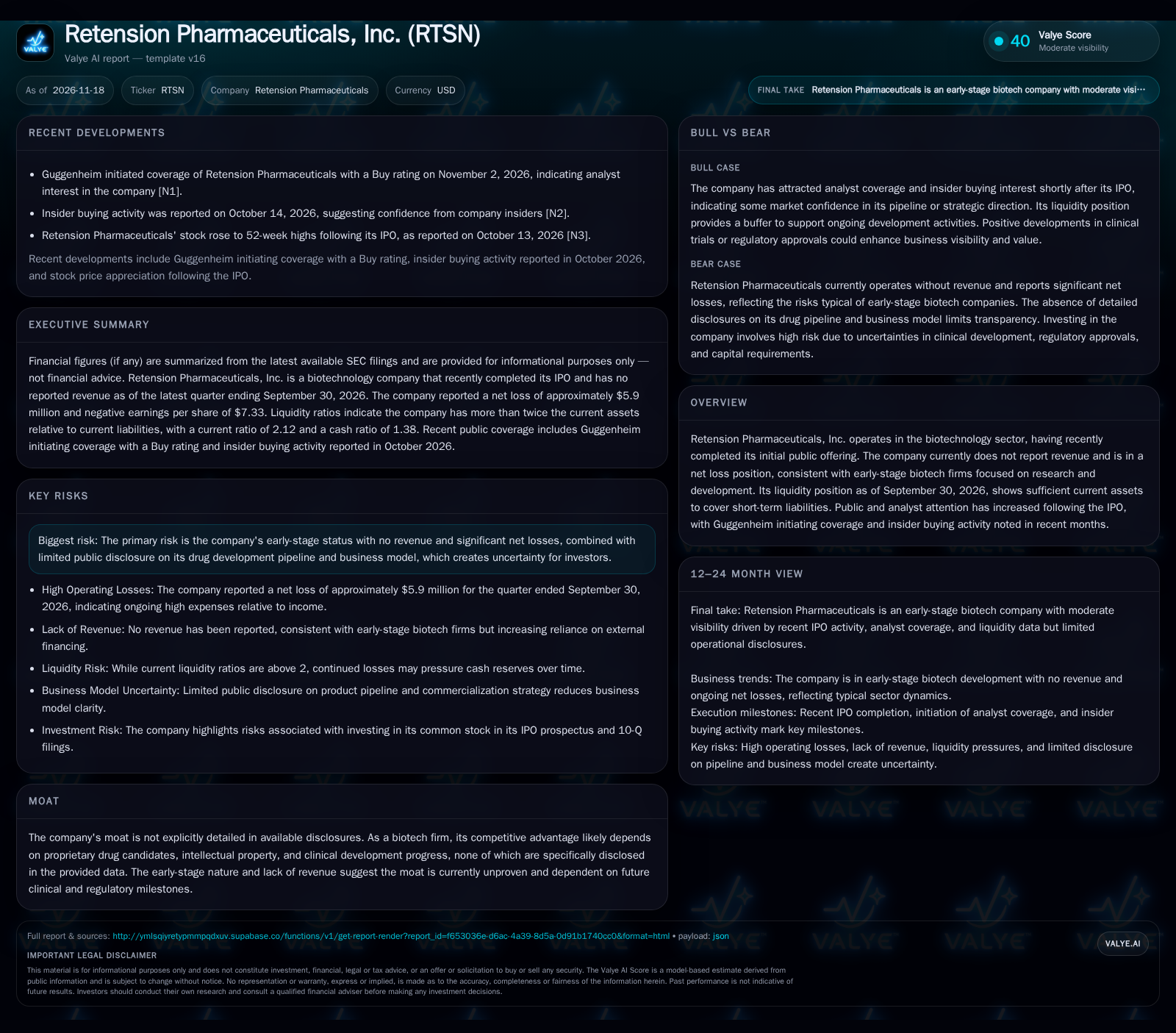
Retension Pharmaceuticals is a clinical-stage biotech focused on RTN-001, an oral PDE-5 inhibitor for hypertension. The company is pre-revenue, reported a net loss of $5.9 million for the last quarter, and holds $9.2 million in cash as of September 30, 2026. Key upcoming catalysts include Phase 2b trial data expected in the first half of 2027. Analyst coverage and insider buying post-IPO reflect market attention, but the business remains highly speculative until clinical and regulatory validation is achieved. [S1] [N1] [N2] [N3]
Retension Pharmaceuticals is at a familiar but high-stakes crossroads for early-stage biotech: its value is driven not by current sales, but by the prospective impact of a lead asset—RTN-001, a next-generation PDE-5 inhibitor for hypertension. Analyst coverage and insider confidence underscore the market’s interest, but the company’s operational and commercial mechanics remain largely untested and undisclosed. [S1] [N1] [N2] [N3]
IPO Momentum and Clinical Progress Define Retension’s Current Position
Retension Pharmaceuticals recently completed its IPO and is now publicly traded, attracting new investor and analyst attention, including a Buy rating from Guggenheim and insider buying activity in October 2026. The company remains pre-revenue, reporting a net loss of $5.9 million for the quarter ending September 30, 2026, and holding $9.2 million in cash with a current ratio of 2.12 at that date. Its lead candidate, RTN-001, is in a Phase 2b trial for uncontrolled hypertension, with topline data expected in the first half of 2027. This combination of near-term clinical milestones and finite capital resources defines the company’s risk/reward profile. [S1] [N1] [N2] [N3]
How Retension Could Create Value: R&D Economics and Commercial Pathways
Retension’s business model is typical of early-stage biotech: capital is deployed primarily into R&D and clinical trials, with no product revenue until—if—regulatory approval is achieved. The company’s current economics are dominated by fixed costs (clinical operations, management, IP, and regulatory functions) and variable costs tied to trial scale-up. With $9.2 million in cash as of September 30, 2026, Retension must manage burn rate carefully, as further capital will likely be needed ahead of pivotal data or commercialization. If RTN-001 demonstrates strong efficacy and safety, potential revenue models could include direct commercialization, out-licensing, or co-development partnerships. Pricing power in hypertension is challenging due to generic competition and payer constraints, making clinical differentiation and safety/tolerability advantages crucial for premium pricing or broad adoption. Operating leverage could materialize post-approval if the company can scale sales faster than fixed cost growth, but this scenario is speculative until clinical proof and a defined go-to-market pathway emerge. [S1]
Furthermore, the reimbursement environment for hypertension therapies is a critical determinant of commercial viability. Payers increasingly emphasize cost-effectiveness and comparative effectiveness data, particularly in markets saturated with generic options. Retension’s ability to demonstrate not only clinical superiority but also health economic benefits—such as reduced hospitalizations or improved quality of life—would be instrumental in securing favorable formulary placement and reimbursement rates. This dynamic underscores the importance of incorporating health economics and outcomes research early in development to build a compelling value proposition for payers and providers alike. Without such evidence, even clinically differentiated therapies may struggle to achieve meaningful market penetration.
Hypertension Market Dynamics and Retension’s Prospective Edge
Hypertension is a vast global market, but it is also highly competitive and dominated by generics and established branded therapies. RTN-001 seeks to differentiate itself as a next-generation PDE-5 inhibitor with improved bioavailability and vascular targeting compared to first-generation agents like sildenafil. If clinical data confirm superior efficacy or safety in uncontrolled hypertension patients, RTN-001 could address an unmet need for those refractory to existing regimens. However, the lack of current disclosures on intellectual property depth, exclusivity duration (with one patent nominally expiring in 2027), and commercial strategy leaves open questions about sustainable advantage. Retension will not only compete with traditional anti-hypertensives, but also with emerging therapies from larger pharma companies with established commercial infrastructures. Partnerships or licensing deals may be necessary to compete at scale, especially if initial uptake is limited by prescriber inertia or payer resistance.
Clinical Validation Unlocks Strategic Options and Market Value
The most favorable scenario for Retension involves strong positive Phase 2b data for RTN-001—demonstrating significant blood pressure reduction and a favorable safety profile in patients with uncontrolled hypertension. Such results could enable a streamlined path to Phase 3, attract potential licensing or co-development partners, and support additional fundraising at favorable terms. If the clinical differentiation is compelling, payers and prescribers may be more willing to adopt the therapy even in a generic-heavy market. Evidence that would confirm this scenario includes statistically significant and clinically meaningful efficacy signals in the upcoming topline readout, absence of serious adverse events, and interest from larger pharmaceutical companies in partnership discussions. This pathway could also be validated by successful capital raises or non-dilutive funding (e.g., grants, milestone payments) following trial results.
Navigating the Typical Biotech Gauntlet: Incremental Progress and Funding Needs
The most plausible outcome for Retension is continued incremental progress: the company completes its Phase 2b trial on schedule and reports mixed or moderate efficacy and safety data. This would allow for further development, but not provide clear clinical differentiation, potentially complicating fundraising and partner discussions. Retension would likely need to raise additional capital in the next 12-18 months, possibly at less favorable terms if data are inconclusive. Market interest may persist due to the large addressable market, but commercial traction would remain distant absent strong clinical signals. Falsification would come from either very strong or very weak trial outcomes, or an inability to secure necessary funding.
Clinical or Funding Setbacks Could Force Strategic Retrenchment
The most adverse scenario involves disappointing clinical data—either insufficient efficacy or unexpected safety issues—in the Phase 2b trial, which would undermine the case for further development and severely limit fundraising options. Additional downside could emerge if intellectual property protection proves weak post-2027 or if competitors launch superior therapies. Evidence for this scenario would include negative trial data, abrupt increases in cash burn, management turnover, or failed capital raises. Early warning signs could also include a sharp decline in analyst coverage or withdrawal of insider support.
Milestones and Metrics That Will Shape Retension’s Investment Thesis
Topline efficacy and safety results from the ongoing Phase 2b trial of RTN-001 in uncontrolled hypertension, expected in the first half of 2027, will be the primary catalyst for business value. [S1]
Announcements regarding additional fundraising, non-dilutive capital, or strategic partnerships would signal market confidence and operational flexibility.
Any disclosure of intellectual property extensions, new patent filings, or exclusivity agreements would help clarify the durability of Retension’s competitive position. [S1]
Progress in building commercial infrastructure or partnering with larger pharmaceutical companies would indicate readiness for commercialization if clinical results are positive.
Regulatory feedback, such as fast-track or breakthrough designation, could accelerate timelines and improve the probability of approval.
Signs of prescriber or payer interest (if disclosed), including early access programs or health economics studies, would help test the commercial adoption thesis.
Disclaimer: This is research-only, informational analysis and not investment advice. It may include AI-generated interpretation and general industry context. Always verify important details using primary sources.

Comments