
CTT Pharmaceutical Holdings: Navigating Severe Disclosure Gaps and Financial Strain
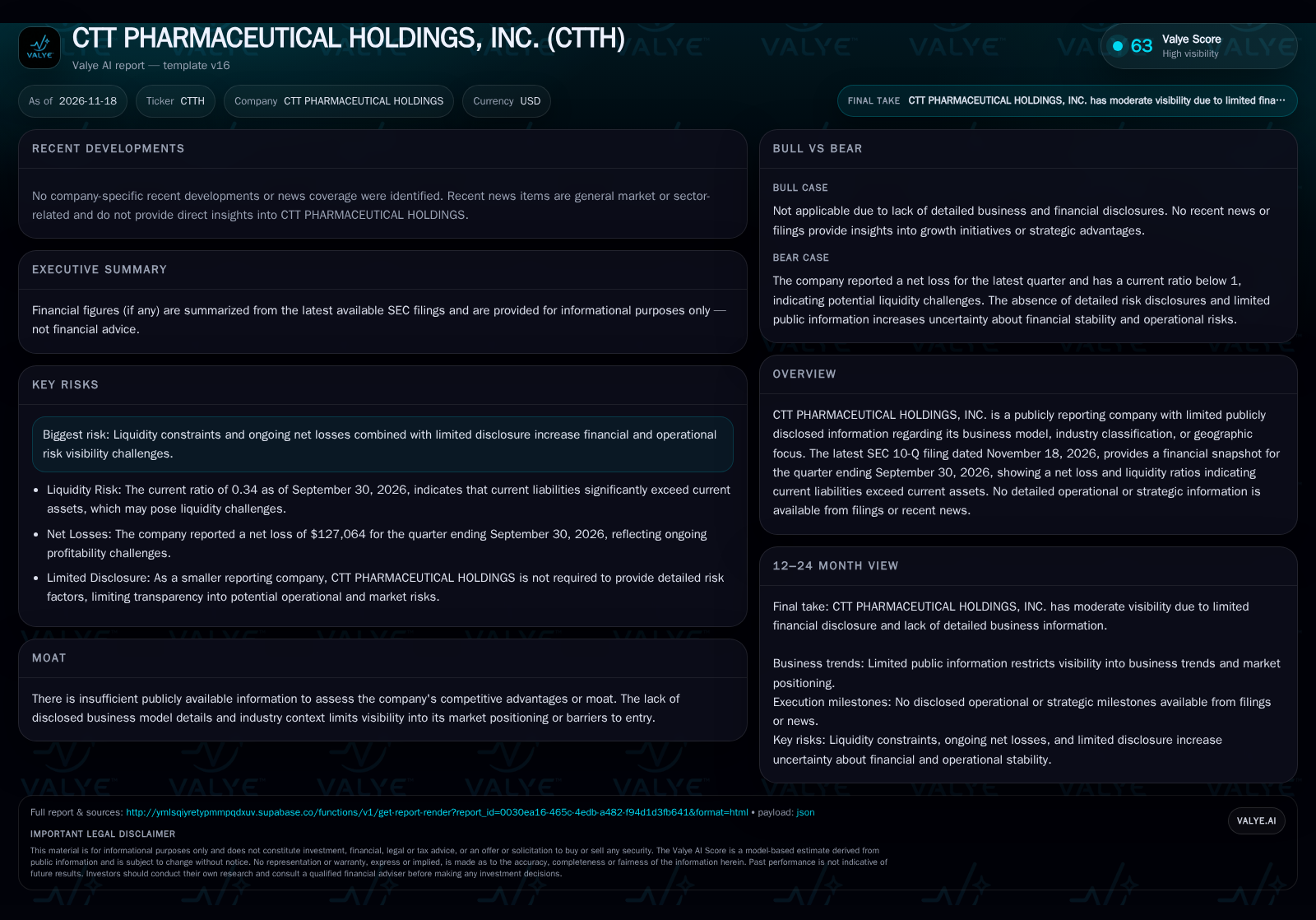
CTT Pharmaceutical Holdings' latest 10-Q reveals a company with significant liquidity pressure and ongoing net losses, but gives no insight into its business model, market, or operational direction. With liabilities far exceeding current assets and almost no disclosure of strategy or industry context, the company's future hinges on its ability to secure fresh capital or fundamentally alter its economic trajectory.
The absence of operational or strategic updates leaves investors with little basis for evaluating its prospects beyond balance-sheet stress.
CTT Pharmaceutical Holdings, Inc. stands out not for its products or growth initiatives, but for the opacity surrounding its business and the acute pressure on its balance sheet. In the absence of operational disclosure, the investment case centers almost entirely on survival: whether CTT can access new capital or transform its underlying economics before liabilities force more drastic measures.
Financial Snapshot: Balance Sheet Stress and Opaque Operations
CTT Pharmaceutical Holdings' most recent 10-Q filing as of September 30, 2026, reveals a company under significant financial strain: cash and cash equivalents stand at just $32,121, while current liabilities total $37,347, dwarfing current assets of only $12,625 [S1]. The current ratio of 0.34 underscores that near-term obligations far exceed liquid resources. The quarter’s net loss of $127,064 compounds these pressures, suggesting negative cash flow and persistent profitability challenges. Critically, there is no substantive disclosure of the company’s business model, industry focus, or operational strategy, leaving investors with very limited ability to assess future prospects beyond these headline numbers.
The company reported cash and liquidity metrics for the period; these figures do not by themselves establish operating runway, investment capacity, financial flexibility, or financing capacity. In capital-intensive industries such as pharmaceuticals, where product development cycles are lengthy and costly, insufficient short-term liquidity can delay critical R&D activities, regulatory submissions, or market entry. This creates a feedback loop where operational stagnation exacerbates financial strain, making it harder to attract investors or partners. Furthermore, the absence of disclosed operational metrics or milestones impedes external assessment of whether the company is making progress toward value creation or merely depleting resources in a holding pattern.
Unknown Revenue Model and the Implications for Funding Needs
With no public disclosure of its revenue model, industry, or product suite, CTT Pharmaceutical Holdings leaves analysts to speculate about its economic mechanics. The persistent net loss and negligible cash position suggest that, at present, the company likely generates little to no material revenue. This raises the possibility that CTT is either pre-revenue (perhaps in a development or licensing phase) or operating at a scale too small to cover fixed costs. The low current asset base and high liabilities imply that the company may be reliant on periodic infusions of outside capital, such as equity or convertible debt, to fund ongoing operations—a precarious position in the absence of a visible business model or imminent milestones.
Without clarity on the revenue model, it is difficult to assess the scalability or sustainability of CTT’s economics. If the company relies heavily on milestone-based licensing fees or contingent payments, revenue recognition may be irregular and unpredictable, complicating cash flow management. Alternatively, if CTT’s business model depends on eventual product commercialization, the timeline to break-even could span several years, necessitating multiple rounds of financing. This would intensify dilution risk for shareholders and heighten dependency on capital markets conditions. Understanding whether fixed costs dominate the expense structure or if variable costs scale with revenue would also influence the company’s financial resilience under different operational scenarios.
Competitive Dynamics Are Impossible to Gauge Without Industry Context
CTT’s filings do not reveal its industry, product focus, or target market, making any assessment of its competitive position necessarily hypothetical. If the company operates in pharmaceuticals or drug delivery (as its name suggests), it may face entrenched competition from established players with robust R&D pipelines and regulatory expertise. In such sectors, barriers to entry often include intellectual property, capital intensity, and regulatory approval timelines. However, without evidence of proprietary technology, customer traction, or commercial partnerships, there is no basis to assert any competitive advantage, network effect, or moat. The complete absence of disclosed operational milestones, contracts, or strategic alliances further suggests that CTT is not meaningfully differentiated in its (unknown) market, at least as far as public filings indicate.
In the absence of disclosed competitive differentiators, one must consider typical industry barriers that could affect CTT’s positioning. For example, if the company operates in drug development, regulatory hurdles and patent protection are critical to establishing market exclusivity and pricing power. Without intellectual property or clinical data, CTT may struggle to negotiate favorable licensing deals or partnerships, limiting access to distribution channels and commercial expertise. Additionally, competitive dynamics such as incumbent firms’ economies of scale and brand recognition could marginalize smaller players lacking clear unique value propositions. The inability to demonstrate progress through clinical endpoints or regulatory milestones further diminishes perceived competitive viability.
Potential for Transformation Hinges on Capital Infusion and Business Model Revelation
The most optimistic scenario for CTT Pharmaceutical Holdings would involve the company securing a substantial capital injection—whether through equity financing, debt restructuring, or a strategic partnership—that provides a runway for business model execution. If CTT possesses unpublicized intellectual property, pending regulatory approvals, or a near-term commercial launch, public disclosure of such milestones could catalyze a re-rating of its prospects. Evidence that would confirm this scenario includes a subsequent filing announcing a material financing event, partnership, or regulatory submission, or the sudden appearance of product revenue in financial statements. Conversely, the absence of such disclosures, continued net losses, or further balance-sheet deterioration would quickly falsify this upside.
A successful capital infusion could also enable CTT to invest in necessary operational infrastructure, such as expanding R&D capabilities, engaging regulatory consultants, or initiating pilot commercial activities. This operational scaling would be essential to translate any latent intellectual property or product candidates into tangible value. However, the quality and terms of the capital raise are critical; highly dilutive or restrictive financing could undermine long-term shareholder value and strategic autonomy. Moreover, the timing of capital deployment relative to regulatory or market windows is crucial—delays or misallocation could erode the potential upside even if funding is secured.
Short-Term Survival Tied to External Funding, Not Organic Operations
The most plausible near-term outlook for CTT is that it will continue to incur net losses and operate with minimal cash until forced to seek additional external financing. With liabilities far exceeding assets and no revenue visibility, the company’s survival is likely contingent on its ability to raise funds or negotiate with creditors. Routine SEC filings that show further dilution, bridge financing, or debt conversions would support this scenario. If, however, CTT fails to secure new funding or faces creditor action, a forced restructuring or bankruptcy filing becomes increasingly probable. Any evidence of cost reductions, asset sales, or a reduction in net losses could modestly improve the base case, but absent a business model pivot or capital raise, the company’s outlook remains highly constrained.
Liquidity Exhaustion and Lack of Business Progress Could Force Restructuring
This could trigger default, creditor actions, or a bankruptcy process, especially since current liabilities already dwarf available assets. The downside case would be confirmed by subsequent filings showing missed payments, going-concern warnings from auditors, or legal proceedings initiated by creditors. The lack of business disclosure compounds this risk, as stakeholders have no visibility into potential near-term catalysts, contingency plans, or monetizable assets that could alter the downward trajectory.
Testing the Survival Thesis: What Would Change the Trajectory for CTT?
Disclosure of a material capital raise—such as a private placement, public offering, or debt facility—would be the most immediate indicator of extended operating runway.
Any announcement of a strategic partnership, licensing agreement, or commercial launch would help clarify the company’s business model and potential revenue streams.
Evidence of reduced operating losses or a shift toward positive cash flow would suggest improved internal economics, if disclosed in future filings.
A useful metric would be the appearance of revenue from product sales, licensing, or services—currently absent from public filings.
If disclosed, the status of any intellectual property, regulatory filings, or clinical trial progress would illuminate potential value inflection points.
Changes in the composition or timing of current liabilities—such as conversion to long-term debt or renegotiation with creditors—would affect near-term viability.
Management commentary or investor presentations that articulate a clear operational strategy or milestone roadmap would provide much-needed visibility.
Updates on cost structure, burn rate, or headcount reductions (if disclosed) could signal efforts to extend runway or pivot the business.
Disclaimer: This is research-only, informational analysis and not investment advice. It may include AI-generated interpretation and general industry context. Always verify important details using primary sources.

Comments