
Cartesian Growth Corp II: Deadline Extensions, Liquidity Strain, and the Challenge of SPAC Value Creation in a Tough Market
Success now hinges entirely on management’s ability to complete a business combination before resources are depleted.
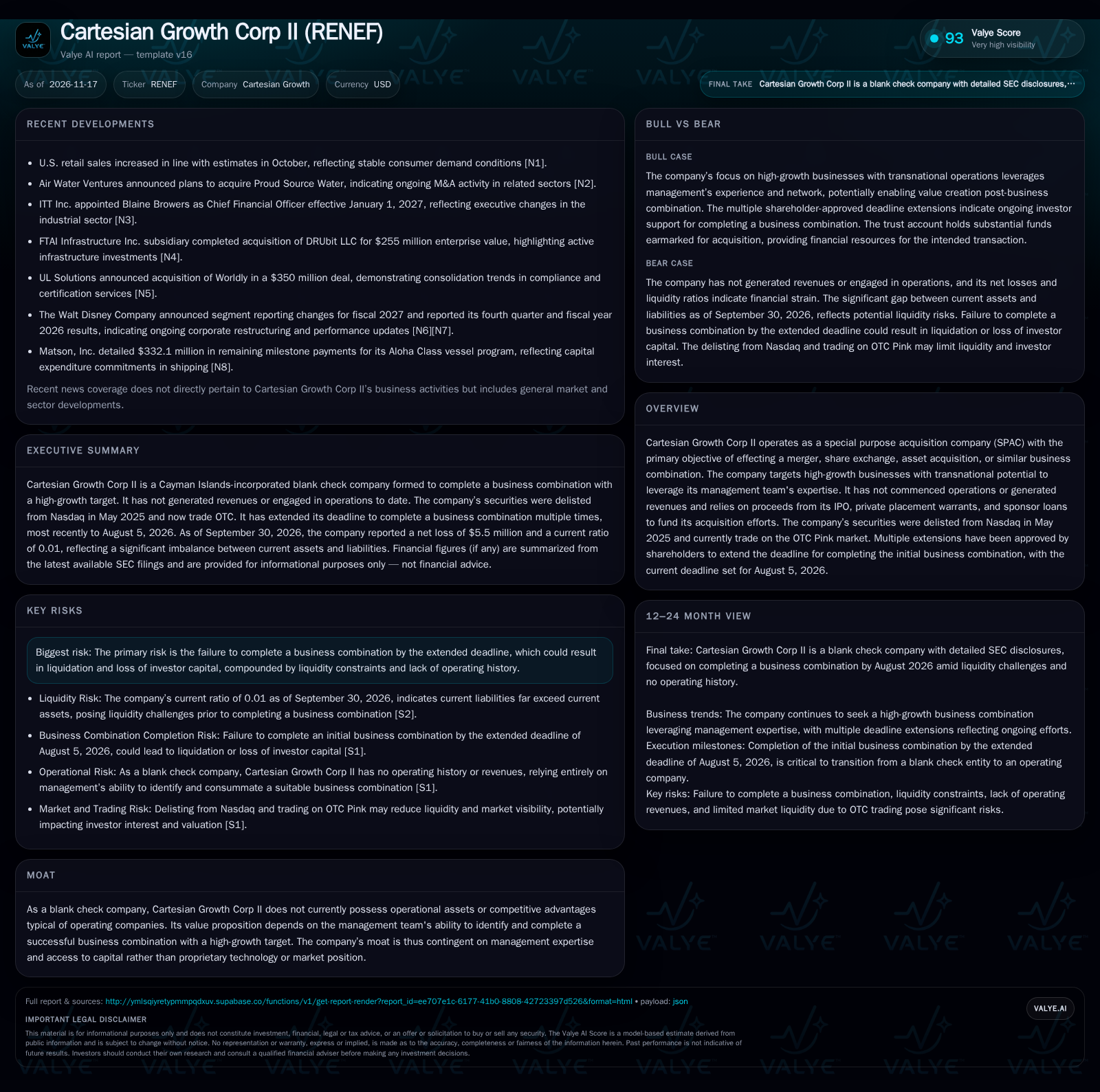
With a trust account of $37.9 million and current liabilities vastly exceeding current assets, its fate depends on sourcing and closing a business combination by August 2026. The risk of investor capital loss is acute if no deal materializes.
With $37.9 million in its trust account but just $42,164 in current assets against $6.74 million in liabilities, the company’s ability to survive and deliver value for shareholders depends entirely on executing a business combination by August 2026. Failure to do so could trigger liquidation and the loss of investor capital, making the coming months critical for both management and stakeholders.
Liquidity Crunch and Looming Deadline Define the Present
Cartesian Growth Corp II’s status has deteriorated since its Nasdaq delisting in May 2025, with shares now trading on the OTC Pink market—typically a venue for securities with lower liquidity and less institutional interest [S1]. The company’s trust account contained $37.9 million as of December 31, 2025, but this capital is strictly reserved for the completion of a business combination or eventual return to shareholders if no deal is consummated [S1].
The company reported cash and liquidity metrics for the period; these figures do not by themselves establish operating runway, investment capacity, financial flexibility, or financing capacity. [S2] Multiple deadline extensions, with the current cutoff set for August 5, 2026, signal ongoing but pressured efforts to identify and close a deal [S1]. If no transaction is completed by this date, the company faces forced liquidation and investor capital loss.
SPAC Mechanics: How Value Could Be Realized or Lost
SPACs like Cartesian Growth Corp II generate value for shareholders only if they can identify and close a business combination with a target that will outperform the cash value held in trust. The $37.9 million trust account is both an asset and a liability: while it represents deal-making firepower, it is also ring-fenced and cannot be used for ongoing operating expenses or to resolve current liabilities except in the context of a deal or liquidation [S1].
Pre-combination, the company produces no revenue, operates at a net loss, and must fund expenses from limited working capital or sponsor loans, as evidenced by the issuance of unsecured, non-interest bearing promissory notes to the sponsor [S1]. The structure is highly levered to a binary outcome: either a successful combination delivers post-deal equity value, or the SPAC liquidates and returns the trust account (net of expenses) to public shareholders. Operating leverage is negative in the pre-deal phase, with costs fixed relative to zero revenue.
If a combination is achieved, the economics shift dramatically and are dictated by the quality of the acquired operating business—its growth, margins, and capital needs. Until then, the only economic function is capital preservation and pursuit of a viable target.
Competitive Dynamics: SPAC Saturation and Sponsor Reputation
The SPAC market has become increasingly crowded, with many blank check companies chasing a shrinking pool of attractive targets. Cartesian Growth Corp II’s competitive position is shaped less by its own attributes and more by its management team’s reputation, deal-sourcing network, and the terms it can offer to potential targets.
Unlike operating businesses, the company has no proprietary technology, market share, or recurring revenue streams. Its only differentiator is the perceived ability of its sponsors to identify and negotiate with high-growth, transnational targets. The delisting from Nasdaq and migration to OTC Pink further diminish its appeal to many targets, who may prefer to merge with SPACs that offer a more liquid and prestigious listing venue.
Potential substitutes for targets include direct listings, traditional IPOs, private equity, and mergers with other SPACs that may offer more favorable terms or better post-combination visibility. The proliferation of SPACs and tighter regulatory scrutiny heighten competition for quality deals, increasing execution risk.
A High-Quality Target and Timely Deal Could Unlock Value
The most favorable outcome is that Cartesian Growth Corp II leverages its management network to secure a high-growth, transnational business as a merger partner before the August 2026 deadline. If the acquired company delivers robust operating growth, scalable economics, and clear strategic rationale, the merged entity could attract renewed investor interest—even despite its OTC Pink status.
Confirmation of this scenario would require public announcement of a definitive agreement with a credible target, favorable deal terms (such as minimal dilution and a strong growth story), and evidence of post-deal capital market support—potentially including relisting on a major exchange. Early signals would include 8-K filings disclosing a signed letter of intent, regulatory approval milestones, and positive market reaction on deal announcement.
This outcome would be falsified if the company fails to announce a target or if the proposed transaction is with a distressed or low-quality business, or if a deal is announced but subsequently terminated.
Most Likely: Prolonged Search, Pressure Mounts, and Outcome Hinges on Final Months
Given the current market environment and the company’s status, the most plausible scenario is continued search for a suitable target under increasing time and liquidity constraints. The company may issue additional sponsor loans to cover operating costs, but this does not materially improve its negotiating leverage or attractiveness to premium targets.
Deal quality may be compromised as the deadline approaches, with the risk that only less desirable or distressed targets are available. Shareholder redemptions could further erode the trust account, reducing deal size and appeal. The base case is that, absent a high-quality target, the company either consummates a marginal transaction or is forced to liquidate, returning remaining trust capital to shareholders.
This scenario would be confirmed by a lack of substantive deal announcements, continued extensions (if possible), or late-stage deals with modest or uncertain upside.
No Deal, Forced Liquidation, and Investor Capital Loss Loom Large
The adverse scenario materializes if Cartesian Growth Corp II fails to secure any business combination by the August 2026 deadline. In this case, the company would be required to liquidate, with the trust account distributed to shareholders (net of expenses). Given the company’s negative working capital and ongoing costs, the final return may be less than the original investment.
Further downside could emerge if sponsor loans or other claims dilute the trust account, or if unexpected liabilities arise. The delisting from Nasdaq and OTC Pink status may also hinder the process, reducing transparency and creating delays in returning capital.
Confirmation would come from an absence of deal announcements as the deadline nears, board resolutions initiating liquidation, and final SEC filings detailing the wind-down and distribution process.
Milestones and Signals That Will Determine Cartesian Growth’s Fate
Announcement of a definitive agreement with a credible operating business prior to August 2026, including deal terms and target profile.
8-K filings or public disclosures indicating a signed letter of intent or advanced negotiations with a merger candidate.
Evidence of new sponsor loans or bridge financing to support ongoing operations, if disclosed.
Changes in the trust account balance, especially after shareholder redemptions or the payment of expenses, as reflected in future SEC filings.
Any regulatory or shareholder approvals required for a proposed business combination, including proxy statements and vote outcomes.
Indicators of potential relisting or plans for uplisting to a major exchange post-combination, if part of the deal announcement.
Progress updates on liquidation procedures if no deal is announced as the deadline approaches.
Disclaimer: This is research-only, informational analysis and not investment advice. It may include AI-generated interpretation and general industry context. Always verify important details using primary sources.

Comments