
Research Alliance Corp III: Trust-Backed SPAC Structure Meets Acute Liquidity Strain and Strategic Ambiguity
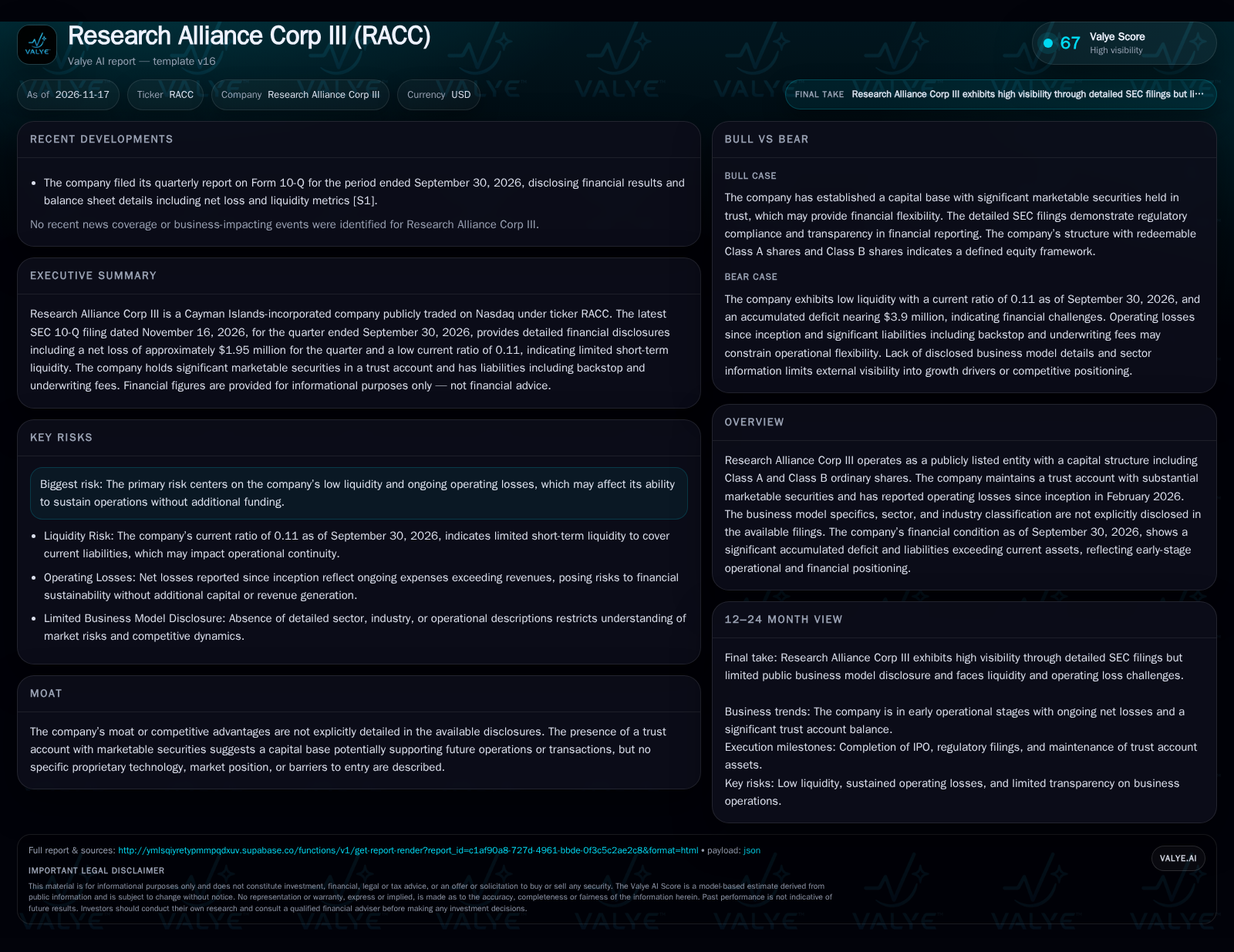
Research Alliance Corp III maintains a sizable trust account and a defined equity structure, but faces a reported current ratio, mounting losses, and significant liabilities. The absence of disclosed business operations or sector focus leaves its thesis and future pathways highly contingent on forthcoming strategic actions.
With no disclosed sector or operational strategy, the company’s value proposition and risk profile remain opaque, hinging on future business combination execution or capital deployment decisions. [S1]
Research Alliance Corp III represents a capital pool with a typical SPAC structure—substantial assets held in trust and a multi-class share system—but its acute liquidity mismatch and lack of disclosed business operations make it more a financial shell than an active operating company as of late 2026. The company’s viability and future value will hinge almost entirely on its ability to execute a business combination or otherwise deploy its trust capital before liabilities and expenses erode its financial base. Until then, the absence of sector focus or deal pipeline renders its risk/reward profile highly opaque and speculative. [S1]
Trust Account Strength Versus Immediate Liquidity Shortfall
The most material facts shaping Research Alliance Corp III’s thesis are its $75.95 million in marketable securities held in trust, its reported current ratio of 0.11 (current assets of $312,054 vs. current liabilities of $2.9 million), and a net loss of $1.95 million for the latest quarter, bringing its accumulated deficit to $3.9 million as of September 30, 2026. These figures highlight a classic SPAC capital structure—where the majority of assets are restricted and earmarked for a future business combination, while operating liquidity is minimal and ongoing expenses quickly erode available cash. The company’s significant backstop and deferred underwriting liabilities further compress its near-term potential financial flexibility. In sum, Research Alliance Corp III’s current context is defined by substantial trust-backed assets but acute operational cash strain and a lack of disclosed commercial execution. [S1]
The dichotomy between the trust account's size and the company’s immediate liquidity constraints underscores a critical tension inherent in SPAC structures. While the trust assets offer a substantial nominal backing, their restricted nature limits their utility for day-to-day operational needs or opportunistic investments prior to a business combination. This structural rigidity means that operational cash flow management must rely on minimal available liquid assets and sponsor support, if any. Consequently, the company’s ability to sustain administrative functions and regulatory compliance without encroaching on trust capital is a delicate balancing act, and any unexpected cash demands could exacerbate liquidity pressures, potentially accelerating the timeline toward a strategic decision point.
SPAC Economic Model: Contingent Value Creation and Capital Constraints
Research Alliance Corp III’s economics are characteristic of a special purpose acquisition company (SPAC): it generates no operating revenue, incurs administrative and regulatory expenses, and is structured to preserve trust capital for a future merger or acquisition. The company’s trust assets are typically invested in low-risk marketable securities, yielding minimal returns relative to the expense base. The primary path to value creation is the successful identification and consummation of a business combination, after which its capital can be deployed to fund a target’s growth or operations. Until such a deal, the company is in a race against time—its fixed cost base (legal, compliance, administrative) steadily reduces available cash, and deferred costs (such as underwriting fees) crystallize upon deal execution or liquidation. The significant mismatch between operating liquidity and current liabilities means that, absent a swift transaction or capital infusion, the company faces increasing risk of failing to meet obligations or being forced into liquidation, where trust proceeds are generally returned to redeeming shareholders.
The contingent value creation model of SPACs inherently aligns incentives around the successful consummation of a business combination, but this model also imposes stringent capital constraints. The trust’s low-yield investments are deliberately conservative to preserve principal, yet this conservative stance restricts the generation of incremental returns that might otherwise offset operational expenses. Moreover, the crystallization of deferred underwriting fees upon transaction or liquidation introduces a significant contingent liability that must be factored into any valuation or risk assessment. This dynamic creates a scenario where the company’s economic viability is effectively a function of timing and deal execution efficiency, as prolonged delays incrementally erode net asset value and heighten the risk of value destruction.
SPAC Market Crowding and the Limits of Financial Differentiation
Research Alliance Corp III operates in a crowded SPAC landscape where capital pools vie for attractive targets and sponsor reputation, sector focus, and deal-structuring creativity can be key differentiators. With no disclosed sector or management value proposition, the company lacks visible advantages over other SPACs targeting similar merger opportunities. SPACs face increasing competition from both traditional private equity and direct listings, and market skepticism has grown as many recent SPACs have failed to deliver sustained post-merger value. Without a defined sector mandate, unique sponsor expertise, or proprietary sourcing channels, Research Alliance Corp III competes primarily on the size and certainty of its trust account. However, this is a commodity feature in the current environment, and the absence of business model disclosure limits its attractiveness to potential targets seeking more than just capital.
In an increasingly saturated SPAC market, differentiation extends beyond capital size to encompass sponsor expertise, sector specialization, and deal origination capabilities. Without a clearly articulated sector focus or demonstrated sourcing advantage, Research Alliance Corp III faces the challenge of attracting high-quality targets that may prefer partners offering strategic value beyond capital provision. This lack of differentiation may also impact investor confidence, as market participants increasingly scrutinize the quality and credibility of the SPAC’s pipeline and management team. Therefore, the company’s competitive position is vulnerable to both external market skepticism and internal strategic ambiguity, limiting its ability to negotiate favorable deal terms or secure value-enhancing partnerships.
Value Unlock if a High-Quality Business Combination Materializes
The most favorable outcome for Research Alliance Corp III is the identification and consummation of a merger with a compelling, growth-oriented private company at a reasonable valuation. Such a business combination could catalyze a re-rating of the equity, unlock the trust capital for productive use, and potentially generate sponsor and shareholder returns. Confirmation would come from a formal deal announcement specifying the target’s sector, financials, and growth plan, followed by shareholder approval and successful transaction close. Additional upside could result from favorable deal terms—such as pipe financing, target management retention, or strategic partnerships—that reduce redemption risk and align incentives. Falsification would occur if the company fails to announce a credible target or if redemption rates strip the trust account before the deal closes.
Incremental Erosion Until Deal or Liquidation Deadline Forces Resolution
The most plausible scenario, absent new disclosures, is a gradual erosion of operating cash as the company continues to incur expenses without generating revenue or securing a business combination. Over time, the fixed cost base and deferred liabilities (such as underwriting fees) will further compress net assets outside the trust. If a business combination is not secured within the SPAC’s typical time window (often 18–24 months from IPO), the company may be forced to liquidate, returning trust account proceeds to shareholders and leaving little or no residual value for sponsors. Confirmation of this scenario would come from a lack of substantive merger announcements, continued net losses, and quarterly filings showing declining operating cash. Falsification would require a material change in strategy, such as a deal announcement or a significant capital infusion.
Accelerating Expense Burn Raises Risk of Forced Liquidation or Default
A more adverse outcome would involve a faster-than-expected depletion of operating liquidity—driven by escalating costs, unexpected liabilities, or legal/regulatory actions—causing the company to be unable to meet its current obligations before a deal is secured. Falsification would require clear evidence of new funding, cost containment, or a near-term business combination that stabilizes the balance sheet.
Milestones and Metrics That Will Define RACC’s Strategic Trajectory
Announcement of a definitive business combination agreement, including target sector, financials, and deal structure.
Quarterly changes in the trust account balance, especially if redemptions or transaction costs begin to erode principal.
Resolution or reduction of significant liabilities, such as deferred underwriting fees and backstop obligations.
Any filings or statements indicating an extension or amendment to the SPAC’s merger deadline.
Evidence of PIPE (private investment in public equity) commitments or other external financing to support a future transaction.
Disclosure of sponsor support, expense advances, or working capital loans bridging to a business combination, if provided.
A useful metric would be the redemption rate of Class A shares in the event of a business combination announcement.
Disclaimer: This is research-only, informational analysis and not investment advice. It may include AI-generated interpretation and general industry context. Always verify important details using primary sources.

Comments