
Hepion Pharmaceuticals: Financial Position, Operational Challenges, and Commercialization Prospects
Hepion Pharmaceuticals maintains a reported liquidity position buffer and continues to invest in research and development, but persistent operating losses and the absence of revenue highlight the critical need for a viable commercialization strategy and sustained access to external capital.
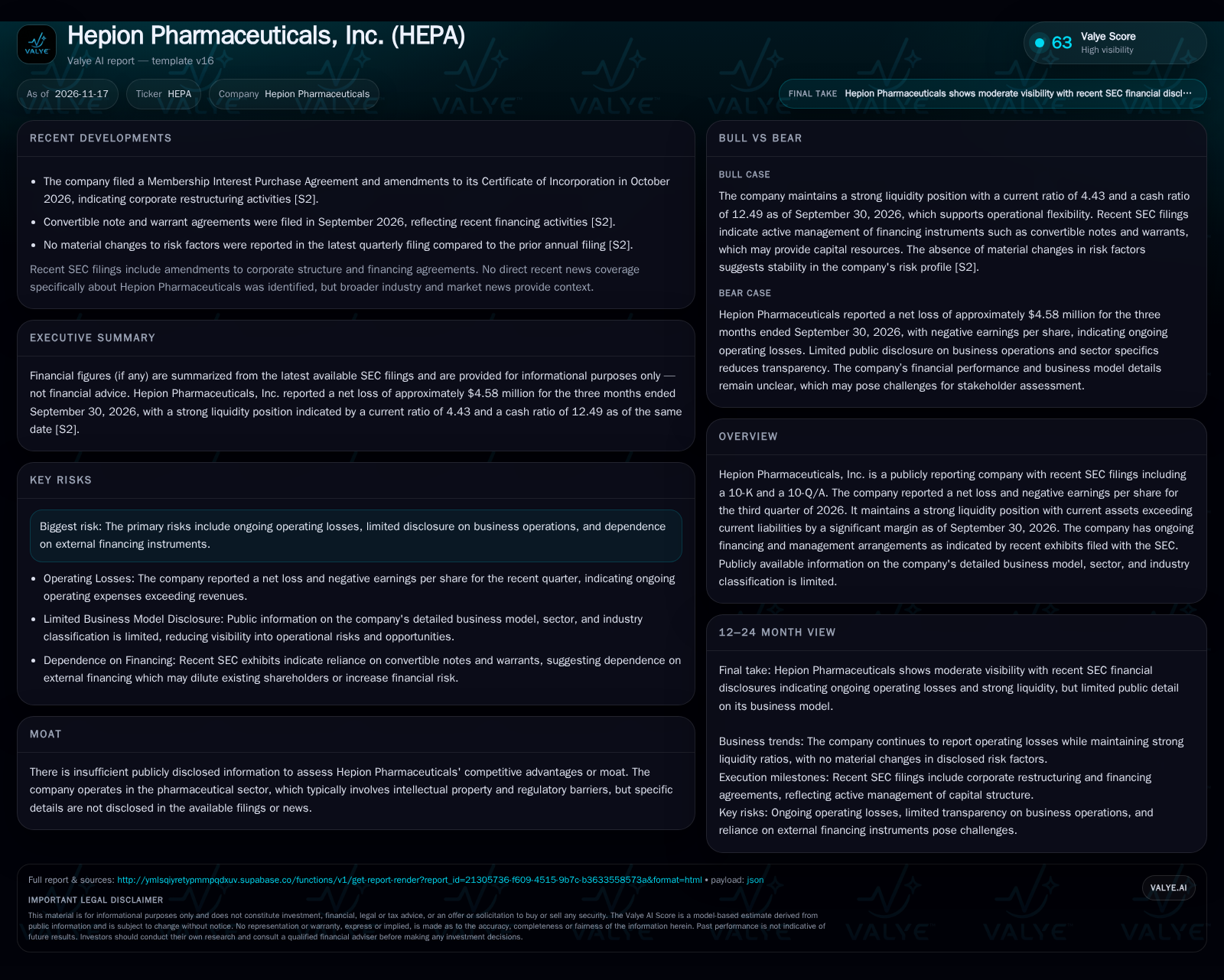
Hepion Pharmaceuticals reported no revenue and a net loss of $4.58 million for Q3 2026, despite current assets of $4.94 million and a current ratio of 4.43 as of September 30, 2026. Ongoing reliance on convertible notes and warrants supports short-term liquidity, but the lack of commercialized products and limited business disclosure leave the long-term outlook highly uncertain. The company's future depends on advancing its pipeline and securing additional financing before its liquidity buffer is exhausted. [S2]
Hepion Pharmaceuticals, Inc. stands at a familiar crossroads for early-stage biotech: a substantial liquidity cushion and ongoing R&D spending are offset by persistent operating losses and the absence of commercial revenue. With recent SEC filings highlighting both active capital management and an accumulated deficit of over $250 million, the company must navigate the demanding road from research to product approval and commercialization—where execution, partnering, and continued access to capital will ultimately determine its fate. The next several quarters are likely to test whether Hepion can convert its financial runway into meaningful clinical or business milestones before funding pressures mount.
Recent Financial Results Reflect Pre-Commercial Operations and Cash Reserves
As of September 30, 2026, Hepion Pharmaceuticals reported current assets of approximately $4.94 million against current liabilities of $1.11 million, yielding a current ratio of 4.43 and a cash ratio of 12.49. This suggests a healthy buffer for meeting short-term obligations. However, the company posted a net loss of $4.58 million for the third quarter of 2026 and reported zero revenue, underscoring its status as a pre-commercial biotechnology company. General and administrative expenses rose to $1.4 million for the quarter, primarily due to increased personnel costs and professional fees. Recent SEC filings also document convertible note and warrant financings, indicating ongoing reliance on external capital to fund operations. There have been no material changes to the company’s risk factors since the previous annual filing, and the accumulated deficit now exceeds $250 million. [S2]
While the current ratio and cash ratio indicate short-term liquidity strength, these metrics alone do not guarantee operational sustainability beyond the immediate horizon. The burn rate relative to cash reserves determines the actual runway duration, which is critical for a pre-commercial biotech reliant on continuous R&D investment. Moreover, the timing of milestone-driven expenditures, such as clinical trial initiations or regulatory submissions, can cause fluctuations in cash needs that simple liquidity ratios may not capture. Therefore, a more granular cash flow analysis and scenario modeling of expense patterns against anticipated funding events would provide a clearer picture of Hepion’s financial resilience in navigating the development cycle.
Cost Structure and Financing Patterns Underpin Hepion’s Economic Landscape
Hepion Pharmaceuticals’ business economics are emblematic of early-stage biotech: high fixed costs, minimal variable cost leverage, and no revenue to offset expenses. The company’s primary expenditures are in research and development and general and administrative activities, with the latter rising in recent quarters. The absence of product revenue means that cash burn is dictated by operating expenses and the pace of pipeline advancement. Funding is sourced through convertible notes and warrants, which provide cash infusions but may dilute existing equity holders over time. The critical economic lever for Hepion is the successful development and eventual commercialization of its product candidates, which could—if achieved—flip the business from cash-burning to cash-generating. Until then, the company’s economics are defined by the need for repeated capital raises, vulnerability to market conditions, and the pressure to demonstrate progress that justifies further investment.
The financing strategy centered on convertible notes and warrants introduces complex dynamics affecting shareholder value and capital structure. Convertible instruments often carry features such as conversion price adjustments, interest accruals, and maturity dates that can influence dilution magnitude and timing. If market conditions deteriorate or clinical progress stalls, the company may face challenges in raising capital on favorable terms, potentially leading to more dilutive financings or restrictive covenants. Additionally, the fixed nature of R&D and G&A costs limits the company's ability to rapidly scale expenses up or down in response to funding availability, increasing operational risk. Effective management of these financing instruments and cost structures is therefore essential to maintain potential financial flexibility and investor confidence.
Evaluating Hepion’s Position Within a Competitive, High-Entry Barrier Market
Hepion operates within the biotechnology and pharmaceutical landscape, which is characterized by intense competition, high regulatory hurdles, and the necessity for significant intellectual property protection. While specifics about Hepion’s therapeutic focus, lead candidates, or differentiation are not disclosed, the sector’s typical dynamics apply: established and emerging biotechs, large pharma, and academic spinouts all vie for similar capital and clinical opportunities. Without clear evidence of proprietary technology, a differentiated clinical asset, or strategic partnerships, Hepion’s competitive position is difficult to assess. The company’s ability to attract collaborators, secure licensing deals, or advance a candidate through pivotal clinical milestones would be the clearest markers of competitive advantage. In the absence of these, Hepion risks being marginalized by better-capitalized or more advanced peers, or by technological and scientific obsolescence.
In a sector marked by rapid scientific evolution, the durability of Hepion’s intellectual property and the novelty of its therapeutic approach are pivotal to establishing competitive moats. Without clear differentiation, the company risks commoditization of its assets in a crowded market where larger players can leverage scale and resources to outpace smaller biotechs. Moreover, the ability to navigate regulatory complexities and demonstrate clinical efficacy and safety is a high barrier that filters out many entrants. Strategic partnerships can mitigate these risks by providing access to complementary expertise, capital, and commercialization channels. Absent such alliances, Hepion’s capacity to compete effectively may be constrained by resource limitations and slower development timelines.
Clinical Advances, Collaborations, and Funding as Catalysts for Value Creation
A favorable trajectory for Hepion would see it advancing one or more pipeline assets through key preclinical or clinical milestones, thereby attracting strategic partners or licensing deals that provide non-dilutive capital and external validation. Success in early-phase trials could spark investor interest, enable up-round financings, or even set the stage for a potential acquisition by a larger pharmaceutical entity. Evidence that would confirm this scenario includes announced positive clinical data, new research collaborations, up-front licensing payments, or a marked increase in R&D outlays tied to program progression. This pathway is contingent on both scientific execution and the ability to communicate a compelling story to investors and partners—a nontrivial challenge in a crowded field.
Extended Pre-Revenue Status and Gradual Developments Outline Expected Progress
The most plausible path for Hepion is a continuation of its current trajectory: incremental R&D activity, ongoing operating losses, and periodic external financings to shore up liquidity. The company may achieve modest pipeline progress, such as advancing a candidate into or through early-stage trials, but without near-term revenue or major partnership infusions. The absence of material changes to risk factors and continued reliance on convertible note and warrant financings would support this view. Evidence confirming this scenario would include stable or rising G&A expenses, repeated small-scale capital raises, and no transformative business development announcements. Falsifying this scenario would require either a dramatic clinical breakthrough or an abrupt cessation of funding options.
Capital Limitations and Development Risks Could Prompt Strategic Retrenchment
The adverse scenario for Hepion centers on the exhaustion of its liquidity buffer before meaningful clinical or business milestones are achieved. If the company is unable to secure additional capital—whether due to unfavorable market conditions, lack of investor interest, or disappointing pipeline data—it could be forced to curtail operations, delay or abandon programs, or pursue distressed asset sales. Evidence of this chain would include a shrinking cash balance, an inability to complete new financings, material reductions in R&D activity, or disclosure of going-concern risks in SEC filings. In extreme cases, Hepion could face delisting, bankruptcy, or dissolution if no strategic alternatives emerge.
Upcoming Milestones and Performance Indicators Shaping Hepion’s Future
Trends in cash and cash equivalents across future quarters—ongoing declines without new financing would heighten risk.
Disclosure of clinical development milestones, including trial initiations, data readouts, or regulatory submissions, if disclosed.
Announcements of research collaborations, licensing agreements, or strategic partnerships that provide external validation and funding.
Changes in research and development and general and administrative expense patterns—sustained increases could indicate pipeline activity, while declines may signal retrenchment.
Frequency, size, and terms of new convertible note or warrant financings, and the associated dilution for existing shareholders.
Explicit discussion of going-concern risks or references to potential operational cutbacks in future SEC filings.
Emergence of peer-reviewed publications or conference presentations related to Hepion’s scientific programs, if disclosed.
Any updates to risk factors that indicate new operational, regulatory, or financial challenges.
Disclaimer: This is research-only, informational analysis and not investment advice. It may include AI-generated interpretation and general industry context. Always verify important details using primary sources.

Comments