
APPlife Digital: Navigating Liquidity Crisis and Structural Constraints in Automotive E-Commerce
APPlife Digital Solutions Inc confronts severe financial distress, debt default, and dilution threats amid efforts to reposition in the competitive automotive parts e-commerce space. The company’s future hinges on resolving capital structure constraints, restoring operational credibility, and finding a viable path to scale in a market dominated by established players.
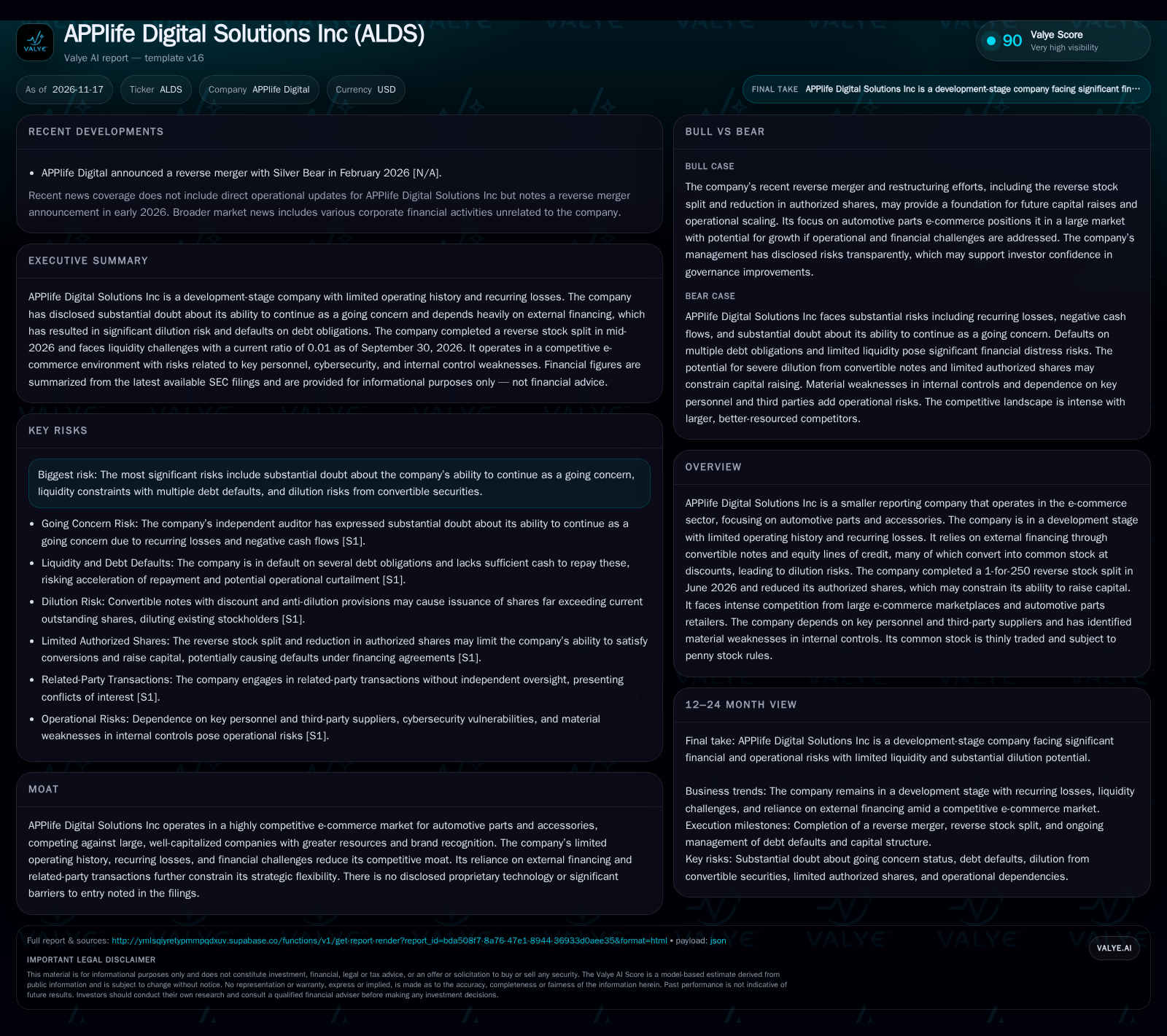
APPlife Digital Solutions Inc is a development-stage automotive e-commerce company facing acute liquidity shortages, recurring losses, and debt defaults. Its reliance on discounted convertible financing and a recent reverse stock split expose shareholders to severe dilution and restrict capital-raising options. The company’s ability to survive and scale depends on restructuring, operational execution, and overcoming entrenched competition in a crowded sector. [S1] [S2]
Recent financials reveal minimal cash, a near-zero current ratio, and persistent operating losses. The company’s reliance on deeply discounted convertible financing and a 1-for-250 reverse stock split has left it with few capital-raising options and exposed shareholders to severe dilution. In a crowded, competitive sector, APPlife Digital’s survival prospects depend on restructuring, operational credibility, and the ability to carve out a defensible niche.
Liquidity Cliff and Dilution: The Immediate Threats Facing APPlife Digital
APPlife Digital’s most pressing realities are its minimal liquidity, ongoing defaults, and capital structure constraints. As of September 30, 2026, the company reported just $24,253 in cash and equivalents against $5.1 million in current liabilities—a current ratio of 0.01, with a cash ratio effectively at zero. This reflects a severe inability to meet short-term obligations and leaves the company highly vulnerable to creditor actions. [S2]
The company is in default under several debt agreements, many of which are convertible notes with steep discounts and anti-dilution provisions. This structure not only heightens the risk of creditor enforcement but also sets the stage for potential issuance of shares far in excess of those currently outstanding, severely diluting existing shareholders. [S1]
In June 2026, APPlife Digital effected a 1-for-250 reverse stock split and reduced its authorized common shares to 20 million, which was intended to facilitate further capital raises and address conversion obligations. However, these actions now limit flexibility for new equity issuance, potentially constraining future financings and exacerbating default risk. [S1]
Beyond the immediate liquidity crunch, the company's capital structure complexity poses significant challenges for potential investors or restructuring partners. Convertible notes with steep discounts and anti-dilution provisions create a misalignment of incentives between existing equity holders and debt holders, often complicating negotiations. If the company cannot negotiate amendments or exchanges that balance creditor recoveries with manageable dilution, it risks protracted default cycles that deter new capital. Moreover, the limited authorized share count following the reverse split restricts flexibility to issue equity as a currency for strategic transactions or debt conversions, potentially forcing the company into suboptimal financing terms or asset sales.
E-Commerce Model Under Strain: Revenue Recognition, Margins, and Funding
APPlife Digital’s core business is the online sale of automotive lift kits and accessories, with revenue recognized at shipment or delivery. In the quarter ended September 30, 2026, the company generated $195,575 in revenue but posted a net loss of $1,129,902, indicating negative gross margins or high fixed operating costs relative to scale. [S2]
The company’s variable cost structure is likely dominated by procurement from third-party suppliers, fulfillment, and transaction fees, with limited ability to negotiate favorable terms due to low volume. Fixed costs include platform maintenance, compliance, and minimal staff. There is no evidence of proprietary technology or high-margin private label products, suggesting limited pricing power and margin compression in a commodity-driven sector.
The heavy use of convertible debt at discounts exacerbates dilution risk and signals a lack of access to conventional funding channels.
The e-commerce model's scalability constraints are exacerbated by the company's small revenue base and high fixed costs, which together limit operating leverage. Without volume growth, fixed costs such as platform upkeep and compliance dilute margins further, while low purchasing volumes reduce bargaining power with suppliers, leading to higher costs of goods sold. Additionally, the absence of proprietary technology or differentiated product offerings restricts pricing power and customer loyalty, making the business vulnerable to price competition and margin erosion. If disclosed, metrics such as customer acquisition cost, repeat purchase rates, and average order value would help assess whether the company can improve unit economics sufficiently to reach sustainable profitability.
Competitive Pressures and the Absence of Defensible Moat
APPlife Digital operates in the highly competitive automotive e-commerce category, facing direct competition from established online marketplaces and specialized auto parts retailers with far greater resources, brand recognition, and operational scale. The company’s filings do not disclose any proprietary platform technology, exclusive supplier relationships, or unique customer acquisition advantages. [S1]
The sector is characterized by low switching costs for consumers, aggressive pricing, and tight integration of logistics and customer service among incumbents. Without meaningful differentiation, smaller platforms typically struggle to attract repeat business or command better supplier terms. The absence of a clear value proposition or ecosystem effect places APPlife Digital at a structural disadvantage.
Additionally, the company’s limited cash restricts marketing investment, further eroding its ability to build brand equity or scale user acquisition cost-effectively.
The automotive e-commerce sector's competitive dynamics favor players with integrated supply chains, strong brand recognition, and scale-enabled logistics capabilities. APPlife Digital's lack of exclusive supplier agreements or technological differentiation means it competes primarily on price and convenience, areas where larger incumbents have significant advantages. The low switching costs for customers imply that without a compelling value proposition or ecosystem lock-in, customer retention will be challenging. Furthermore, limited marketing budgets restrict the company's ability to build brand awareness or invest in data-driven customer acquisition strategies, which are critical in digital retail environments. The company’s position may thus remain precarious unless it identifies niche segments or innovative service models to differentiate itself.
Restructuring and Strategic Partnerships as a Pathway to Survival
A plausible bull case for APPlife Digital would require a successful restructuring of its capital stack—potentially through debt renegotiation, fresh equity injection, or a strategic partnership/merger that brings operational and financial resources. The February 2026 reverse merger announcement with Silver Bear hints at potential for a broader platform or asset base, though operational details and benefits remain undisclosed. If the merger results in recapitalization, improved governance, and access to new customer channels or technology, the company could stabilize and begin to rebuild credibility.
Confirmation of this scenario would require new capital raised on less dilutive terms, reduction or conversion of defaulted debt without catastrophic dilution, and demonstrable growth in revenue with improved gross margins. Evidence of a shift toward proprietary products, recurring revenue streams, or exclusive supplier/customer relationships would further support the case for long-term viability.
Continued Struggle: Incremental Revenue, Ongoing Losses, and Dilution Risk
The most probable outcome, given current facts, is that APPlife Digital continues to operate at subscale, generating modest revenue from automotive e-commerce but incurring ongoing operating losses and negative cash flows. Without immediate access to new funding, the company will likely resort to further discounted convertible issuances, if its share authorization permits, compounding dilution and perpetuating a cycle of financial distress.
Operational execution may remain constrained by lack of marketing budget, limited supplier leverage, and persistent internal control weaknesses. The company could remain a marginal participant in the sector, with its stock thinly traded and subject to penny stock volatility. Confirmation of this scenario would include continued debt defaults, minimal growth in revenue, and further increases in shares outstanding due to conversions.
Default Cascade and Forced Liquidation Risks
The adverse scenario is a rapid acceleration of creditor action due to unresolved defaults, exhaustion of authorized shares for conversion, or inability to raise new capital. In this case, APPlife Digital could face forced asset sales, bankruptcy proceedings, or delisting. The lack of independent audit and compensation committees, ongoing related-party transactions, and material weaknesses in internal controls increase the risk of governance failures that could further erode stakeholder confidence.
Falsifying this scenario would require evidence of forbearance agreements with creditors, a negotiated resolution of defaulted notes, or a credible external capital commitment. Conversely, news of legal actions, asset seizures, or trading halts would confirm the downside risk.
Signals That Will Define APPlife Digital’s Next Chapter
Progress—or lack thereof—on resolving debt defaults and renegotiating convertible note terms, particularly any public forbearance or restructuring agreements.
Evidence of new capital raised on terms that do not result in catastrophic dilution, or a material strategic investment/partnership announcement.
Changes in authorized share count or stockholder approvals for further increases to facilitate conversions and capital raises.
Quarterly revenue growth and gross margin improvement, if disclosed, to indicate operational scaling or better procurement terms.
Updates on the integration or results of the announced Silver Bear reverse merger, including synergies, management changes, or platform expansion.
Disclosure of new proprietary products, exclusive supplier relationships, or technology differentiators that could signal a sustainable competitive advantage.
Resolution of material weaknesses in internal controls and establishment of independent audit/governance committees, if disclosed.
Any regulatory, delisting, or legal proceedings that could disrupt operations or impair shareholder value.
Disclaimer: This is research-only, informational analysis and not investment advice. It may include AI-generated interpretation and general industry context. Always verify important details using primary sources.

Comments