
SIM Acquisition Corp. I: SPAC Execution Window Narrows as AIT Letter of Intent Sets Next Strategic Hurdle
With a letter of intent signed for a business combination with American Industrial Technologies, SIM Acquisition Corp.
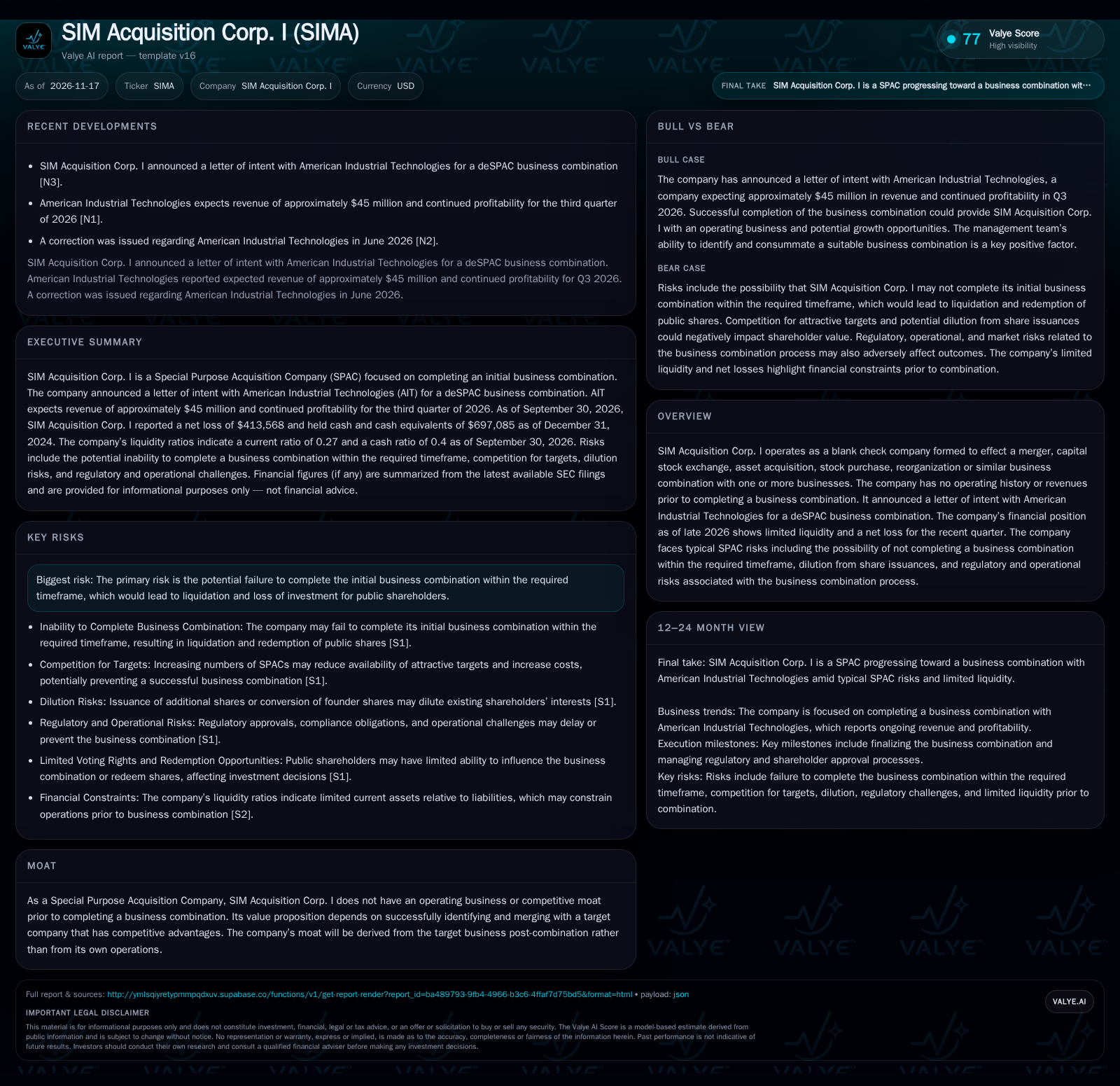
SIM Acquisition Corp. I remains a pre-revenue SPAC, now advancing a potential merger with American Industrial Technologies. The next phase depends on converting the AIT letter of intent into a definitive agreement and securing necessary approvals before the deadline, with dilution and financing risks looming large. [N3] [S2]
SIM Acquisition Corp. I has entered a critical stage in its lifecycle, recently announcing a letter of intent for a business combination with American Industrial Technologies. As a blank check company with no operating history or revenues, its future depends entirely on the successful execution of this transaction. However, the company’s latest financials reveal reported liquidity position and a significant net loss, underscoring the urgency of securing a deal before its SPAC window closes. In a crowded and challenging SPAC environment, SIM Acquisition Corp. I must overcome financing, regulatory, and dilution risks to deliver value to shareholders—or face the prospect of liquidation.
Letter of Intent with AIT Defines Next Milestone Amid Liquidity Pressures
The most material development for SIM Acquisition Corp. I is its announced letter of intent with American Industrial Technologies (AIT) for a deSPAC business combination. This signals progress toward transforming from a shell company to an operating business, but no definitive agreement has yet been reached [N3]. Financially, the company reported a net loss of $413,568 for the quarter ended September 30, 2026, and held current assets of $472,645 versus current liabilities of $1,735,389—a current ratio of just 0.27 and a cash ratio of 0.4 as of September 30, 2026 [S2]. These figures highlight acute liquidity constraints, raising the stakes for timely execution of the business combination. The company's future now turns on its ability to finalize the AIT transaction before the SPAC deadline, with failure likely resulting in liquidation and shareholder redemption [S1] [S2].
SPAC Economics: Dilution, Deal-Driven Value, and the Cost of Delay
SIM Acquisition Corp. I, like all SPACs, does not generate revenue or cash flow until a business combination closes. Its economic model is binary: value creation depends entirely on consummating a merger with a viable target. Until then, operating costs, legal fees, and due diligence expenses are funded from the sponsor’s capital and any remaining trust account proceeds. The company reported cash and liquidity metrics for the period; these figures do not by themselves establish operating runway, investment capacity, financial flexibility, or financing capacity. [S2]
Upon successful completion of a merger, the combined entity may access target company revenues, but also faces immediate integration costs, possible additional capital needs, and the risk of significant dilution from sponsor shares, warrants, and PIPE (private investment in public equity) financings. In this model, fixed costs are modest pre-combination but can rise sharply post-merger as the new entity takes on operating and public company expenses. If the AIT deal proceeds, terms such as valuation, additional capital requirements, and dilution from new share issuances will determine the economic upside for original shareholders.
Competing for Targets in a Crowded SPAC Arena
SIM Acquisition Corp. I faces intense competition from a large number of SPACs seeking attractive targets. This competitive pressure can drive up target valuations and lead to less favorable deal terms for SPAC sponsors and public shareholders [S1]. Furthermore, regulatory scrutiny has increased across the SPAC sector, lengthening approval timelines and adding compliance costs. As SIM Acquisition Corp. I is not limited to a particular sector, it may pursue targets outside the core expertise of its management team, which can increase execution risk and reduce the likelihood of post-combination success.
The company’s value proposition is entirely dependent on the merits of its chosen target. Until a deal is finalized, SIM Acquisition Corp. I has no inherent moat or recurring revenue stream. If the AIT transaction is completed, the combined entity’s relative standing will be determined by AIT’s competitive position in its industry, not by the SPAC structure itself. In the current environment, SPACs with strong sponsor reputations, access to PIPE capital, and differentiated sector focus tend to have a competitive advantage. SIM Acquisition Corp. I’s path forward will depend on its ability to move quickly, negotiate favorable terms, and secure market confidence in the chosen target.
If the AIT Deal Closes Smoothly: Pathways to Value Creation
The most favorable outcome for SIM Acquisition Corp. I is a swift progression from the AIT letter of intent to a definitive merger agreement, with regulatory and shareholder approvals secured on schedule. In this scenario, the company could access additional capital through PIPE financing or trust redemptions, enabling the combined entity to pursue its growth strategy. The success of this pathway depends on AIT’s financial health, growth prospects, and public-market readiness.
Confirmation of the upside scenario would come from the announcement of a definitive merger agreement with AIT, details on transaction structure (including valuation and financing), and evidence of strong PIPE or institutional investor support. Additional positive signals would include limited shareholder redemptions, favorable regulatory feedback, and early post-merger operational momentum. Falsification would occur if negotiations stall, regulatory approval is delayed, or PIPE funding cannot be secured, leaving the SPAC short of capital and at risk of liquidation.
Most Likely Trajectory: Extended Negotiations and Heightened Dilution Risk
Given current liquidity constraints and the complexity of SPAC deals in 2026, the most plausible scenario is an extended negotiation period with AIT, during which SIM Acquisition Corp. I may need to renegotiate terms, seek additional financing, or face higher dilution to get the deal done. In this scenario, shareholder redemptions could be significant, further reducing cash available to the combined business. Regulatory reviews may add additional time and uncertainty.
Evidence confirming the base scenario would include multiple deal amendments, delays in filing a definitive agreement, or announcements of additional financing rounds with dilutive terms. Signs of heavy redemptions or lackluster institutional interest would further support this view. A more positive base scenario could emerge if the company is able to secure a PIPE on reasonable terms and limit redemptions, but the balance of risks currently favors a protracted and costly path to completion.
Deal Failure or Liquidation: What Could Derail the Transaction
The principal downside risk is failure to close the AIT transaction before the SPAC’s deadline, resulting in forced liquidation and redemption of public shares at trust value. This could occur if due diligence uncovers material issues, if regulatory approvals are delayed or denied, or if SIM Acquisition Corp. I cannot secure sufficient capital to meet closing conditions. In this scenario, public shareholders may receive less than expected due to redemption costs and any trust account erosion.
Downside confirmation would come from public announcements of deal termination, missed regulatory or shareholder approval deadlines, or inability to raise necessary PIPE or bridge financing. Additional warning signs would include severe liquidity deterioration, sponsor withdrawal, or legal/regulatory actions that block the transaction. If the company is forced to liquidate, all upside optionality is lost and public investors are left with trust account proceeds, typically less than the original investment after expenses.
Milestones and External Factors That Will Shape SIM Acquisition Corp. I’s Outcome
Announcement of a definitive merger agreement with American Industrial Technologies, including deal terms, valuation, and financing structure.
PIPE financing commitments or alternative capital raises—volume, pricing, and investor quality would help test the ability to fund the transaction and limit dilution.
Shareholder redemption levels at the time of combination—high redemptions would reduce available cash and may jeopardize transaction viability.
Regulatory approval progress and any disclosed feedback from the SEC or other agencies.
Timeline disclosures for proxy filings, shareholder meetings, and expected closing date—delays would signal execution risk.
Sponsor actions: additional capital infusions, extensions, or waivers to keep the deal alive.
Public statements or filings from AIT regarding its financial condition, strategic plans, and readiness for public-market scrutiny.
Disclaimer: This is research-only, informational analysis and not investment advice. It may include AI-generated interpretation and general industry context. Always verify important details using primary sources.

Comments