
Ranger Gold Corp.: Speculative Ambitions Confront Zero Cash and No Assets
With no mining properties, revenue, or cash, Ranger Gold Corp. remains a pure exploration-stage vehicle. Its future depends entirely on acquiring assets and raising capital—against steep industry and operational odds.
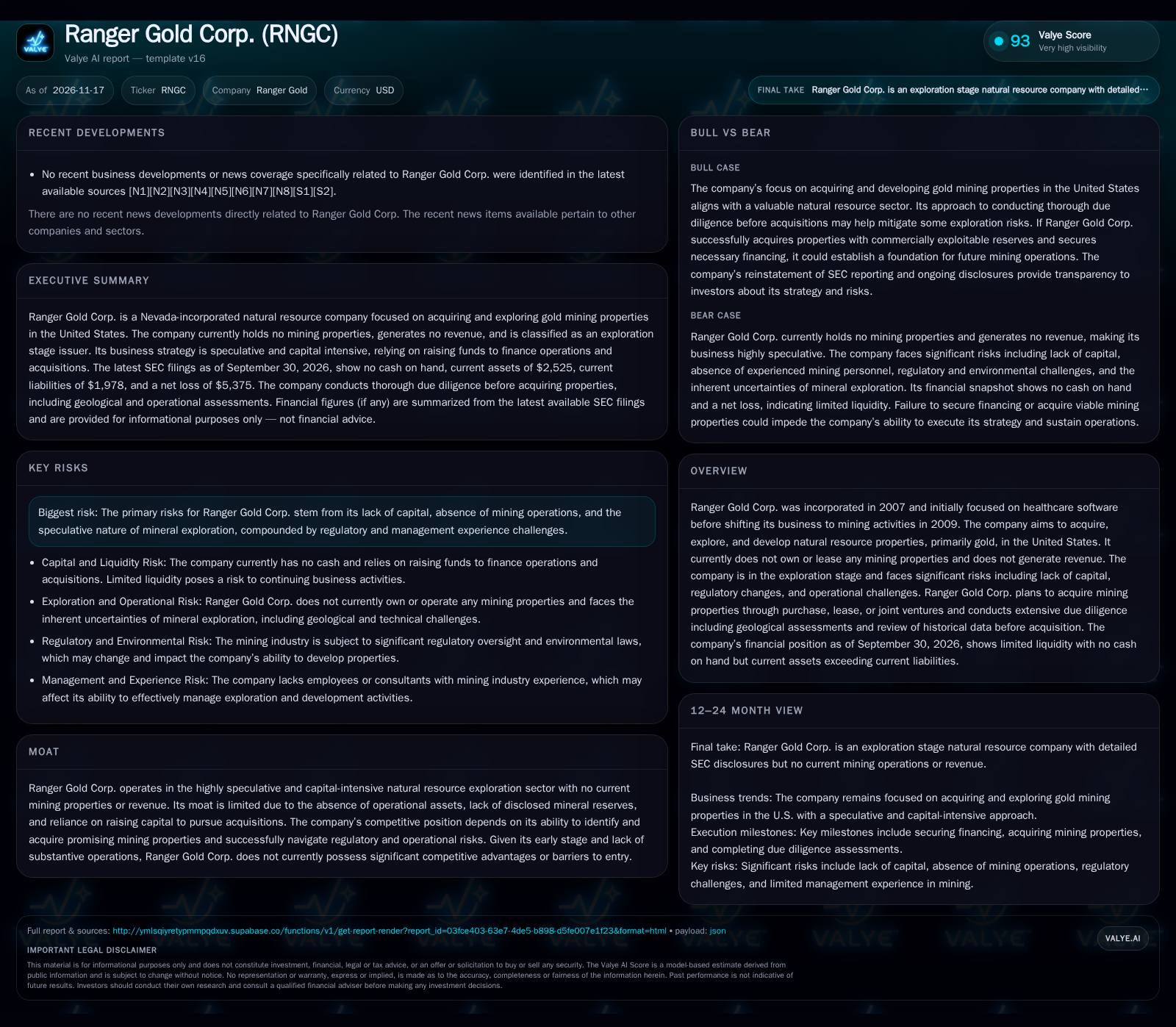
Ranger Gold Corp. is a U.S.-incorporated natural resource company with no current mining properties, revenue, or operational personnel. As of September 2026, it reports zero cash and only minimal current assets exceeding liabilities. The business is speculative, hinging on its ability to acquire gold projects and secure funding. Execution risk is high given the absence of reserves, experienced staff, or operating history in mining. Investors face a binary outcome: either Ranger Gold acquires and develops assets with new capital, or it remains a non-operating shell.
Ranger Gold Corp. exemplifies the high-risk, high-uncertainty end of the junior mining spectrum. Despite its Nevada incorporation and stated focus on acquiring and developing U.S. gold properties, the company currently owns no mining assets, generates no revenue, and reports zero cash on hand. Its business model is purely aspirational: success hinges on the future acquisition of promising mineral properties and the ability to raise sufficient capital to explore and develop them. For now, Ranger Gold is a shell with a mining ambition, facing steep barriers in both capital formation and operational execution.
Snapshot: No Properties, Cash, or Revenue—A Shell Awaiting Opportunity
As of September 30, 2026, Ranger Gold Corp. reports no ownership, lease, or rights to any mining properties and has not generated any revenue [S1] [S2]. The company's financials show zero cash and cash equivalents, with current assets of $2,525 just exceeding current liabilities of $1,978, resulting in a current ratio of 1.28 [S2]. There are no employees or consultants with mining industry experience, and the net loss for the reporting period is $5,375 [S2]. Ranger Gold is classified as an exploration-stage issuer, with no disclosed mineral reserves or operational activity underway [S1]. In effect, the company is a non-operating shell, its future contingent on the successful identification, acquisition, and development of viable gold properties, as well as on raising capital to fund those activities.
How Value Creation Would Work: Capital Intensity, Exploration Risk, and Binary Outcomes
In the natural resource sector, exploration-stage companies like Ranger Gold typically create value by acquiring properties with geological potential, conducting exploration to delineate resources, and then either developing those properties into producing mines or selling them to larger operators. The business is capital intensive and high risk: substantial funds are needed for property acquisition, exploration (including drilling and geological surveys), permitting, and environmental compliance. Fixed costs are low at present due to the absence of operations and staff, but would rise sharply if exploration or development were initiated.
Revenue, if any, would be realized only after a successful resource delineation, permitting, and either production or asset sale. Until then, Ranger Gold is entirely dependent on external financing—typically through equity issuance, private placements, or joint-venture funding. There is no internal cash generation to finance activities. The economics hinge on acquiring assets with genuine resource upside; if properties acquired lack commercial viability, sunk costs are unrecoverable. The model is thus binary: either unlock value through successful exploration and development, or erode shareholder capital with no return.
Positioning in a Crowded Junior Mining Field: Barriers, Substitutes, and The Absence of Moat
Ranger Gold currently possesses no competitive advantages: it lacks physical assets, experienced personnel, and exploration rights. In the junior mining sector, competition for quality properties is intense—numerous similar vehicles seek to acquire, explore, and promote early-stage gold assets, often chasing the same opportunities. Without technical expertise or a track record, Ranger Gold may struggle to secure attractive projects or raise capital on favorable terms.
The company faces not only direct competition from other junior explorers but also indirect competition from alternative investment vehicles (such as royalty/streaming companies and ETFs) that offer exposure to gold without single-asset risk. Additionally, larger mining companies may outbid juniors for high-potential properties. Given the absence of an operating asset base or technical team, Ranger Gold's ability to differentiate itself is limited. Any future edge would likely need to come from opportunistic acquisition, strategic partnership, or the recruitment of experienced personnel—none of which are currently in evidence.
Unlocking Value: Acquisition and Development of a Promising Gold Project
A favorable scenario for Ranger Gold would see the company successfully raising capital—likely via equity or convertible debt—and using those funds to acquire an exploration-stage gold property with credible geological potential. Following acquisition, the company would conduct technical due diligence, including fieldwork and initial drilling, to define resources and demonstrate economic viability.
Confirmation of this scenario would require public announcements of completed financings, property acquisitions with disclosed resource estimates, recruitment of experienced geologists or mining executives, and the initiation of exploration programs. Further validation would come from positive exploration results (e.g., drill intercepts, NI 43-101 compliant resource statements), permitting progress, and, ideally, interest from larger mining companies or investors.
Falsification of this upside would occur if Ranger Gold either fails to raise capital, cannot secure property deals, or acquires assets of negligible value, resulting in continued operating inactivity and capital erosion.
Ongoing Dormancy: Prolonged Inactivity and Incremental Dilution
The most plausible near-term scenario is continued inactivity: Ranger Gold remains a shell, incurring nominal administrative expenses, and periodically seeking to raise small amounts of capital to cover public company costs. Without a technical team or operating track record, it may struggle to attract either quality projects or the funding needed to acquire them.
Evidence supporting this base case would include ongoing SEC filings with no substantive operational updates, continued zero cash or revenue, and sporadic small financings primarily used for overhead. The company may announce intentions to review or negotiate property options, but without closing transactions or initiating exploration programs.
The base scenario would be falsified if Ranger Gold announces a significant acquisition, hires experienced mining personnel, or launches an exploration campaign with new funding—any of which would indicate a shift toward active business development.
Prolonged Stasis or De-Listing: Failure to Secure Assets or Funding
A negative outcome would see Ranger Gold unable to raise even minimal capital, leading to an inability to maintain SEC reporting obligations, pay basic administrative costs, or pursue property acquisitions. Over time, this could result in de-listing, dormancy, or dissolution.
Supporting evidence would be a continued lack of cash, mounting administrative liabilities, missed filing deadlines, or auditor going-concern warnings. Regulatory non-compliance or lack of public communication could further erode credibility, making future fundraising or transactions even more difficult.
This scenario would be challenged if the company manages to raise operating capital or secures a joint venture or merger with an entity possessing assets or mining expertise.
Milestones That Would Signal a Shift in Ranger Gold’s Trajectory
Any public disclosure of completed financings or equity placements, particularly those sufficient to fund property acquisition or initial exploration.
Announcements of signed agreements to acquire, lease, or joint venture gold properties, especially with supporting geological data or NI 43-101 technical reports.
Recruitment or retention of personnel or consultants with demonstrated mining or exploration experience.
Initiation of fieldwork, drilling, or other on-the-ground exploration activities, with disclosed budgets and timelines.
Material updates to SEC filings showing a transition from zero to positive cash balance, or from administrative to exploration expenditures.
Evidence of third-party validation—such as investment from a strategic partner, or farm-in by a more established mining company.
Disclosure of any regulatory or compliance issues that could impede future financings or listing status.
Disclaimer: This is research-only, informational analysis and not investment advice. It may include AI-generated interpretation and general industry context. Always verify important details using primary sources.

Comments