
AdaptHealth's Operating Income Decline Contrasts with Robust Cash Flow Generation
AdaptHealth Corp. delivers home healthcare products to millions but faces profitability pressures amid regulatory and inflationary challenges.
AdaptHealth Corp. operates as a leading provider of healthcare-at-home solutions across four segments, servicing an expanding patient base through a broad referral network. Over the past four years, the company exhibited volatile operating income reflecting significant headwinds in 2023 but recovered partially by 2025 despite negative net income in the latest year. Strong operating cash flow continues to support capital expenditures and working capital needs, although regulatory investigations and inflation remain salient risks. Growth drivers include expanding at-risk capitated contracts and acquisitions, while compliance costs and evolving reimbursement policies could cap margins.
Company Overview
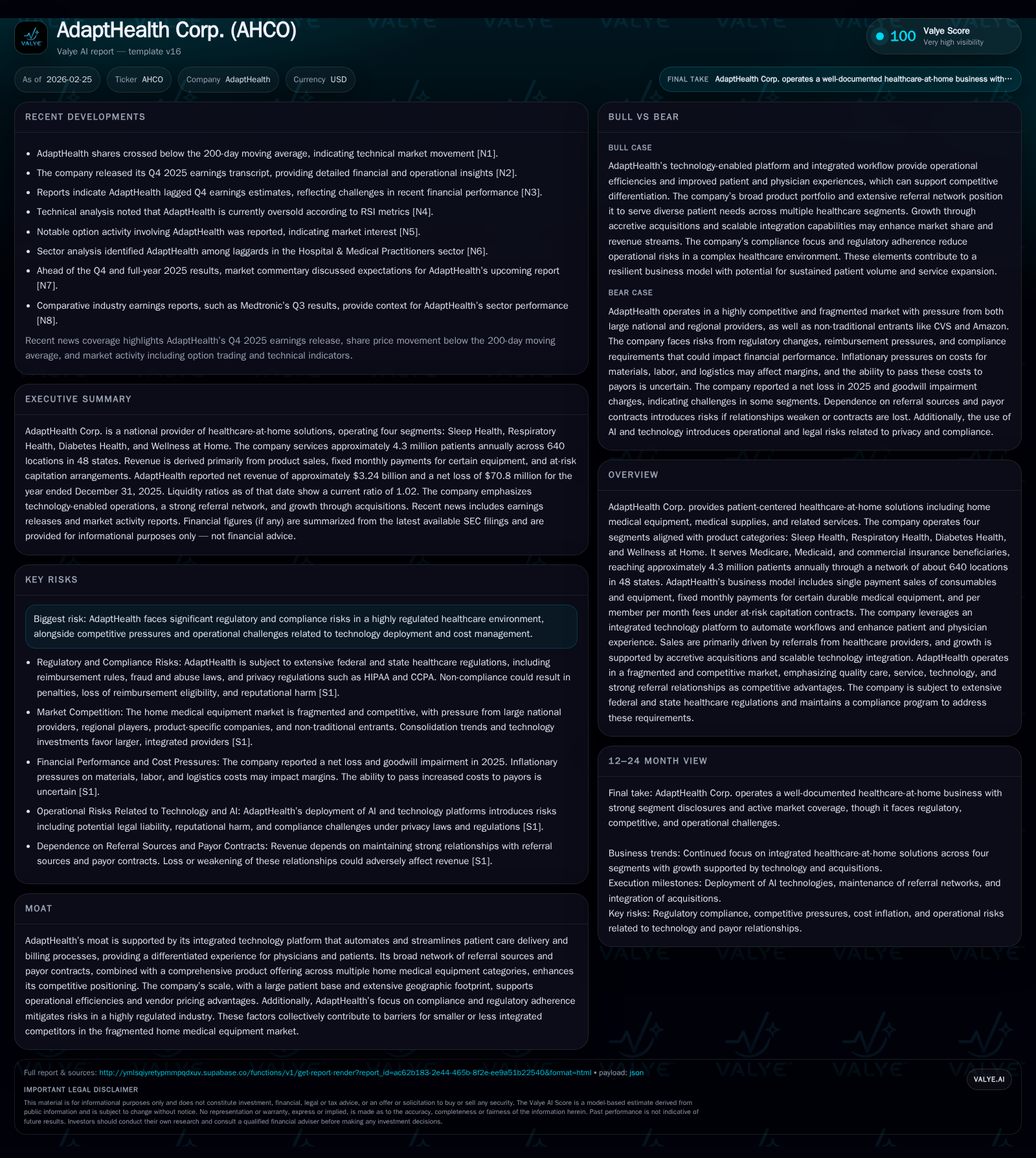
AdaptHealth Corp. is a national leader specializing in delivering healthcare-at-home solutions including home medical equipment (HME), medical supplies, and related services. Operating across four product-aligned segments — Sleep Health, Respiratory Health, Diabetes Health, and Wellness at Home — AdaptHealth serves approximately 4.3 million patients annually through around 640 locations spanning 48 states [S1][S9].
Its key customer bases involve Medicare, Medicaid, and commercial insurance beneficiaries, with referrals primarily sourced from healthcare providers such as hospitals, sleep labs, pulmonologists, endocrinologists, long-term care facilities, and hospice operators [S9][S18]. The company's extensive network combined with its integrated technology platform provides operational scale that supports negotiating power with vendors and streamlines billing and patient management processes.
Historical Financial Performance
While explicit revenue figures are not furnished in the provided data set, operating income trends reveal fluctuations indicative of broader challenges faced by the company over recent years. The table below summarizes key financial performance metrics for fiscal years ended December 31 from 2022 through 2025 [F1].
Historical performance (annual)
| FY | Net ($mm) | CFO ($mm) | OpInc ($mm) | Capex ($mm) | Net YoY |
|---|---|---|---|---|---|
| 2025 | -71 | 602 | 91 | 382 | -178.3% |
| 2024 | 90 | 542 | 264 | 306 | +113.3% |
| 2023 | -679 | 481 | -598 | 337 | -1079.4% |
| 2022 | 69 | 374 | 190 | 391 |
Note: Omitted columns lack sufficient annual XBRL coverage in the provided tags (need ≥2 annual points): Rev, Div. Source: SEC companyfacts cache [F1].
Capital returns and efficiency (annual)
| FY | Buybacks ($mm) | FCF ($mm) | ROE% |
|---|---|---|---|
| 2025 | 0 | 219 | -4.7 |
| 2024 | 0 | 236 | 5.8 |
| 2023 | 29 | 143 | -46.5 |
| 2022 | 14 | -18 | 3.2 |
Source: SEC companyfacts cache [F1].
Note: Revenue data unavailable from tags.
The sharp operating loss in fiscal year (FY) 2023 reflects intensified cost pressures stemming from increased regulatory scrutiny—including ongoing False Claims Act investigations—as well as elevated inflation impacting supply chain and labor costs [S5][S6][S14]. Despite recovering operational profitability in FY24 to $264 million, AdaptHealth experienced a significant decline again in FY25 with operating income falling by roughly two-thirds compared to the prior year.
Net income also exhibits pronounced volatility; after recording profits in FY22 and FY24, the company reported a notable net loss of $70.8 million in FY25 due mainly to legal settlements totaling about $49 million related to billing practice disputes along with heightened compliance costs [S5][S15].
However, the company's ability to generate robust cash flows from operations—rising steadily from $374 million in FY22 to $602 million in FY25—highlights strong underlying working capital management despite earnings fluctuations. This cash generation enabled increased capital expenditures reaching $382 million last year primarily invested toward patient equipment acquisition and expansion of services infrastructure [S19]. The resulting positive free cash flow approximating $219 million (operating cash flow less capex) supports sustaining growth without reliance on external equity financing.
Equity values contracted considerably during FY23 due to losses but stabilized around $1.5 billion thereafter [F1]. There were no common stock repurchases conducted since FY23 when buybacks curtailed sharply compared to prior periods; dividend distributions were not available for analysis.
Growth Drivers and Future Prospects
AdaptHealth’s growth strategy hinges on several core factors:
Patient Base Expansion: With a referral-driven model relying on partnerships with over multiple thousands of healthcare providers nationwide, the company focuses on growing organic patient starts especially post-acute care discharge where complex care needs foster recurring demand [S9][S18].
At-Risk Capitated Contracts: Representing approximately 4% of net revenue as of FY25, these capitation arrangements provide fixed per-member per-month fees wherein AdaptHealth assumes responsibility for delivering comprehensive home medical services within contractual risk frameworks [S9][S22]. Expanding these multi-year agreements offers predictable revenue streams alongside improved margin potential if managed efficiently.
Acquisitions: AdaptHealth continuously assesses targets complementary to its segment mix aiming to bolster market share or add new product lines leveraging technological integration synergies [S18].
Technology Platform Enhancements: Continued investment in digitization—covering prescription processing through delivery logistics—aims to enhance cost efficiencies and scalability while improving collaboration between patients, physicians, payors, and suppliers [S9][S19].
Nevertheless, several factors may impede future growth:
- Persisting inflation affecting input costs without full pass-through capability may pressure margins [S1][S16].
- Ongoing labor shortages heighten wage expenses amid competitive recruitment environment [S1][S16].
- Heightened regulatory environment, including False Claims Act investigations focused on diabetes product billing and respiratory devices reimbursement pose material compliance risk and potential financial liabilities [S6][S11].
- Changes in reimbursement policies from CMS or commercial insurers could restrict pricing flexibility or alter equipment classification affecting revenue recognition timing.
Operational Highlights and Segment Dynamics
AdaptHealth’s four reportable segments cover substantial breadth of home healthcare equipment:
- Sleep Health: Supplies PAP machines and accessories for obstructive sleep apnea treatment.
- Respiratory Health: Provides oxygen therapy devices plus home mechanical ventilation supporting chronic pulmonary conditions.
- Diabetes Health: Incorporates continuous glucose monitors (CGM), insulin pumps alongside management supplies.
- Wellness at Home: Focuses on equipment aiding patients transitioning from acute care or managing complex comorbidities via durable medical equipment rentals.
Consumables sales—which include most sales of PAP masks, CGM sensors, diabetic supplies—accounted for approximately 63% of net revenues in FY25 while rental contracts comprised roughly one-third of revenues [S9][S22]. Capitated contract revenues remain a smaller yet fast-growing portion aligned with industry shifts toward value-based care models.
Operations leverage centralized revenue cycle management combined with localized sales teams closely aligned with clinical personnel ensuring effective physician referrals conversion [S9][S18]. Warehouse logistics utilize a blend of dedicated fleet vehicles as well as subcontracted carriers optimizing delivery efficiency amidst geographic spread.
Capital Allocation and Returns Analysis
Return on equity (ROE) based on reported net income versus equity fluctuated negatively at approximately -4.7% for FY25 after profitable years prior, constrained by legal charges despite operational recovery [F1]. Although lacking declared dividends or share repurchase activity recently suggests reinvestment priority into organic growth initiatives and acquisitions rather than shareholder distributions.
Liquidity remains adequate evidenced by $106 million cash balances alongside sizable revolving credit facility availability ($300 million revolver), complemented by a term loan maturing late next decade providing funding flexibility for working capital or strategic investments [S4][S13]. The company complies with restrictive covenants under its credit agreements maintaining leverage metrics within permitted ranges.
Capital expenditure commitments (~$382 million in FY25) predominantly target acquiring patient equipment necessary ahead of expected service periods given medical devices’ recurring needfulness impacting depreciation schedules directly embedded within cost structures [S19]. Management emphasizes technological enhancements acting both as cost controllers and quality differentiators fostering stronger referral networks.
Regulatory Environment and Legal Risks
AdaptHealth confronts substantial regulatory scrutiny typical of the healthcare distribution sector subject to federal fraud enforcement statutes such as the False Claims Act (FCA). These include ongoing investigations regarding billing practices primarily concerning diabetes products starting from January 2017 onward as well as respiratory-related equipment since January 2018 [S6][S11].[S10] Several class action lawsuits addressing alleged improper billing practices have reached settlement stages incurring liabilities approximating tens of millions including anticipated insurance recoveries mitigating net impact somewhat [S5][S15].
Failures in compliance could lead to penalties including exclusion from Medicare/Medicaid programs which would materially disrupt revenue generation capabilities [S8][S17]. Robust compliance frameworks featuring centralized oversight coupled with integrated technology systems aim to minimize risks though escalating requirements may increase operational expense burdens.
Additionally, labor union activity remains minimal currently but could become more significant thus elevating wage pressures further if organized workforce demands materialize particularly given ongoing labor market tightness affecting delivery personnel and clinical support staff alike [S1][S16].
Industry Context Analysis (Non-Firm Specific)
The home medical equipment market has trended toward consolidation as larger players like AdaptHealth leverage scale advantages including better vendor terms amidst raw material inflation cycles seen industry-wide post-pandemic.
Providers increasingly focus on integrated care models adopting capitated payment structures incentivizing cost control balanced against patient outcomes requiring sophisticated data analytics platforms.
Pressure from government audits has intensified prompting improved compliance investments across peer companies; failure notably results in steep civil penalties plus reputational damage potentially impairing payer relationships.
Operating models integrating telehealth monitoring tied into durable equipment footprints form emerging growth niches aligned with chronic disease management.
Monitoring Points & Outlook Considerations
Absent explicit forward guidance published within analyzed filings or news releases, key items warrant monitoring going forward:
- Evolution of FCA investigations' resolution timeline impacting contingent liabilities recognition clarity.
- Trajectory of at-risk capitated contract wins contributing incremental steady-state recurring revenues.
- Ability to navigate inflationary cost inputs vis-à-vis reimbursement adjustments maintaining operating margins above breakeven thresholds.
- Integration effectiveness following acquisitions measured via realized synergy benefits improving profitability capture over time.
- Labor market developments influencing wage inflation trends specifically impacting delivery logistics segment economics.
- Reimbursement policy updates particularly CMS rule changes potentially redefining durable medical equipment coverage categories.
Liquidity positioning relative to debt maturities remains comfortable near term though longer-term financing conditions should be reviewed given general macroeconomic uncertainty potentially affecting credit markets.
Conclusion
AdaptHealth presents a complex operational profile balancing growing scale advantages within the fragmented home healthcare space against challenging regulatory exposures amplified by cost inflationary headwinds. The company’s robust cash generation underpins its investment capacity even amidst headline net losses linked principally to legal settlements rather than core operations deterioration.
Continuous scrutiny on compliance regimes combined with cost control effectiveness will be critical determinants shaping sustainable profitability trajectories over coming periods while patient base expansion paired with increasing capitated contract penetration remain pivotal catalysts supporting future top line growth acceleration.
This report is prepared for informational purposes only without making any buy or sell recommendations.
Disclaimer: This is research-only, informational analysis and not investment advice. It may include AI-generated interpretation and general industry context. Always verify important details using primary sources.

Comments