
Akso Health’s Transition to Healthcare Services and Medical Devices Highlights Structural Challenges
Recent quarter disclosures confirm Akso Health’s operational pivot towards online hospitals, pharmacy chains, and medical device sales amid ongoing losses and strategic restructuring.
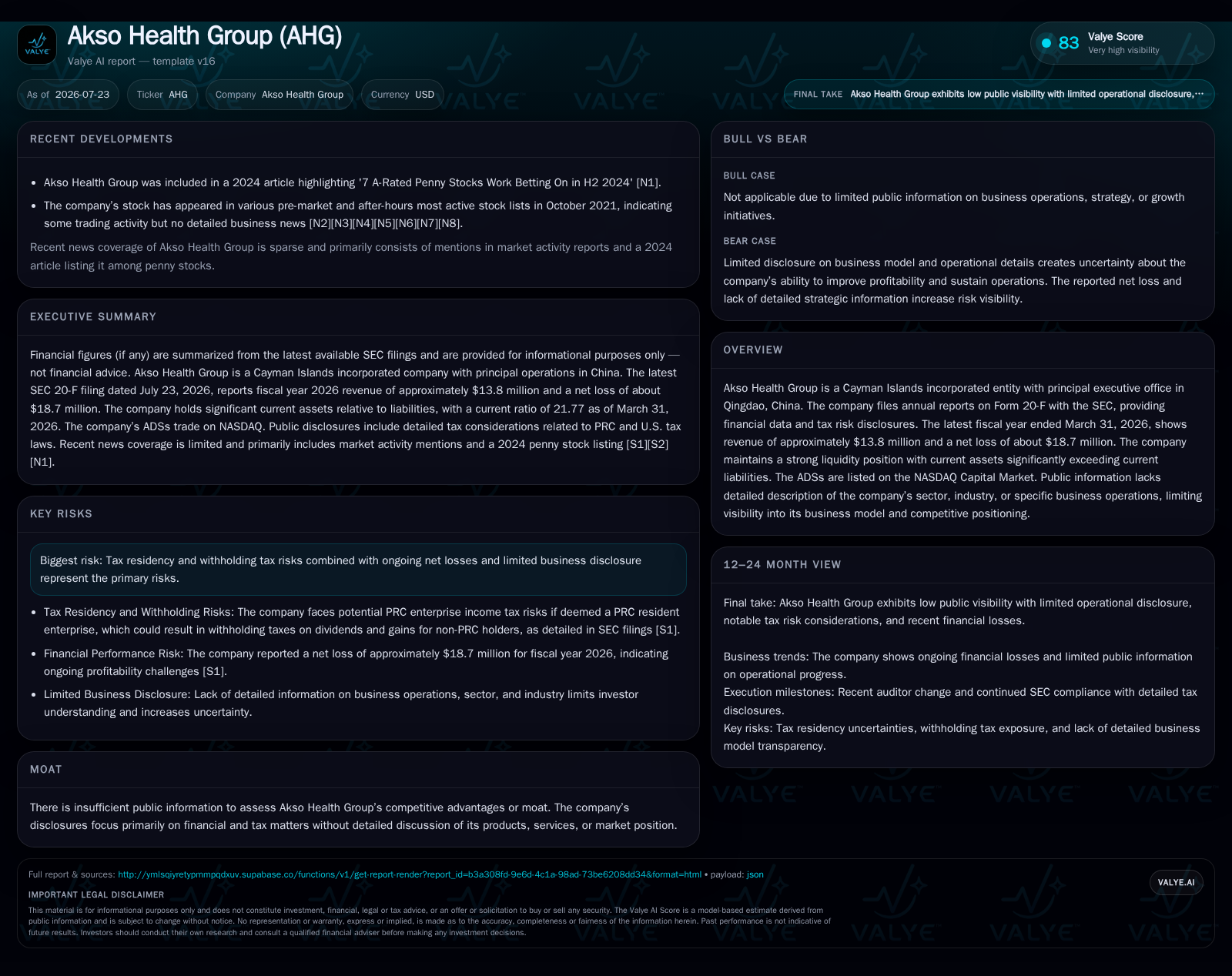
Akso Health Group has shifted its business model away from financial services and social e-commerce toward healthcare services and medical devices, including sales of COVID-19 test kits and operation of online hospitals and pharmacies. The latest filings show modest revenue growth but persistent net losses driven by goodwill impairments related to acquisitions. The company operates primarily in China and the U.S., facing structural challenges such as regulatory oversight, integration of fragmented healthcare segments, and intense competition from established peers. Key growth drivers include expansion of telemedicine and pharmacy chains complemented by digital health solutions, while substantial tax, liquidity, and governance risks remain. Monitoring execution on acquisitions, service adoption metrics, and regulatory compliance will be critical.
Recent Operating Update
Notably, the company completed a minority acquisition of Tianjin Wangyi Cloud Co., Ltd., an operator of online hospital services encompassing initial diagnoses, follow-ups, chronic disease management, and connected offline clinics as recently as April 2024 [S1][S6]. However, this expansion was costly financially: impairments of goodwill and purchased intangible assets associated with Tianjin Wangyi weighed heavily—$16.7 million impairment recorded in FY26 following a $162 million charge the prior year—due partly to reassessed future cash flow projections after uncovering pre-acquisition discrepancies [S11][S17][S23].
Business Model Analysis
Akso Health operates predominantly within the downstream segment of the healthcare value chain by combining three principal streams: (1) medical device distribution targeting both U.S. and Chinese markets via supply agreements—for example, selling “iHealth” branded COVID-19 rapid antigen test kits to U.S. distributors through Akso Online Meditech incorporated in Wyoming; (2) clinical service provision via online hospital platforms capable of supporting extensive patient consultations facilitated through digital means; (3) managing a growing network of pharmacy chains aimed at integrating fragmented independent outlets under a consolidated IT-enabled operational framework [S1][S6]. This multi-pronged approach aligns with industry archetypes where revenues stem from product sales margins (medical devices), fees for patient consultations (online hospitals), and pharmaceutical retail sales commissions (pharmacy chains).
However, these models reveal operational complexity given differing monetization mechanics: medical devices rely on high-volume supply agreements with margin pressure common in commoditized product distribution; online hospitals generate fee-for-service income dependent on user base growth and retention; pharmacies face retail competition requiring differentiation through pricing strategies and digital engagement enhancements [S1]. The company’s early-stage marketing promotion services show negative gross margins that improved slightly year-over-year but remain loss-making [S13][S17]. Declining revenues from device sales exacerbate margin compression underscoring unresolved market demand softness or competitive displacement [S13][S17].
Industry Structure and Competitive Position
Akso operates within the broader Healthcare Services and Medical Devices industry segment characterized by stringent regulatory oversight (e.g., FDA regulations for U.S. operations) and rapid technological evolution favoring integrated digital health solutions. Emerging competition spans large incumbent players like Medtronic for devices; Teladoc Health for telemedicine; CVS Health for retail pharmacies; Alibaba Health and Ping An Good Doctor disrupting China’s internet healthcare ecosystem.
Given Akso’s relatively small scale—revenue under $14 million annually—and limited detailed disclosure on customer contracts or supplier partnerships beyond generic supply agreements, its competitive positioning appears nascent. Significant goodwill impairments suggest prior acquisition integration challenges compromising synergy realization [S11][S23]. Competitors benefit from robust IT platforms, vast installed bases of patients/users, economies of scale in procurement/distribution, strong brand recognition, regulated reimbursement pathways with payors/govt programs that Akso is likely still navigating.
Growth Drivers
Key sector tailwinds underpinning Akso’s growth prospects encompass increased adoption of telemedicine services spurred by ongoing healthcare digitization policies in China; rising prevalence of chronic diseases enlarging demand for sustained online management solutions; demographic trends like aging populations fueling needs for home-based diagnostics (COVID test kits) and durable medical equipment; expansion opportunities through pharmacy chain consolidation addressing fragmented offline markets; governmental initiatives promoting enhanced access to healthcare via internet hospitals [S1][S6].
Akso aims to leverage these trends via selective acquisitions such as Tianjin Wangyi Group facilitating access to established patient networks with subsequent plans targeting nationwide pharmacy acquisitions designed around scalable IT-enabled operational efficiencies [S1][S6]. Successful execution could improve customer acquisition cost metrics, increase active user counts on digital platforms, raise consultation volumes boosting service fee revenue streams while achieving improved inventory turnover rates via consolidated supply chain operations.
Risks and Watchpoints
Despite clear strategic intent toward an integrated healthcare services ecosystem combining medical device sales with online hospitals plus retail pharmacies, Akso faces material risks impinging near-term sustainability:
- Regulatory Risk: Compliance burdens spanning FDA rules for device labeling/promotions in U.S., PRC regulations governing online medicine sales/hospital operations plus shifting policies affecting microlending legacy impacts remain salient [S19].
- Tax Residency & Withholding Risk: Complex cross-jurisdictional structures create vulnerabilities including potential subjectivity over "de facto" management location classifications possibly resulting in unexpected tax charges or withholding deductions [S1].
- Integration & Execution Risk: The substantial impairment charges associated with past acquisitions underscore possible difficulties realizing expected value from investments compounded by lack of disclosed operational KPIs such as retention rates or order values limiting transparency into progress.
- Liquidity Constraints: Cash reserves stood at approximately $170,572 as of March 31, 2026, with current assets totaling about $189.5 million against current liabilities near $8.7 million, yielding a current ratio of approximately 21.77 [F1]. However, the relatively low cash balance presents challenges for near-term liquidity given ongoing operating cash burn and capital expenditures invested heavily into Internet Hospital module development [F1][S5][S10].
- Competitive Intensity & Customer Adoption: Established peers with long-standing market footprints present formidable barriers especially where player scale enables more attractive pricing or superior platform integration.
- Data Privacy & Cybersecurity: Operating online hospitals using telemedicine tools introduces exposure to data breach risks governed under both Chinese cybersecurity mandates and U.S. privacy frameworks.
What To Watch Next
Investors should monitor forthcoming operational disclosures focusing on: quantitative updates regarding active users on online hospital platforms reflecting patient adoption traction; progress on pharmacy chain rollouts including new store openings or integration milestones; margins trends particularly gross profit improvements stemming from better mix or purchasing terms; updates on regulatory approvals or compliance incidents affecting operating licenses; any further impairment triggers signaling reevaluations of asset carrying values; capital raising actions addressing liquidity gaps given cash depletion alongside expenses related to marketing promotions; audit committee reports on ongoing remediation efforts following auditor transition announced May 2026 aiming at strengthening internal controls over financial reporting [S2][S16]; strategic announcements concerning pipeline acquisitions or divestitures clarifying capital allocation discipline.
Financial Profile Discussion
strategic investments.
This analysis relies exclusively on available SEC filings up to July 23, 2026 combined with informed contextual framing derived from Healthcare Services & Medical Devices industry norms. No investment advice is expressed or implied herein.
Disclaimer: This is research-only, informational analysis and not investment advice. It may include AI-generated interpretation and general industry context. Always verify important details using primary sources.

Comments