
Thunder Power Holdings Reinforces Electro-Mobility Trajectory with Strategic European Production
Latest quarterly filings highlight Thunder Power’s modular EV development, strategic M&A in clean energy, and phased manufacturing approach underpinning future growth.
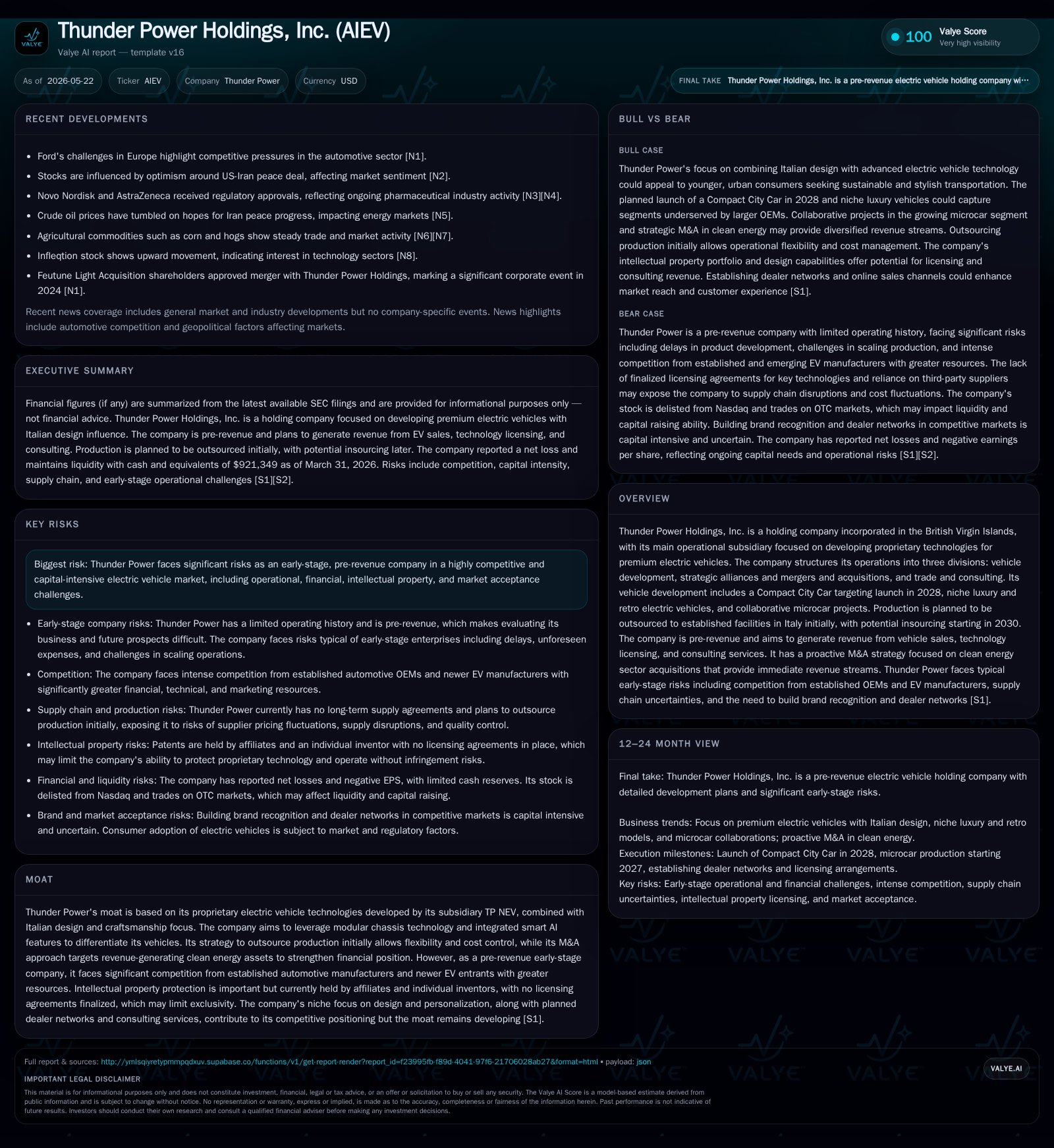
Thunder Power Holdings, Inc. remains a pre-revenue electric vehicle firm progressing on multiple fronts as detailed in its latest 10-Q. The company continues development of its Compact City Car targeting a 2028 launch with initial production outsourced to Italy, while pursuing revenue-generating clean energy acquisitions to strengthen financial footing. Its modular vehicle platform and Italian design focus aim to carve out a niche within the competitive premium electric vehicle segment. Key risks include capital intensity, regulatory compliance complexity, and intellectual property challenges. Stakeholders should monitor prototype milestones and further integration of clean energy assets as primary near-term catalysts.
Latest Quarterly Operating Update: Signals from the 10-Q
Thunder Power Holdings' latest quarterly filing dated May 22, 2026 (10-Q) underscores continuity in its risk landscape, citing no material amendments to previously disclosed risk factors [S2]. This stability indicates management’s consistent view of operating challenges amid its early-stage status. Importantly, the quarter includes substantive progress on merger and acquisition front: on April 9, 2026, Thunder Power completed an equity exchange issuing over 31 million shares for approximately 26.8 million shares of Electric Power Technology Limited (EPT), a Taiwanese renewable energy company [S3]. This move bolsters Thunder Power’s foothold in clean energy assets offering near-term revenue streams to complement its capital-heavy vehicle development efforts.
Thunder Power’s Business Model and Product Strategy: Modular Design Meets Italian Craftsmanship
Thunder Power operates as a holding entity primarily through its subsidiary TP NEV focused on proprietary electric vehicle technologies developed since before its public listing [S1]. The business model hinges on three core divisions: vehicle development (Compact City Car plus niche luxury and retro EVs), strategic alliances including M&A in clean energy sectors, and trade & consulting activities aimed at interim revenue generation [S5].
The flagship Compact City Car is slated for a 2028 commercial launch with initial manufacturing outsourced to established facilities in Italy — a strategic choice balancing quality, craftsmanship associated with Italian automotive heritage, and cost containment [S1]. This modular chassis platform enhances product differentiation by enabling flexible design integrations across luxury retro models and emerging microcar segments [S9].
Trade & consulting operations serve pragmatic purposes as cash flow cushions while long-term vehicle commercialization unfolds [S5]. Together these components form an interconnected ecosystem where proprietary tech advances support differentiation; manufacturing partnerships confer agility; and strategic M&A supplements revenues.
Value-Creating Mergers & Acquisitions in the Renewable Sector
A distinguishing facet of Thunder Power’s strategy is its active pursuit of acquisitions that generate immediate cash flow aligned with sustainability themes [S7]. The recent share exchange increasing ownership in EPT — representing roughly a one-third stake — implicates a significant pivot to fortifying financial resilience outside inherently prolonged EV commercialization cycles [S3][S7].
This transaction received Taiwanese government approval and is expected to imbue Thunder Power with renewable energy operational assets that synergize with its clean mobility mission while providing non-vehicle revenue sources crucial during heavy R&D outlays inherent in EV industry entrants [S3]. Effectively integrating such renewable businesses may smooth capital burdens and afford strategic flexibility missed by pure-play automotive startups.
Industry Dynamics: Competitive Positioning in the Premium EV Market
Operating pre-commercially within the premium electric vehicle market places Thunder Power against a backdrop of entrenched incumbents and well-funded new entrants possessing proven production scale, extensive distribution channels, and brand recognition advantages [S15]. Unlike established OEMs leveraging traditional dealership models favored by some customers, Thunder Power’s business-to-consumer distribution plans remain nascent.
Regulatory complexity further complicates this landscape. Thunder Power must obtain detailed foreign certifications subject to evolving environmental safety standards notably in U.S. Federal domains (EPA) and stringent European Union regulations mandating national authority approvals before market entry [S1][S4]. Such compliance requirements may enforce costly redesigns or protracted testing delays impacting timing.
Intellectual property protection constitutes another vulnerability. The company’s proprietary technologies reside mainly under patent ownership by affiliates or individual inventors without binding licensing agreements finalized yet — limiting exclusivity assertions against infringement risks [S6][S18]. This exposes the firm to potential competitive encroachment absent robust IP enforcement mechanisms.
Growth Catalysts: From Compact City Car Launch to Revenue-Generating Partnerships
Several initiatives converge as growth drivers over the medium term:
- Completion of the Compact City Car design framework led by a renowned European designer provides tangible progress toward launch readiness targeted for 2028 [S1][S9].
- Production outsourcing agreements enable scalable manufacturing in Italy affording quality controls while capping upfront capital commitments; the option for internalizing manufacturing post-2030 allows capture of higher margin contributions longer term [S1][S7].
- Expansion into niche segments like retro "electromods" leverages modular chassis tech aiming at younger sustainable mobility enthusiasts interested in vintage aesthetics married with modern performance [S9].
- Collaborative ventures advancing microcar projects tap into a rapidly expanding urban mobility segment forecasted by industry surveys as a $340 billion opportunity by 2030 [S9], further diversifying exposure.
- Strategic equity stakes in renewable energy entities augment immediate cash flows supporting operational liquidity during extended periods prior to vehicle sales uptake [S3][S7].
- Trade & consulting activities supplement income while scaling capital-intensive product rollouts.
Collectively these drivers link observable milestones such as prototype completions, regulatory certifications pending or achieved, scaling manufacturing volumes initially via contract partners, plus clean energy acquisition integration enriching revenues.
Risks and Constraints: Capital Intensity, Regulatory Hurdles, and Market Adoption Challenges
Thunder Power confronts formidable barriers characteristic of early-stage automotive technology ventures:
- Absence of commercial production history amplifies uncertainty surrounding execution capability across manufacturing ramp-up, dealer/e-commerce formation, customer acquisition, and service infrastructure establishment [S1][S4].
- Heavy R&D investments amid prolonged pre-revenue phases stress capitalization needs; inability to timely raise funds could impair operations significantly [S13].
- Complex regulatory compliance demands across international markets require expensive adaptation cycles subject to delays or redesigns; failure risks fines or market access denial [S4][S6][S18].
- Intellectual property enforcement uncertainties raise exposure to infringement claims or unauthorized competitive use weakening returns on proprietary innovations [S6][S19].
- Market adoption volatility exists given competing legacy brands' trust prominence juxtaposed against emerging mobility preferences potentially limiting initial volume traction.
- Noteworthy are ongoing legal proceedings involving controlling shareholder which inject reputational risks that could indirectly impact corporate reputation or financing access despite no direct litigation against Thunder Power itself currently [S24][S25].
- Talent retention particularly in specialized engineering domains remains imperative yet challenging within tight competition for qualified personnel globally [S11].
These elements compound typical startup risks layered atop highly cyclical automotive demand patterns subject to macroeconomic swings.
Upcoming Milestones and What Investors Should Monitor Next
Key forthcoming benchmarks include:
- Progression toward full prototype demonstrations for the Compact City Car incorporating modular chassis innovations sustained by Italian design leadership scheduled for validation ahead of planned 2028 commercial introduction [S2][S5].
- Further regulatory certification achievements especially critical EU approvals assuring market entry prerequisites compliance.
- Completion phase updates from integration efforts relating to Electric Power Technology acquisitions enhancing revenue trajectory from renewables sector involvement.
- Development strides within collaborative microcar projects expected around medium term confirming scalability potential.
- Regular quarterly disclosures refining financial visibility particularly trading off growing capital expenditures against emerging income streams from M&A derived businesses.
Tracker emphasis on these operational indicators will elucidate execution momentum bridging foundational technology creation toward commercial viability.
Financial Profile and Liquidity Snapshot
As of March 31, 2026, Thunder Power held current assets totaling approximately $13.14 million against current liabilities near $8.83 million yielding a current ratio of about 1.49 — indicative of short-term liquidity adequacy during ongoing developmental expenditures [F1][S2]. Cash and equivalents stood around $0.92 million as per mid-2024 data reflecting constrained but positive working capital positioning given limited operating revenues reported thus far [F1]. Net losses persist consistent with early-stage investment cycles featuring continued negative operating income pressures last evidenced at year-end 2023 roughly negative $1.25 million further underscoring reliance on external funding support during ramp-up phases [F1].
Overall financial posture suggests manageable liquidity buffers but underscores necessity for sustained capital inflows enabled partly via equity issuances tied to strategic M&A deals expanding recurrent income foundations beyond pure R&D investment burn rates.
This analysis reflects publicly filed information through May 2026 without forward-looking speculation beyond cited statements. It does not constitute investment advice or research views.
Disclaimer: This is research-only, informational analysis and not investment advice. It may include AI-generated interpretation and general industry context. Always verify important details using primary sources.

Comments