
AAR CORP Reorganizes Segments and Accelerates Growth Through Strategic Acquisitions
AAR CORP's Q4 2026 report highlights operating segment realignment, acquisition-driven expansion, and a multi-year wind-down of low-return legacy business.
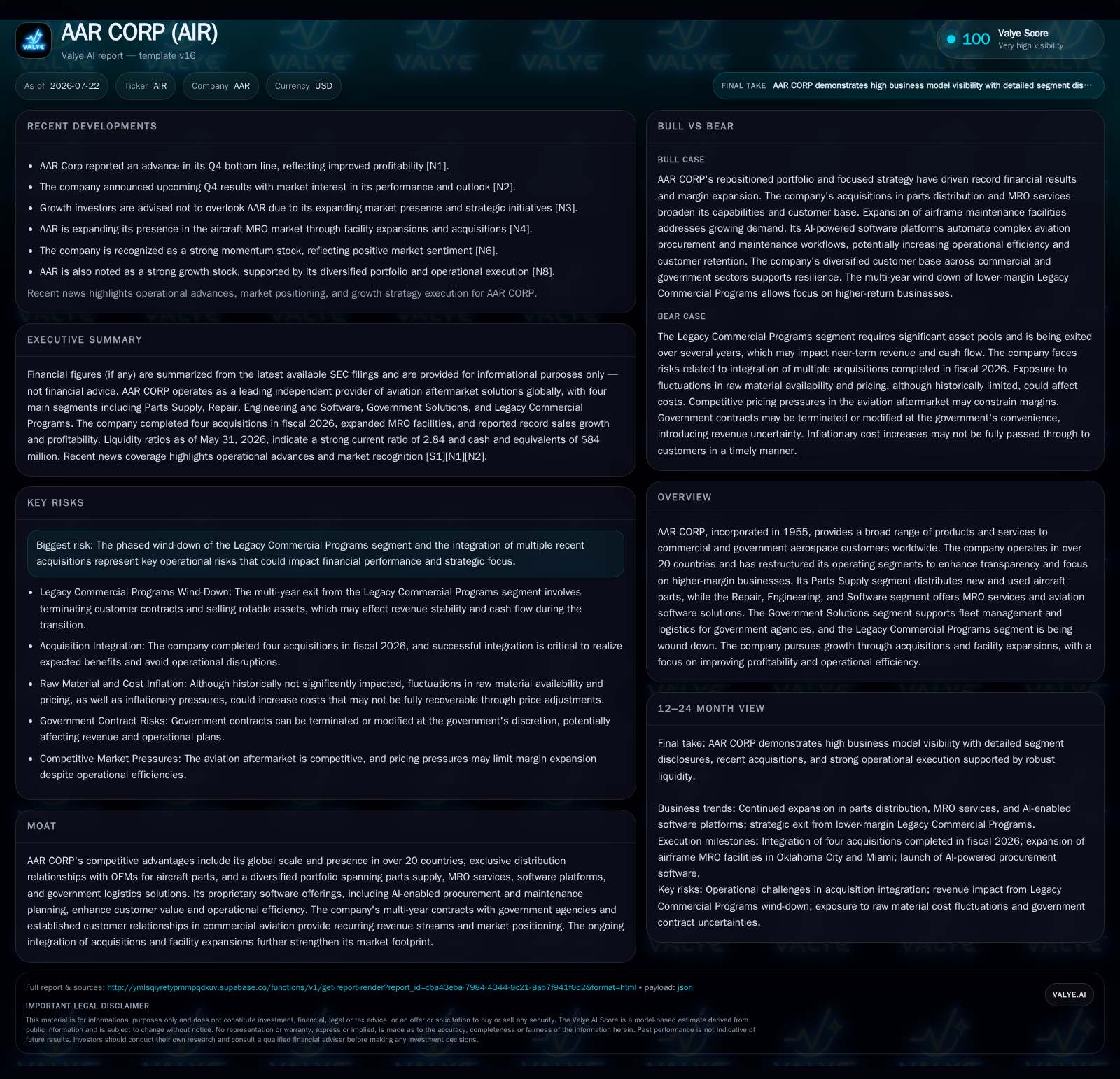
In its latest quarterly and annual filings, AAR CORP disclosed a restructured segment framework designed to align its aerospace aftermarket services around higher-margin and growth-focused lines, including Parts Supply, Repair, Engineering & Software, and Government Solutions. The company pursued strategic acquisitions during fiscal 2026 to deepen its MRO capabilities and software offerings while beginning a gradual exit from Legacy Commercial Programs due to capital inefficiencies. AAR’s multi-faceted business model combines parts distribution, MRO services, proprietary aviation software platforms, and government fleet logistics underpinned by long-term contracts and exclusive OEM relationships that provide a competitive moat. Key risks involve integration challenges with recent acquisitions and execution on the wind-down of legacy assets. Financially, AAR maintains solid liquidity with a current ratio near 2.84 and advances profitability as it transitions towards asset-light segments.
Recent Operating Update
AAR CORP reported Q4 fiscal 2026 results on July 21, 2026 [S3], revealing significant restructuring of its operating segments to enhance transparency and sharpen strategic focus. The reorganization created four distinct segments: Parts Supply; Repair, Engineering & Software; Government Solutions; and Legacy Commercial Programs — the latter being earmarked for a multi-year wind-down due to poor capital returns [S1],[S15]. This aligns management’s resource allocation more explicitly around growth-oriented businesses such as proprietary software platforms and government logistics solutions while shedding historically asset-heavy commercial programs.
Notably, the company further bolstered its Repair & Engineering segment via high-profile acquisitions completed during fiscal 2026. These include HAECO Americas ($78 million), which expanded heavy aircraft MRO capacity in North America [S1],[S17]; Aircraft Reconfig Technologies (ART) ($36 million), notable for FAA Organization Designation Authorization enabling AAR to issue supplemental type certificates without reliance on third parties [S1],[S16],[S15]; Aerostrat ($19 million), a provider of long-range maintenance planning software increasingly important in optimizing MRO scheduling [S1],[S19]; plus American Distributors Holding Co. (ADI), an electronic components distributor enhancing OEM supply capabilities within Parts Supply [S15]. Integration efforts include consolidation of facilities such as closing the Indianapolis airframe maintenance shop [S17],[S25].
From an operational perspective, these developments reflect AAR’s transition away from legacy flight-hour based commercial component pool programs towards an integrated platform emphasizing parts distribution efficiency, MRO services breadth, aviation software innovation, and stable government contracts. This shift intends to drive margin expansion by reducing rotable asset pools that previously compressed returns.
Business Model Analysis
AAR operates primarily in the aerospace aftermarket services sector focusing on downstream support for commercial airlines and government fleets worldwide. Its revenue is generated through several complementary avenues:
Parts Supply: Supplying new aircraft parts via exclusive OEM agreements alongside sales of used serviceable material (USM) sourced from disassembled retirements or third-party inventories. Revenue depends heavily on volume movements tied to aircraft utilization cycles but benefits from diversification between commercial and government customers.
Repair, Engineering & Software: Delivering MRO services including heavy airframe maintenance (e.g., through acquired HAECO Americas), component repair programs, plus proprietary aviation software solutions such as Trax and recently integrated Airvoyant — an AI-powered procurement automation tool aimed at optimizing historically complex parts sourcing workflows. This segment blends asset-heavy operations (hangars/labor) with growing asset-light SaaS-like recurring revenue streams dependent on platform adoption among airlines/MROs.
Government Solutions: Encompasses fleet management of customer-owned aircraft along with customized supply chain logistics contracts supporting U.S. Department of Defense/State missions as well as allied foreign governments. The performance-based contracts foster strong visibility into backlog revenues backed by multi-year commitments.
Legacy Commercial Programs: Consists primarily of flight-hour based rotable asset pools servicing commercial airlines plus consumables distribution; however, this business requires significant capital investment relative to return potential prompting management’s decision to phase it out over several years.
Revenue mechanics differ by segment but generally rely on negotiated contracts including minimum volume commitments or pricing escalators addressing inflationary pressures when possible [S11]. Margins are highest in proprietary software offerings where incremental costs are lower versus the capital-intensive repair shops or parts inventory carrying costs within legacy programs.
Customer retention is critical given switching costs involving qualification requirements for USM parts or FAA-approved engineering repairs. Contract renewals and backlog size provide key leading indicators for future earnings stability.[S1],[S20]
Industry Structure and Competitive Positioning
Within aerospace aftermarket services, AAR competes with independent providers like HEICO Corporation known for niche parts distribution plus major OEMs’ aftermarket divisions such as Collins Aerospace which leverage installed bases for bundled solutions. Government aerospace logistics segments feature specialized contractors like L3Harris Technologies who command steady defense budgets.
AAR’s moat derives from global scale—with operations in over 20 countries—and its portfolio diversity spanning goods/services/software that few peers match comprehensively [N12],[N14]. Exclusive OEM distribution rights safeguard supply chain access while proprietary AI-enabled platforms differentiate its Maintenance Planning offerings critical amid rising airline operational complexity.
Integration of acquisitions expanding North American heavy maintenance footprint elevates capacity addressing industry-wide aging aircraft demands driving sustained MRO needs [S15]. Meanwhile government logistics integration enables performance-based contracting optimizing fleet readiness with less capital tied up compared to traditional ownership models.
Growth Drivers
Several secular trends underpin AAR’s growth trajectory:
- Growing commercial aircraft fleets globally combined with aging aircraft necessitating increasing MRO frequency provides a structural volume tailwind benefiting parts supply and repair services.
- Expansion in aftermarket software demand fueled by complexity growth incentivizes adoption of AI-driven platforms like Airvoyant enhancing procurement efficiency.
- Defense spending increases coupled with evolving fleet modernization highlight opportunities within Government Solutions supported by long-term contracts backed by performance metrics.
- Consolidation strategies through bolt-on acquisitions allow accelerated geographic footprint expansion synergistic cross-selling.
- Rising regulatory oversight mandates frequent high-quality maintenance reinforcing demand for certified repair services over lower-cost alternatives.
These drivers collectively suggest durable revenue streams supported by contractual lock-ins providing visibility into backlog metrics—a critical KPI monitored by management to anticipate future throughput capacity needs.[S1],[S20]
Risks and Growth Constraints
Key operational risks include:
- Execution complexity integrating multiple recent acquisitions while consolidating facilities creates near-term cost pressures and risks of customer service disruption as specialized hangar capacities are rationalized [S9].
- Volatility in commercial aviation demand driven by macroeconomic cyclicality impacts flight hours flown directly affecting parts consumption volumes along with labor utilization rates in MRO shops.
- Legacy Commercial Programs run-off requires careful asset disposition without financial impairment beyond projections preserving capital efficiency goals.[S15]
- Increasing competition from OEM-owned aftermarket services leveraging direct customer trust may constrain margin growth potential especially in component repairs or authorized parts distribution.
- Cybersecurity threats remain material given digital platform operations; however AAR maintains comprehensive multi-layered defenses guided by NIST frameworks combined with continuous monitoring mitigates incident risk [S1].
- Supply chain disruptions affect availability timing especially for USM inventory impacting customer satisfaction unless rapidly mitigated through diversified sources.[S11]
- Currency fluctuations along international operations could influence reported results though hedging policies likely moderate material exposures.
What to Watch Next
Investors should track several milestones indicative of successful strategy execution:
- Quarterly updates on operating segment profit contributions particularly margins improvement within Repair, Engineering & Software validated by growing SaaS-linked ARR or usage metrics from platforms like Airvoyant.
- Backlog composition changes reflecting contract renewals or expansions within Government Solutions provide insight into revenue visibility under long-term agreements.
- Progress metrics on wind-down timeline for the Legacy Commercial Programs including rotable asset sales volumes verifying disciplined capital redeployment capabilities.
- Integration progress updates related to acquisitions highlighting any facility consolidation cost savings or cross-selling synergies realized.
- Bookings or pipeline announcements regarding new contracts with commercial airlines or defense agencies signaling market penetration momentum amid competitive dynamics.
- Commentary on pricing actions taken relative to raw material inflation pass-through effectiveness beyond historical offsets documented in filings.
Financial Profile Discussion
As of May 31, 2026, AAR held cash and equivalents totaling $84 million against current liabilities of approximately $613 million yielding a healthy current ratio near 2.84 that supports working capital needs given sizeable inventories nearing $958 million [F1],[S2]. Total debt reported was not explicitly updated in the latest filings but best-effort estimates indicate approximately $679 million measured historically [F1]. Interest expense remains a manageable component reflecting recent issuances including senior notes placed in March 2024 with modest amortization impacts observed [S10],[S18].
Net income showed strong improvement with $137 million recorded over the nine months ended February 28, 2026 versus prior losses reflective largely of acquisition-related gains including bargain purchase recognition totaling nearly $36 million [S20],[S25]. Operational cash flow remains supported by disciplined receivables management despite large inventories necessary for fulfillment requirements.
Capital expenditures have focused heavily on facility expansions such as the Oklahoma City airframe MRO extension supporting future heavy maintenance volumes along with investments into proprietary aviation software development platforms aimed at improving free cash flow conversion over time through subscription-like models [N4][N9][N14]
Overall balance sheet strength coupled with targeted acquisition financing underscores AAR's commitment to balancing growth investments against return thresholds aligned with its repositioned portfolio emphasizing higher-margin businesses [F1][S4]
This analysis synthesizes publicly filed SEC disclosures including recent quarterly results (10-Q), annual filing (10-K), investor communications (8-K), supplemented by industry contextual knowledge without offering investment opinions or forecasts.
Financial position in context
As of 2026-05-31, companyfacts shows $84mm in cash and equivalents [F1]. Current assets of $1742mm and current liabilities of $613mm imply a current ratio near 2.84x for 2026-05-31 [F1].
Disclaimer: This is research-only, informational analysis and not investment advice. It may include AI-generated interpretation and general industry context. Always verify important details using primary sources.

Comments