
GE Vernova’s Strategic Realignment Drives Energy Transition at Scale
The company’s Q2 2026 report details momentum in core product focus and installed base servicing amid ongoing supply chain and tariff challenges.
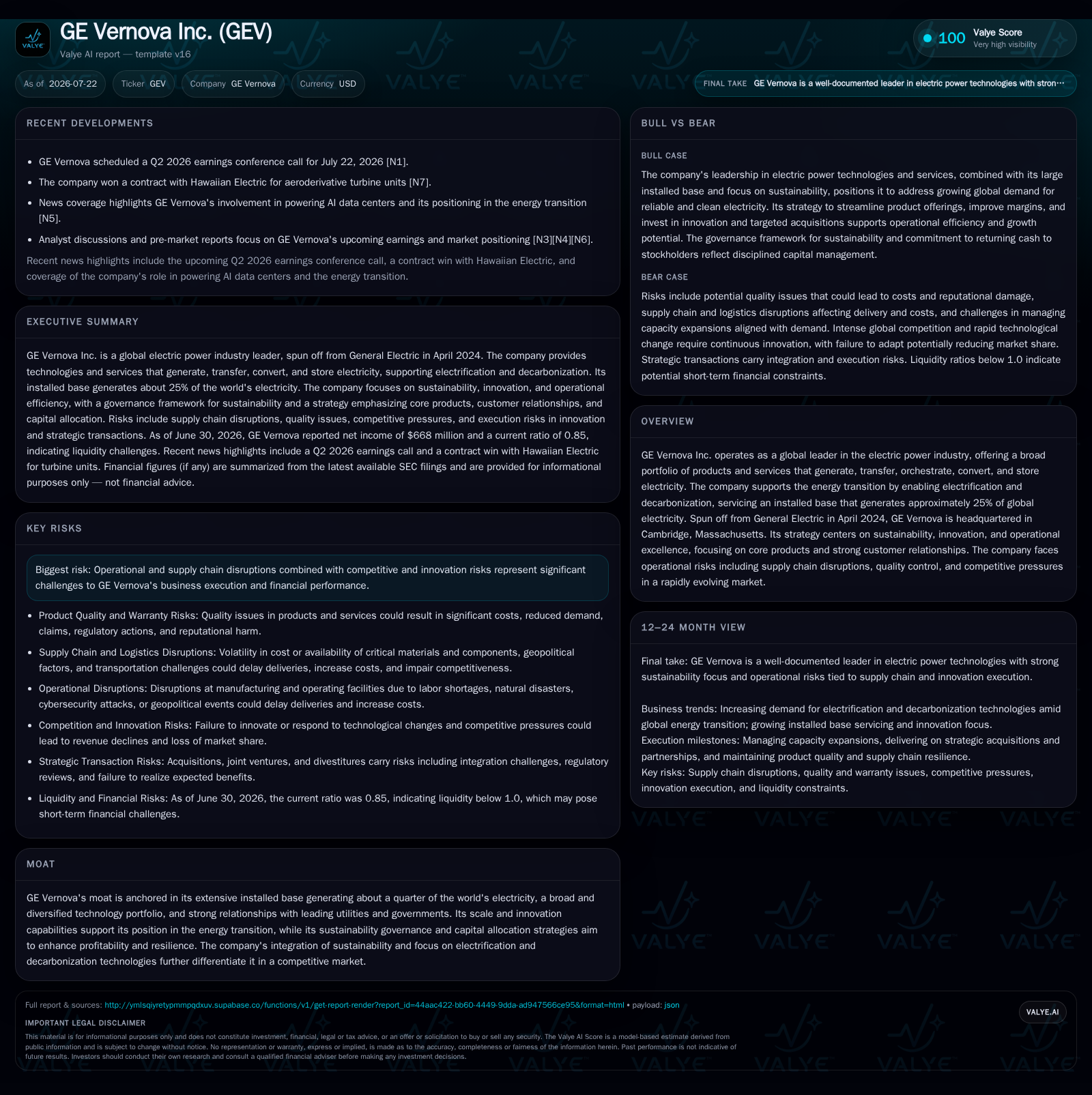
GE Vernova's second-quarter 2026 filings highlight progress in streamlining its portfolio toward core power generation and grid products, facilitating margin improvements despite persistent supply chain disruptions and tariff costs. With an installed base generating approximately 25% of global electricity, the company leverages stable service contract renewals to underpin cash flow and backlog growth. However, margin pressures from tariffs estimated at $250 million in 2025 and quality-related warranty risks remain key operational challenges. GE Vernova’s strategic investments in decarbonization technologies and the acquisition of Prolec GE reinforce its positioning within the energy transition, supported by manageable leverage and adequate liquidity.
Q2 Operating Momentum Illuminates Impact of Portfolio Streamlining
GE Vernova’s Q2 2026 filing underscores its continuing strategic realignment focusing on scaling core power generation equipment—specifically gas turbines and wind turbines—and grid infrastructure products such as transformers [S2][S3]. This concerted portfolio concentration aims to bolster cost efficiency and improve product quality amid complex supply chain conditions. The management commentary indicates that this focus is beginning to yield benefits visible through improved operating income segments despite tariff headwinds. Notably, order backlog data reflect sustained customer demand for these streamlined offerings, signaling favorable market receptivity to established workhorse products [S2]. Such refinement complements efforts in lean operations aiming to reduce overhead, a critical move given industry-wide inflationary pressures.
Anchoring Revenue Growth Through Installed Base Servicing & Contract Renewals
A cornerstone of GE Vernova’s business model is its extensive installed base responsible for generating roughly 25% of global electricity [S1]. This vast footprint generates consistent aftermarket services revenues through long-term service contracts with utilities, governments, and large industrial customers. These agreements provide predictable cash flow streams underpinned by high renewal rates—a KPI intimately tied to customer satisfaction and operational reliability. The stability from service revenue diversification reduces dependency on cyclical equipment orders while enhancing overall margin resilience. By fueling incremental services innovation and leveraging digital integration for predictive maintenance, the company strengthens customer retention amidst increasing competitive complexity.
Supply Chain Constraints and Quality Risks Underpin Margin Pressures
Despite operational progress, GE Vernova faces sustained challenges from supply chain volatility exacerbated by geopolitical tensions resulting in tariffs costing approximately $250 million during 2025 [S1]. These costs partially stem from specialty metals and rare earth dependencies, concentrated among limited suppliers primarily outside the U.S., causing extended manufacturing lead times and elevated input costs. Although tariff impacts are partially mitigated contractually or through pricing adjustments, uncertainty around their duration injects ongoing risk into margin forecasts.
Furthermore, product complexity inherent in sophisticated power generation and grid equipment increases exposure to quality control issues with potential warranty claims. Recent company disclosures point to heightened risks associated with new technology introductions where design or production defects can cascade into substantial financial liabilities or reputational damage [S4]. Given the capital intensity of projects and regulatory compliance requirements—especially in nuclear equipment—execution fidelity remains paramount.
Positioning for Energy Transition: Innovation Focus and Portfolio Depth
GE Vernova’s strategy aligns tightly with accelerating decarbonization mandates worldwide by delivering efficient gas turbines optimized for lower emissions alongside expanded wind turbine capacity enhancements. The consolidation of Power Conversion & Solar & Storage units into a unified business line equips the company to better address integrated energy storage solutions critical for grid stability amid intermittent renewable adoption [S1]. Innovation investment prioritizes R&D aimed at electrification technologies expanding beyond traditional generation towards dynamic grid modernization capabilities.
This R&D emphasis is strategically positioned to capitalize on tightening regulations favoring low-carbon generation sources while creating barriers to entry based on technological sophistication—a key moat element against emerging competitors.
Competitive Landscape Shaped by Legacy Scale Against Siemens Energy & ABB
Post spin-off from General Electric (now GE Aerospace), GE Vernova retains substantial scale though now operates independently within an intensely competitive power equipment marketplace. Peers such as Siemens Energy offer integrated generation-to-grid solutions with a strong European foothold, while ABB Ltd. commands significant positions in advanced electrification infrastructure globally. Mitsubishi Power competes directly within turbines sectors whereas Schneider Electric focuses more narrowly on energy management software and automation.
GE Vernova leverages its heritage installed base size alongside broad product breadth spanning turbines to transformers as distinguishing competitive advantages but must continuously adapt amid peer innovation cycles particularly in renewables integration and digitalization initiatives.
Growth Drivers: Decarbonization Demand, Grid Modernization, Electrification
Several structural growth drivers underpin GE Vernova’s market opportunity: expanding demand for electricity driven by global economic development; policy-driven shifts toward renewable energy replacing coal; aging asset replacement cycles demanding modernization; rising electrification across transportation (electric vehicles), industrial processes, and buildings; plus increased government incentives accelerating clean energy project financing.
Advancements in energy storage technologies coupled with power conversion improvements facilitate intermittent renewable penetration while maintaining grid reliability—areas where GE Vernova actively invests. Enhanced order backlogs reflecting firm customer commitments alongside growing service contract footprints serve as early confirmation of demand durability.
Risks: Tariffs, Quality Execution, Supply Chain Volatility
Operating risks derive largely from external factors including tariff policy shifts—where projected costs remain uncertain beyond current estimates—and intrinsic execution risks surrounding complex product manufacturing demanding high-quality standards [S1][S4]. A deterioration in product quality could translate into escalating warranty claims or project delays incurring financial penalties.
Supply chain vulnerabilities introduced by reliance on sole-source suppliers for critical materials amplify exposure to geopolitical or logistical disruptions. The propensity for cascading supplier failures or price spikes warrants close monitoring especially given industry's tight material market dynamics.
Key Indicators to Monitor: Backlog, Renewal Rates, Order Lead Times
Near-term performance tracking should emphasize order backlog trends reported quarterly as tangible demand proxies; improvements here indicate successful execution on portfolio focus. High service contract renewal rates are critical to validating installed base revenue stability—a direct moat indicator.
Manufacturing lead times and on-time delivery rates serve as operational sensors reflecting supply chain health; elongating cycles or frequent delays may presage margin compression or customer dissatisfaction.
Financial Profile Discussion: Leverage and Liquidity Enable Strategic Investments
As of June 30, 2026, GE Vernova holds approximately $2.79 billion in total debt with an estimated net debt position roughly equal given cash balances [F1]. Its current ratio stands below one at about 0.85 indicating working capital tightness characteristic of capital-intensive industries but manageable through committed credit facilities [F1]. The company’s recent upgrade in credit ratings permits favorable financing terms supporting planned strategic acquisitions such as Prolec GE—a transformative deal expected to close early 2026 augmenting transformer manufacturing scale [S1][S19].
Cash flow generation remains robust supported by recurring service revenues from the installed base complemented by improving operating income margins seen in Q4 2025 figures (~$1.39 billion) pointing toward operational leverage gains [F1][S24]. Ongoing capital allocation balances growth investment with shareholder returns under a disciplined buyback program facilitated by strong liquidity reserves [S18].
This analysis is based solely on information publicly available through SEC filings dated up to July 22, 2026 ([S1]–[S3], [S4] risk disclosures) and contemporaneous company financial data ([F1]), supplemented by validated industry context relevant to electric power sector dynamics. It reflects analyst interpretation without providing investment advice or forecasts.
Financial position in context
As of 2026-06-30, companyfacts shows $2.8bn of total debt [F1]. Companyfacts also indicates net debt of roughly $2.8bn for the latest available period [F1]. Current assets of $47.4bn and current liabilities of $55.8bn imply a current ratio near 0.85x for 2026-06-30 [F1].
Disclaimer: This is research-only, informational analysis and not investment advice. It may include AI-generated interpretation and general industry context. Always verify important details using primary sources.

Comments