
Delixy’s Credit Flexibility and Nasdaq Bid Price Risk Shape Its Oil Trading Growth Trajectory
Delixy Holdings advances oil product trading with strategic credit offerings but faces critical Nasdaq minimum bid price compliance.
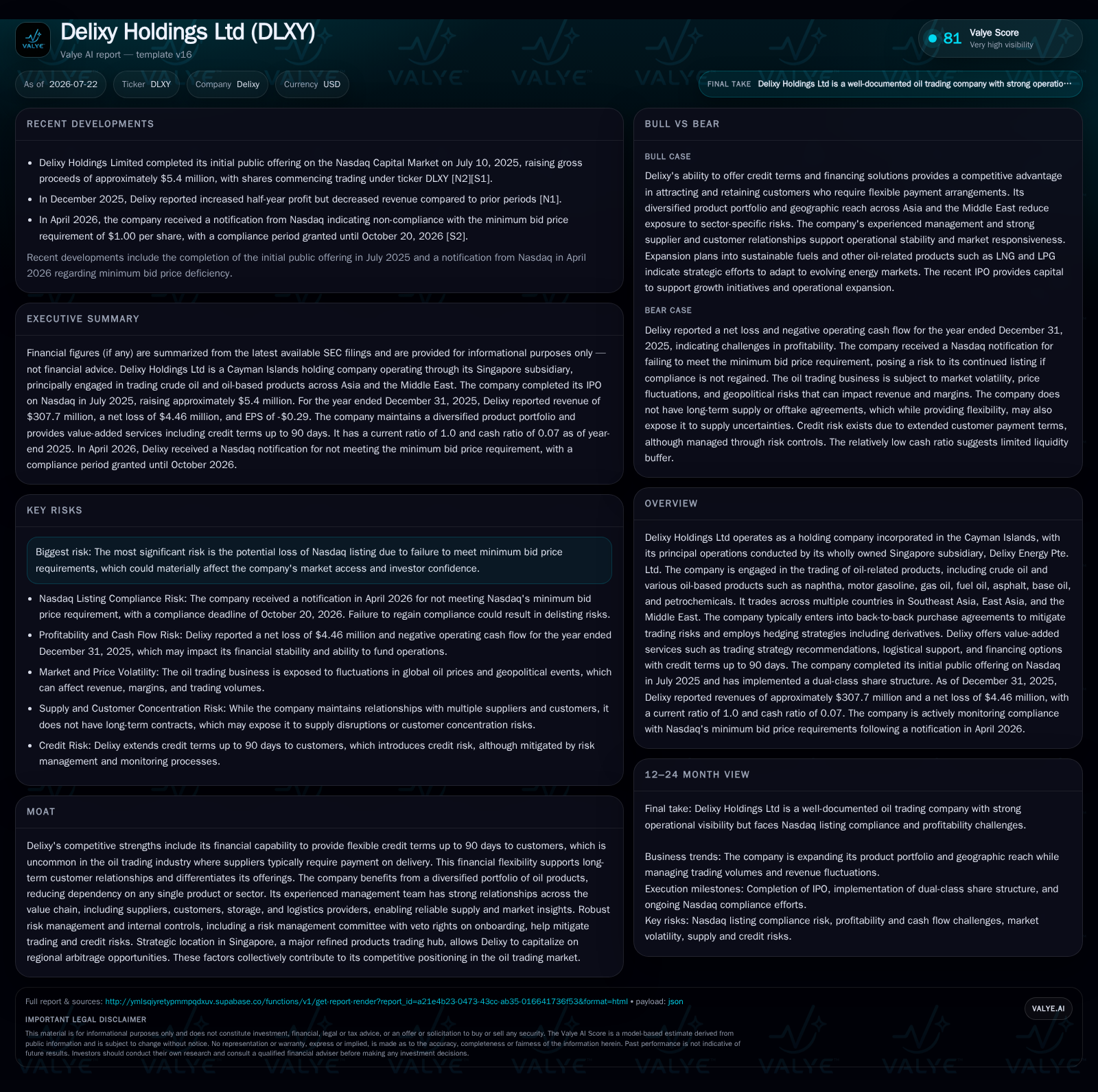
Delixy Holdings Ltd operates as a midstream trader in crude oil and refined petroleum products primarily across Asia and the Middle East, leveraging financial flexibility to offer up to 90-day credit terms uncommon in the sector. Despite a 13.9% increase in trading volume for 2025, revenue slightly declined due to market dynamics, while expanding crude oil's share of sales. The company faces an urgent risk of delisting from Nasdaq unless it remedies its sub-$1 bid price by October 2026. Strengths include a diversified product portfolio, strong supplier-customer relationships, and hedging capabilities; weaknesses include negative net income and extended receivables without collateral. How Delixy manages its Nasdaq compliance challenge and sustains trading margins amid competitive pressures will be critical growth milestones.
Recent Operating Update: Nasdaq Notification Highlights Urgency
In late April 2026, Delixy Holdings Ltd disclosed receipt of a Nasdaq notification regarding its failure to maintain the minimum $1 bid price for its Class A ordinary shares over a consecutive 30-business day period ending April 22, 2026 [S2]. Although this does not immediately affect the listing status, the company has been granted a compliance window until October 20, 2026, to restore its share price above this threshold for at least ten consecutive business days. Failure to do so could lead to delisting or require remedial actions such as a reverse stock split [S2], [S9]. This pending compliance issue materially impacts investor confidence and access to capital markets.
Business Model: Trading Margin Levers and Credit-Driven Customer Retention
Delixy operates primarily as an intermediary oil trader through its Singapore subsidiary, sourcing crude oil and a broad range of refined petroleum products—including gasoline, naphtha, diesel variants—and petrochemicals across Southeast Asia, East Asia, and the Middle East [S1]. Its revenues derive from arbitraging price differentials between purchase commitments with suppliers and resale contracts with customers. A hallmark of Delixy's model is entering back-to-back procurement agreements post customer contract finalization to hedge inventory risks. Adding another layer of protection are derivatives used for managing commodity price volatility [S1].
Revenue growth depends on total trading volumes measured in thousands of barrels (kBBLs), product mix (with crude oil commanding higher margin profiles), pricing spreads, and effective risk management through hedging instruments [S1]. Delixy's value proposition differentiates around offering up to 90-day payment terms—uncommon in this sector where immediate payment upon delivery is standard—which supports stronger customer loyalty but also inflates accounts receivable balances absent collateral [S1], [S12].
Importantly, the company complements physical trading with value-added services such as advising customers on optimal trade strategies tailored for volatile markets as well as logistical support including bulk transportation coordination—a critical service given the geographic breadth of operations involving multiple time zones and jurisdictions [S1].
Industry Structure & Competitive Position: Midstream Player Amid Global Traders
The broader oil and petroleum product trading industry is layered between upstream producers/refiners and downstream consumers comprising industrial users and regional distributors. Players like Vitol or Glencore operate as global commodity houses with vast scale advantages and integrated logistics assets providing deep liquidity access. In contrast, Delixy appears positioned as a regional midstream-focused player emphasizing agile relationship management within Asia-Pacific hubs like Singapore—a major refined product trade node—and the Middle East.
Its ability to extend financial flexibility grants it partial moat characteristics uncommon among more transactionally rigid larger peers who may require stricter payment terms. However, capital constraints are evident given reported net losses in FY2025 equating to $4.46 million despite near throughput growth—pressure that can impair sustained margin capture amid intense competition from entrenched players wielding broader balance sheet firepower [F1], [S4], [S11].
Growth Drivers: Volume Expansion Coupled With Product Line Diversification
Between December 31, 2024, and December 31, 2025 Delixy increased total trading volume by nearly 14% from approximately 3.84 million barrels to over 4.37 million barrels—a healthy throughput rise supporting revenue resilience despite slight top-line contraction attributable largely to commodity pricing headwinds or product mix effects [S1], [S8]. The growing proportion of crude oil revenue—from 53.8% in FY24 to nearly 59.3% in FY25—signals strategic prioritization of base hydrocarbons commanding steadier demand profiles relative to more cyclical refined products or petrochemicals [S1].
The company signals intent to expand into liquefied natural gas (LNG) and liquefied petroleum gas (LPG) segments by recruiting specialized traders adept at these market dynamics—a forward step that aligns with regional energy demand shifts toward cleaner fuels [S1]. Geographic diversification also buffers revenue volatility by accessing emerging Southeast Asian markets alongside established Middle East corridors.
Robust risk management frameworks undergird growth ambitions: regular reassessment of counterparty creditworthiness supports cautious extension of longer credit terms up to three months without collateral backing; back-to-back purchasing minimizes inventory exposure; designated risk committees possess veto rights over counterparty onboarding—tools essential in an industry marked by price fluctuation sensitivity [S1], [S12],.
Risks & Watchpoints: Share Price Compliance Risks Overshadow Operational Progress
The most pressing concern is maintaining Nasdaq listing eligibility given persistent bid price deficiencies recorded through early 2026 [S2]. Any failure could constrain access to capital markets crucial for managing working capital-intensive operations reliant on bank-backed trade financing lines issued on conditions tied directly to purchase contracts secured via personal guarantees from key executives [S3],.
On the operational side, extension of uncollateralized credit elevates counterparty default risk despite management assertions of no historical collection issues; rising accounts receivable—to $22.4 million at end-2025 from $17.5 million a year prior—underline growing exposure needing careful monitoring as delayed collections could impair cash flows critical for supplier payments settled upon order confirmation [S12], [F1].
Competitive pressures remain pronounced as Delixy contends with larger international players boasting deeper logistics networks, capital capacity for larger-volume trades at thinner margins, potentially compressing gross trade spreads further [S1],. Regulatory uncertainties tied to multi-jurisdictional commodity trading licenses add compliance complexity.
What To Watch Next: Market Response & Execution On Product Expansion
Key short-term indicators include monitoring Delixy's effectiveness at re-establishing share price compliance before the October deadline via potential corporate actions like reverse stock splits or improving investor optics through operational performance improvements [S2]. Financially important will be tracking accounts receivable aging trends beyond reported windows reflecting continued credit quality.
Confirming successful entry into LNG/LPG markets through signed contracts or new customer acquisitions will signal diversification progress reducing reliance on traditional oil products vulnerable to decarbonization trends [S1]. Additionally, any disclosures regarding derivative hedging effectiveness will clarify risk mitigation robustness amid volatile energy pricing.
Continued engagement with banking partners under current credit facilities—including usage patterns vis-à-vis zero outstanding loans at year-end but activated during peak cycles—will reveal liquidity agility supporting trading volumes without stress [S3], [S10]. Finally, monitoring gross margin trends across crude vs refinery products offers early insights into contract pricing competitiveness amidst evolving supply-demand fundamentals.
Financial Profile Discussion
As of December 31, 2025 Delixy reported revenue of approximately $308 million but registered an operating loss close to $4.53 million alongside a net loss near $4.46 million indicating margin pressure possibly linked with increased costs or lowered spreads on greater volume throughput [F1]. The balance sheet records nearly balanced current assets ($24.9 million) versus current liabilities ($24.8 million), yielding a current ratio around unity—a neutral liquidity state requiring efficient working capital management given thin operating cash flows reported especially in FY25 [F1], [S11], [S12].
Cash reserves were modest at roughly $1.79 million at year-end limiting buffer capacity for sudden market shocks or supplier prepayment needs without activating bank facilities which appear undrawn currently though available under well-defined collateral frameworks including letters of credit secured by contractual rights assignments backed by personal guarantees from senior leadership—an indication that although funding channels exist they rely heavily on executive commitment and creditor confidence rather than intrinsic company liquidity alone [S3],.
Management's past reliance on proceeds from its July 2025 IPO (~$5.4 million gross) partially offsets liquidity strain but IPO costs alongside initial operating losses accentuate need for improved profitability going forward. Working capital strategy includes offsetting payables against receivables optimizing cash flow efficiency but ultimate sustainability rests upon maintaining client payments timeliness especially considering sizable unpaid invoices aged within the permitted credit window up to three months without interest or collateral guarantees—a structural vulnerability if macroeconomic conditions deteriorate or customer defaults rise unexpectedly [F1], [S12], [S23].
The company's decision to implement a dual-class share structure concentrates voting power among founders which may impact governance perceptions but facilitates long-term strategic control potentially necessary during Nasdaq compliance remediation efforts and operational turnaround phases approved recently by shareholders early-2026 [S5], [S16].
This analysis synthesizes material operations updates anchored on Delixy’s latest quarterly filings alongside annual disclosure context highlighting business model fundamentals typical within regional midstream oil traders. Market participants should weigh Delixy's demonstrated volume growth tempered by persistent earnings challenges against upcoming Nasdaq regulatory deadlines that create material uncertainty around public market status beyond late-2026 hence critical scrutiny on share-price restoration initiatives remains warranted.
Disclaimer: This report provides an analytical perspective based solely on available regulatory disclosures without recommending investment actions or predicting future stock performance.
Disclaimer: This is research-only, informational analysis and not investment advice. It may include AI-generated interpretation and general industry context. Always verify important details using primary sources.

Comments